ICL-specific training.
Dr. Shehz pursued advanced refractive training that included EVO ICL implantation. Your examination checks the prescription, chamber depth, endothelial cells, and lens health needed for candidacy.
An implantable-lens evaluation checks more than whether LASIK is unsuitable. Review your prescription, eye measurements, and follow-up needs with our Plano team before planning surgery from McKinney.
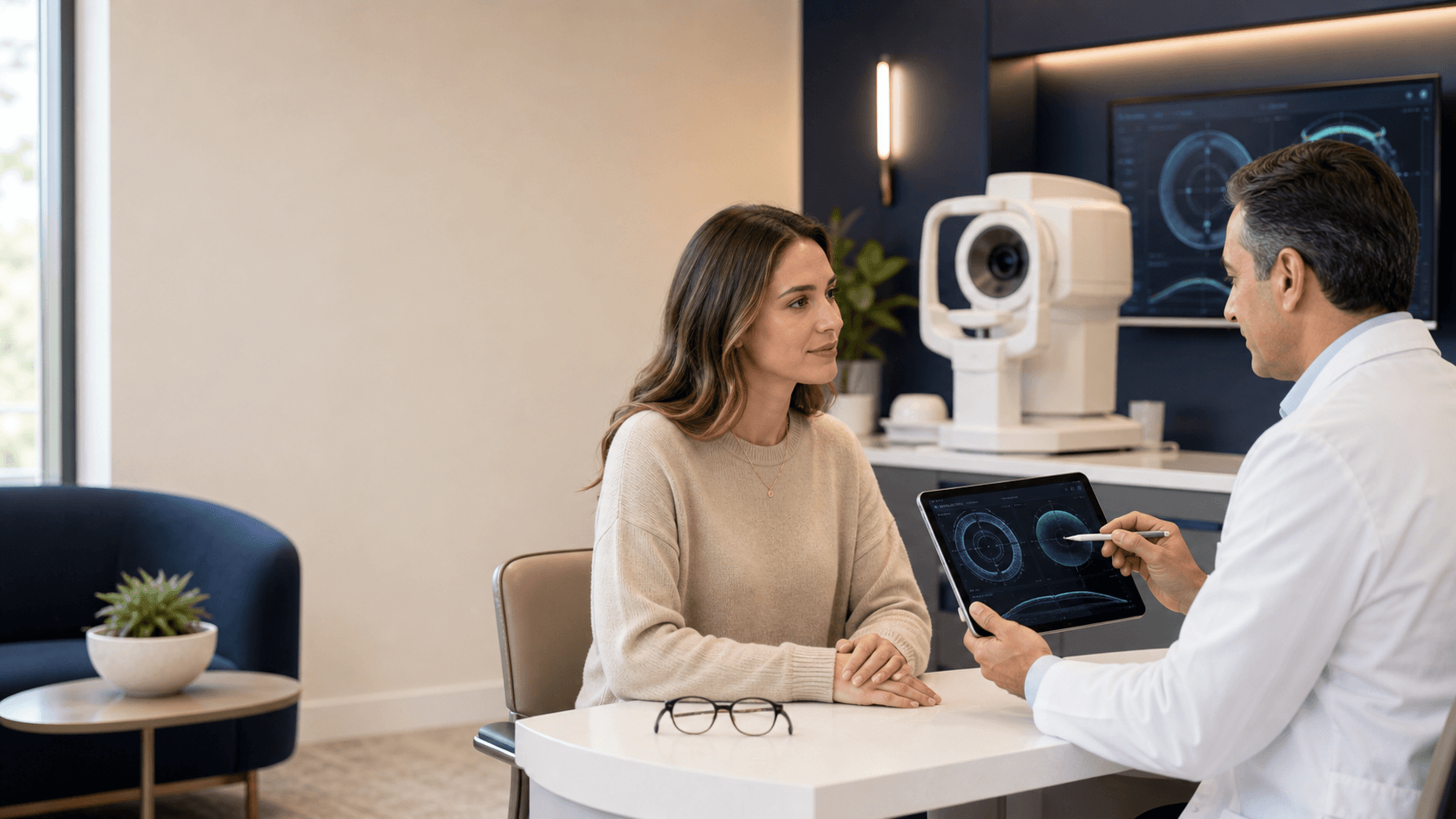
Dozens of optometry offices and chain vision centers have opened along US-75 and US-380 as McKinney has grown. They do excellent work screening patients and managing prescriptions. But when corneal topography or a high prescription rules out LASIK, the conversation usually ends at "you're not a candidate." That is where it should begin.
EVO ICL may be an option when LASIK is unsuitable, but not every patient excluded from LASIK qualifies. A Collamer lens is placed behind the iris through a small incision. Chamber depth, endothelial cells, prescription stability, lens and retinal health, and dry-eye findings all inform the recommendation. Recovery and glasses needs vary.
Dr. Shehz is double board-certified, trained at Dean McGee Eye Institute, and completed advanced refractive training that included EVO ICL. He has performed nearly 7,000 procedures and handles every consultation, implantation, and follow-up himself. McKinney is 20 minutes south on US-75.
Stonebridge Ranch, Adriatica, Tucker Hill. The answer LASIK could not give them was twenty minutes away.
Dr. Shehz pursued advanced refractive training that included EVO ICL implantation. Your examination checks the prescription, chamber depth, endothelial cells, and lens health needed for candidacy.
The physician who maps your anterior chamber is the one implanting the lens and following up. No handoffs, no rotation.
All-in quote before you commit, 20/Happy Patient Guarantee behind eligible procedures, FSA/HSA and financing explained up front.
A high prescription, corneal findings, or dry-eye symptoms may change the options discussed at your consultation. Ask how each finding affects candidacy and whether treating an eye-health problem should come before a surgery decision.
Three distinct procedures cover the full spectrum of refractive correction. Your consultation determines which one your eyes support.
A Collamer lens placed behind the iris without laser removal of corneal tissue. It may fit qualifying myopia when LASIK is unsuitable. Removal or exchange requires another operation; vision and recovery vary.
Best for: High myopia (-3 to -20D), thin corneas, dry-eye-prone eyes, patients told they can't get LASIK
Two advanced lasers reshape the cornea in about 15 minutes. Fast recovery, wide eligibility, and decades of outcomes data — but it requires adequate corneal thickness and a prescription within its treatment range.
Best for: Stable prescriptions within range, healthy corneas, fastest visual recovery
The natural lens is replaced with an intraocular lens. Selected patients may reduce glasses dependence, but age over 40 alone does not establish candidacy. Lens designs have different near-vision, glare, and contrast tradeoffs.
Best for: Over 40, reading-glasses dependence, presbyopia, early lens changes
Every quote below is a real, public Google review — part of the 5.0-star rating across 92 reviews on our profile.
Dr. Shez is the most informative and detail oriented LASIK doctor I have met in my entire life. With other LASIK doctors, the volume of patients they have is so high that they don't take the time to discuss with you what your options are. Dr. Shez on the other hand took over an hour the first time I visited and made sure to explain to me the variety of… Read full review
I had a great experience with Visionary Eye Surgery and Dr. Shehz throughout my LASIK journey. From the consultation to the follow-ups, the staff was professional, patient, and reassuring every step of the way. Even when I had a healing complication with one eye early on, they took care of it immediately, stayed in close contact with me, and made sure I… Read full review
I had lasik and it was the easiest process! No pain and Dr. Shehz is amazing! I definitely recommend visionary eye and should have done this years ago.
US-75 south or the Sam Rayburn Tollway — about 20 minutes from central McKinney. Ground floor with free patient parking at the door.
8080 Independence Pkwy, Suite 155
Plano, TX 75025
Trip one is a complimentary consultation with anterior-segment mapping — about an hour. Trip two is surgery day. Follow-ups are scheduled around your routine; McKinney patients often pair visits with a morning errand run south.
Open Monday–Friday 8:00–5:00 and Saturday 9:00–3:00, with English- and Spanish-speaking staff. Questions before booking? Call 214-972-2020 and a human answers.
Don't see your question? Call 214-972-2020 or book a visit and ask Dr. Shehz directly.
Talk to our team, no pressure, no sales pitch. We answer the question, not the upsell.
LASIK, EVO ICL, and Custom Lens Replacement each correct different eye profiles. The free consultation tells you which one Dr. Shehz recommends for your eyes.
Explore cost, recovery, and candidacy at your own pace.
EVO ICL in Plano is listed at $4,500-$5,500 per eye. Learn how prescription, thin corneas, astigmatism, lens sizing, and financing shape candidacy.
Read articleA practical EVO ICL recovery timeline for Plano patients, including the first 24 hours, follow-up checks, activity guidance, and symptoms that need an urgent call.
Read articleAn evidence-based explanation of halos, glare, night vision, and other EVO ICL risks, plus the measurements Plano patients should expect before surgery.
Read articleBook a free consultation, get your full anterior-segment workup and one written quote, and leave with a real answer. Call 214-972-2020 or book online.