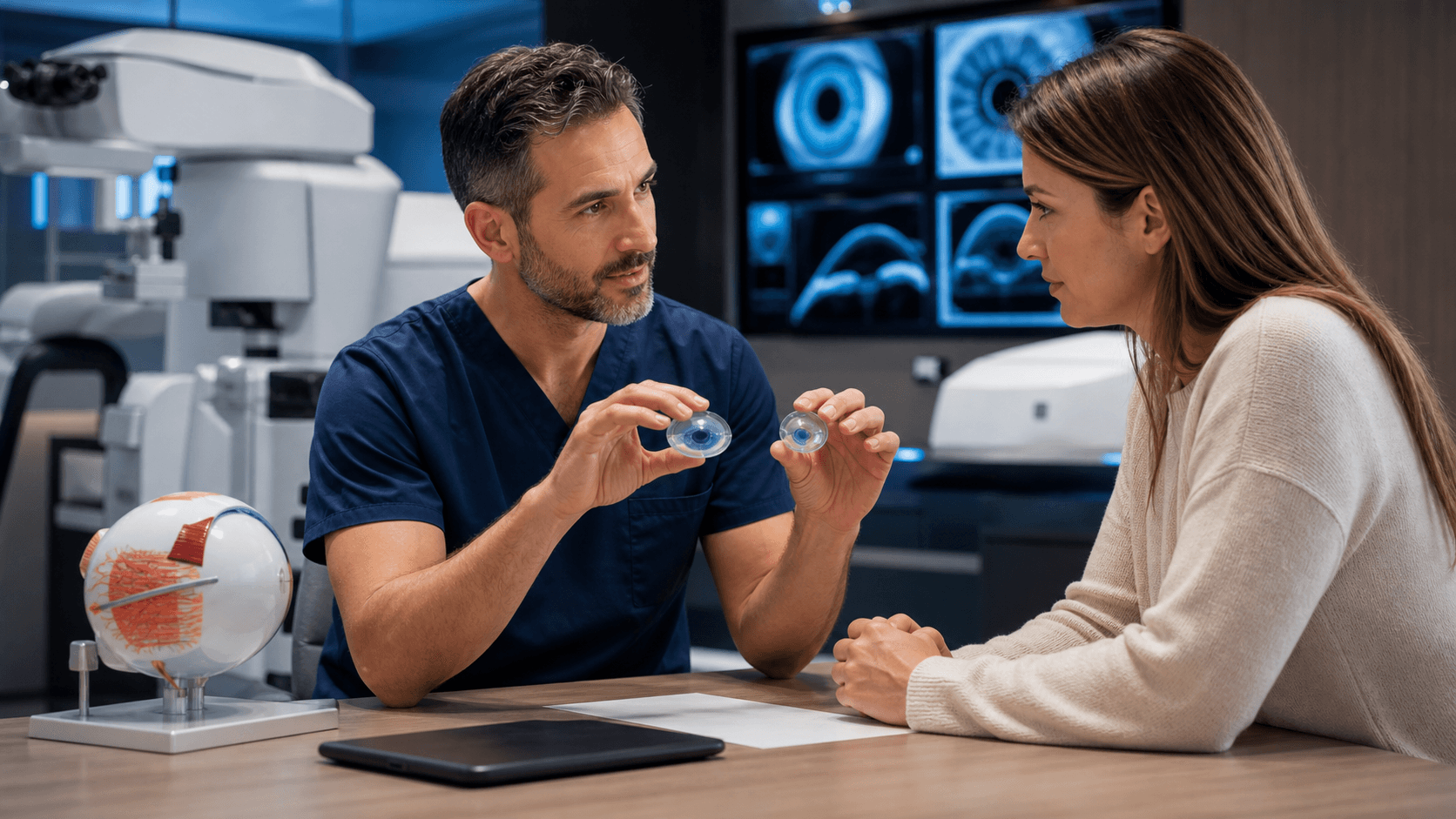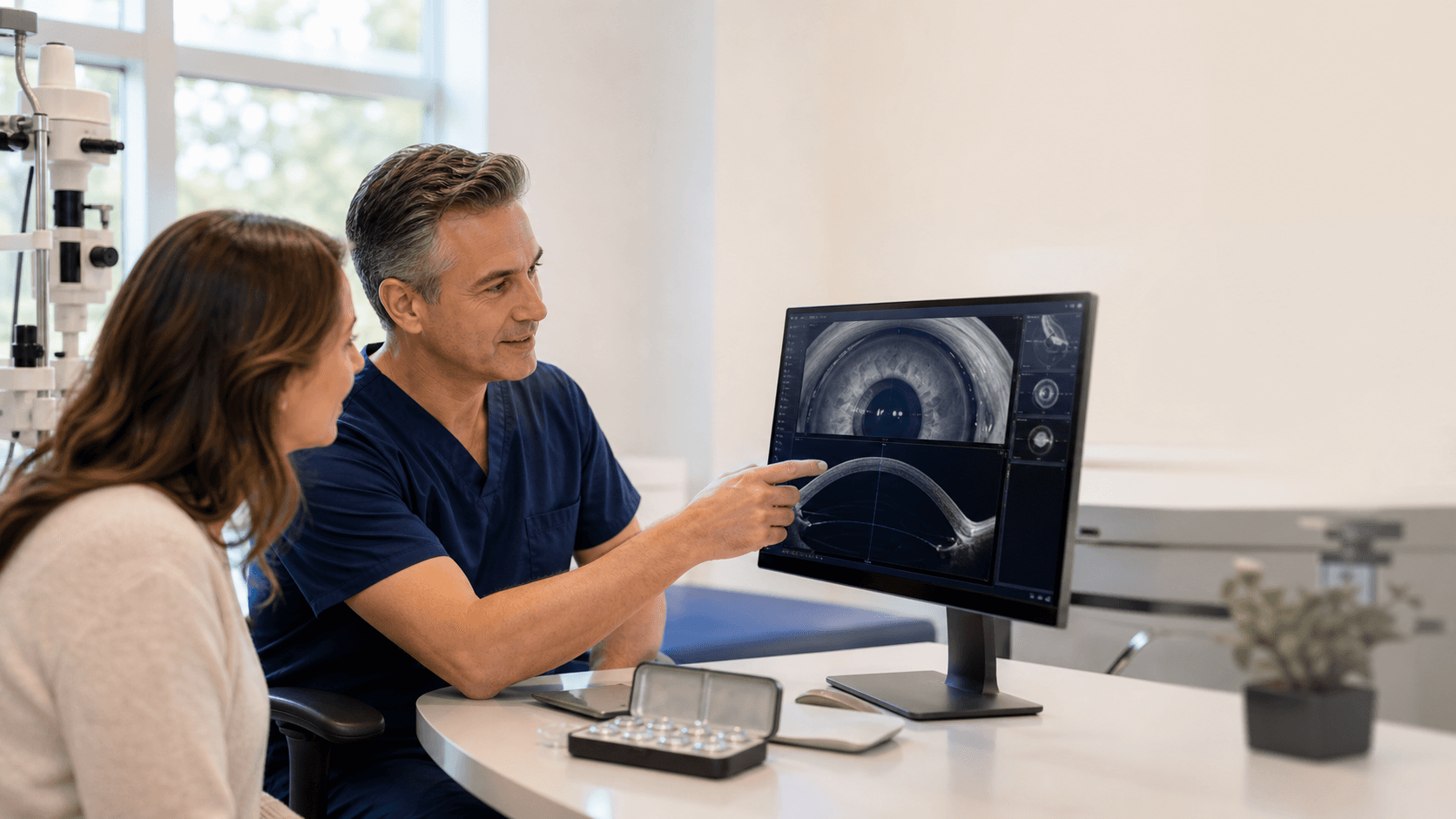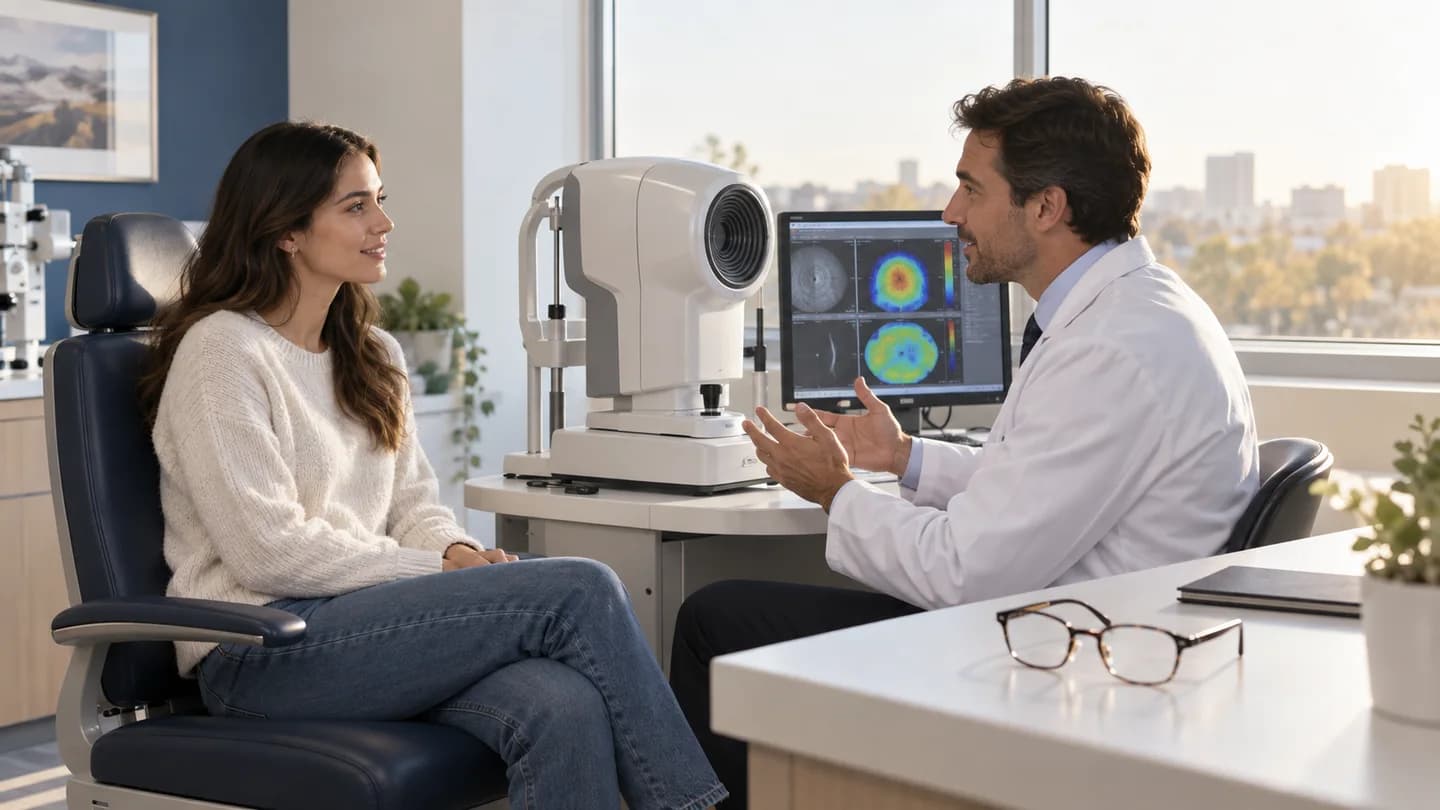
EVO ICL and SMILE can both reduce dependence on glasses for eligible people with nearsightedness, but they solve the problem in different places. EVO ICL adds a lens inside the eye without removing corneal tissue. SMILE changes corneal shape by removing a small lenticule through a short incision. The better discussion starts with your prescription, corneal maps, front-of-eye anatomy, and tolerance for the distinct risks of each operation.
This is a comparison of two options, not a claim that everyone with a high prescription should choose a lens or everyone with a healthy cornea should choose laser treatment. Read the EVO ICL and SMILE service pages for the full procedure descriptions.
What is the essential difference?
SMILE is corneal laser surgery. A femtosecond laser creates a shaped piece of tissue within the cornea, which is removed through a small opening. The treatment changes the cornea's focusing power. The removed tissue cannot be put back.
EVO ICL places a thin prescription lens behind the iris and in front of the natural lens. Corneal tissue is not removed to correct the prescription. The implant can be removed or exchanged when medically appropriate, but that does not undo every consequence of an intraocular operation. "Removable" should never be interpreted as "risk-free" or "temporary surgery."
Both need a stable prescription and a complete examination. The approved range and restrictions depend on device labeling and the individual eye. Neither treatment can be selected from a glasses prescription alone.
Which tests could rule one option out?
For SMILE, the surgeon needs reliable refraction, corneal topography or tomography, thickness measurements, and a plan for remaining tissue. Irregular shape, inadequate tissue reserve, or an unstable ocular surface can make corneal laser surgery a poor fit. Contact lens wear may need to stop before final measurements so the cornea can be measured accurately.
For EVO ICL, the workup also measures the space inside the front of the eye, the angle, endothelial cell health, and other anatomy used to select and size the lens. Eye pressure and the natural lens are part of the discussion. A thin cornea does not by itself prove EVO ICL eligibility; the internal measurements must support an implant as well. Our EVO ICL measurement guide explains why sizing and follow-up matter.
If you have a high degree of myopia, a dilated retinal examination may also be important regardless of which correction you prefer. Correcting focus does not erase the underlying retinal risks associated with a highly myopic eye.
Do the operations carry the same risks?
No. With SMILE, questions include postoperative dryness, glare, undercorrection or overcorrection, inflammation, infection, and the possibility of needing glasses or further treatment. With EVO ICL, the discussion also includes pressure rise, lens sizing or vault problems, cataract formation, endothelial cell loss, infection, and potential lens removal or exchange. An individual risk estimate requires examination; neither list predicts what will happen to you.
They also have different follow-up needs. An implanted lens calls for ongoing checks of lens position, pressure, the natural lens, and other eye health measures. A corneal laser result also needs postoperative checks and may still require routine eye care. Ask what follow-up is included and who performs it if you live outside Plano.
Does a high prescription make EVO ICL the automatic answer?
No. Prescription magnitude may make a corneal procedure less suitable because more correction can require more tissue, but the actual decision depends on corneal thickness and shape, approved treatment range, internal-eye anatomy, eye health, age-related lens changes, and your goals. Some patients qualify for both; some qualify for one; some need a different plan.
For a Dallas or Frisco resident making the trip to Visionary Eye Surgery in Plano, the question to bring is not "Which procedure do you prefer to sell?" It is "What would rule out each option in my eye, and what would follow-up involve?" The EVO ICL versus LASIK guide addresses a different comparison if LASIK is also under consideration.
What should your consultation resolve?
Ask to see the corneal maps and the internal-eye measurements in the same visit or workup. Request a plain-language explanation of the risks that matter most for your anatomy, what residual glasses use is realistic, and whether night-driving concerns change the recommendation. Ask what would happen if the planned result is not reached and whether a future cataract operation would change the long-term plan.
The right answer may be to treat dry eye first, repeat the measurements, keep using glasses or contacts, or choose another procedure. A vision-correction evaluation should make that reasoning visible rather than forcing a quick choice between two names.
Sources
- FDA: EVO ICL approval information
- FDA: SMILE patient information booklet
- Royal College of Ophthalmologists: Laser vision correction
Keep reading
Explore this content with AI
Open this article in your preferred AI assistant for a plain-English summary, action steps, and questions to ask before booking a consultation.
Want a direct answer about your eyes? A complimentary consultation gives you a clear, written recommendation.