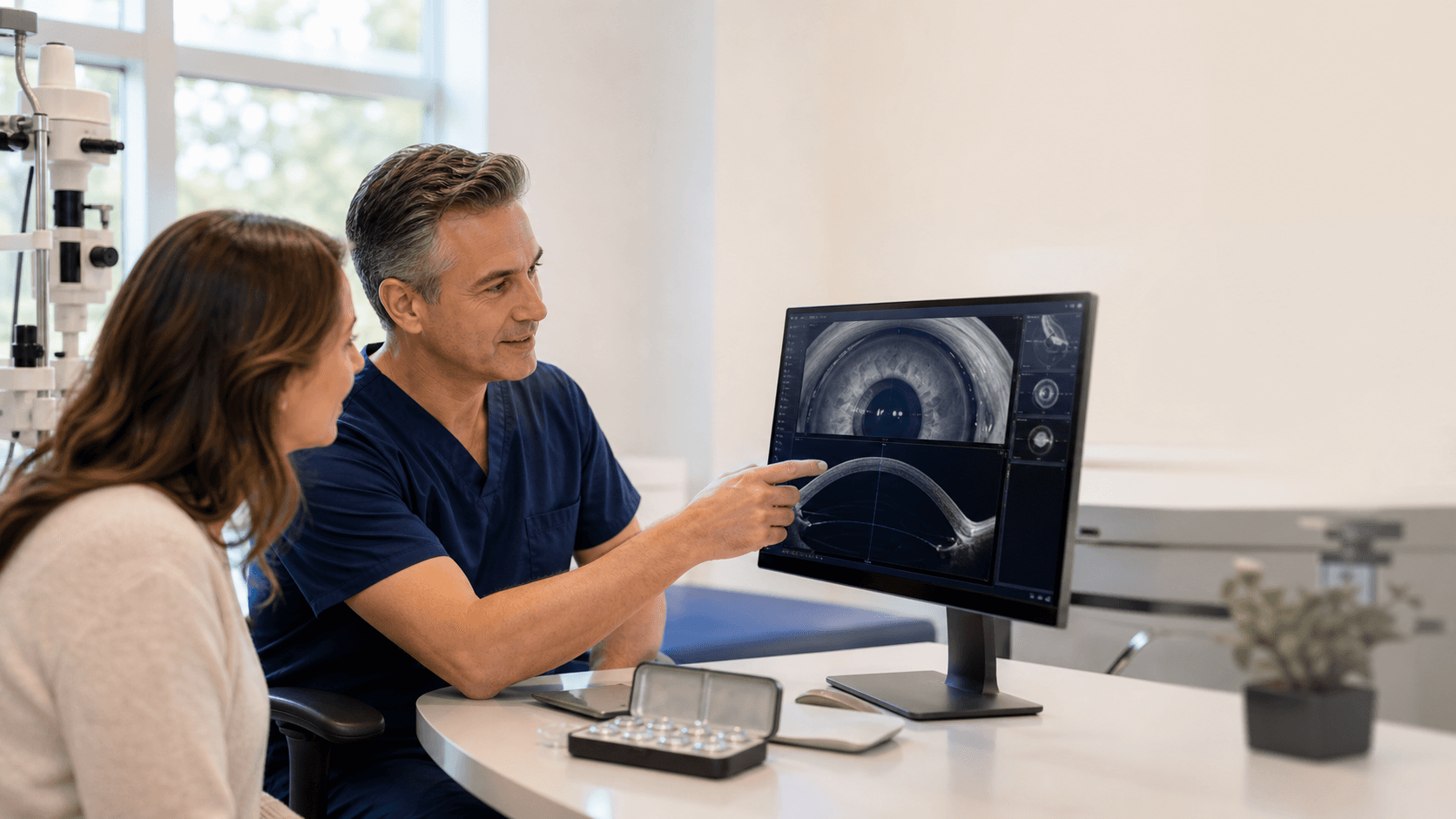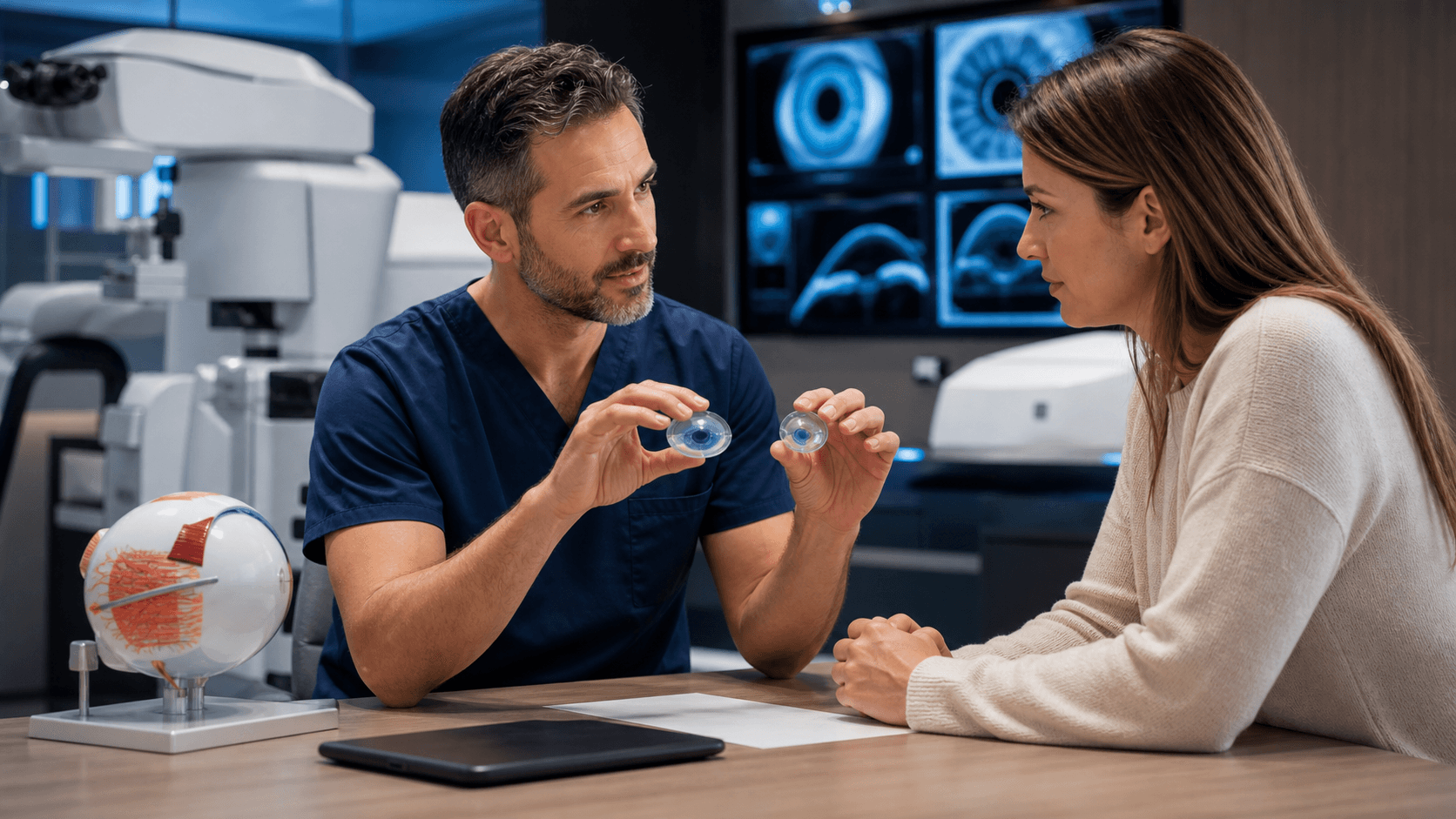
If you have worn thick glasses for years, or your contact lens prescription starts with a large minus number, you may have already heard one frustrating sentence:
"Your prescription may be too high for LASIK."
That does not automatically mean you are out of vision-correction options. It means the decision needs to move from a generic LASIK conversation to a high-prescription refractive consultation.
This guide explains when a prescription may be too high for LASIK, why EVO ICL in Plano often enters the conversation, and how the exam separates LASIK, PRK, SMILE, EVO ICL, and lens-based options.
For the procedure itself, start with EVO ICL surgery in Plano. If you are comparing tissue-removal options, use the PRK vs EVO ICL guide. Use this guide for the narrower question: is my prescription too high for LASIK?
What "too high for LASIK" usually means
If the abbreviations on your prescription are unfamiliar, start with what SPH, CYL, axis, and ADD mean. Understanding the numbers is separate from deciding whether surgery is appropriate.
LASIK corrects vision by reshaping the cornea. The stronger the prescription, the more tissue the laser plan may need to treat.
That is why high prescriptions are not judged by the glasses number alone. A -7 prescription with a thick cornea, stable tear film, and regular topography is a different situation from a -7 prescription with a thin cornea, dry eye, large pupils, or irregular mapping.
When a surgeon says LASIK may not be a fit, the reason is usually one of these:
- The correction would remove too much corneal tissue.
- The cornea is thin or borderline.
- The corneal map is irregular.
- Dry eye could make healing or measurements less predictable.
- The prescription is changing.
- The patient is over 40 and the natural lens is part of the problem.
- The correction may create more night-vision risk than another option.
The right question is not "what number is too high?" The right question is: how much safe treatment room does this eye have?
Why high myopia changes the plan
High myopia means the eye needs more nearsighted correction. Patients may describe this as:
- "My glasses are very thick."
- "My contacts are -8, -9, -10, or stronger."
- "I was told my prescription is too high for LASIK."
- "I have high myopia with astigmatism."
- "I want LASIK, but another clinic said no."
With LASIK, PRK, and SMILE, the cornea is part of the treatment. That can be fine for many patients, but high myopia makes the tissue budget more important.
EVO ICL works differently. It adds an implantable Collamer lens inside the eye without reshaping the cornea. Patients may also hear it called Visian ICL or an implantable contact lens. For patients with high myopia, thin corneas, or dry-eye sensitivity, that can make EVO ICL a more logical conversation than forcing a laser plan.
When EVO ICL may be the better high-prescription option
EVO ICL may enter the discussion when a high prescription makes corneal laser correction less attractive.
It may be worth a serious look if:
- Your prescription is high enough that LASIK would remove too much tissue.
- You have high myopia and thin or borderline corneas.
- You have high myopia with astigmatism that may fit Toric EVO ICL.
- You have dry-eye sensitivity or contact lens intolerance.
- You were told you are not a LASIK candidate but still want to reduce glasses or contacts.
- You want a doctor-removable lens option rather than permanent corneal reshaping.
EVO ICL is not automatic. It is surgery inside the eye, so the internal anatomy matters. The consultation needs to confirm anterior chamber depth, angle anatomy, endothelial health, lens sizing, prescription stability, retina status, and whether the current treatment range fits your prescription. The current FDA age indication for EVO/EVO+ ICL/TICL is 21-60, and the U.S. indication includes myopia from -3.0 D to -20.0 D at the spectacle plane when the other anatomic requirements fit, but candidacy still depends on those measurements, not age or prescription alone.
When LASIK, PRK, or SMILE may still fit
A high prescription does not always rule out laser vision correction.
LASIK may still fit when the prescription is within a safe laser range, the cornea is thick and regular, the tear film is stable, and the residual tissue plan is comfortable.
PRK or ASA may fit when the cornea is too thin for a flap but the prescription is still modest enough for surface laser correction. That is why thin-cornea patients should not assume EVO ICL is the only alternative.
SMILE may fit some nearsighted patients who want a small-incision, flapless laser option and whose prescription and corneal measurements fit the treatment range.
The decision depends on the reason LASIK was questioned.
High prescription plus astigmatism
Astigmatism changes the conversation because blur can come from more than one optical source.
Some patients with high myopia also have regular astigmatism that may fit LASIK, PRK, SMILE, or Toric EVO ICL. Others have irregular astigmatism from corneal shape changes, prior injury, contact lens warpage, or keratoconus risk. Those are not the same problem.
A high-prescription consultation should check:
- Corneal topography and tomography.
- Whether astigmatism is regular or irregular.
- Whether the astigmatism comes mostly from the cornea or internal lens.
- Whether Toric EVO ICL is needed.
- Whether residual astigmatism is realistic.
- Whether corneal stability should be evaluated before elective correction.
If the map suggests keratoconus or progressive thinning, start with a keratoconus evaluation or corneal cross-linking discussion before choosing a refractive procedure.
What the exam should measure before deciding
The exam matters more than the procedure name.
Before anyone recommends LASIK or EVO ICL for a high prescription, the workup should include:
- Refraction and prescription stability.
- Corneal thickness.
- Corneal topography and tomography.
- Tear-film and dry-eye evaluation.
- Pupil and night-vision discussion.
- Retina review, especially for high myopia.
- Anterior chamber depth for EVO ICL.
- Angle anatomy and endothelial health.
- Lens sizing measurements.
- A comparison against LASIK, PRK, SMILE, EVO ICL, and age-based lens options.
This is why a high-prescription visit should not feel like a quick screening. The measurements are the safety decision.
Sources and clinical references
FDA labeling is only one part of candidacy. Corneal, anterior-chamber, endothelial, lens-sizing, and retinal measurements still determine individual fit.
Related resources
- EVO ICL procedure page
- Out-of-town patient planning
- PRK vs EVO ICL comparison
- How to choose an EVO ICL surgeon
- EVO ICL cost and candidacy
- LASIK, EVO ICL, PRK, and SMILE alternatives
Bottom line
If your prescription is high, the goal is not to squeeze you into LASIK. The goal is to identify the safest way to reduce glasses or contacts based on your cornea, tear film, internal eye anatomy, age, and long-term risk profile.
Sometimes that is LASIK. Sometimes it is PRK or SMILE. For many high-myopia patients, EVO ICL deserves a serious discussion because it corrects vision without removing corneal tissue.
At Visionary Eye in Plano, the high-prescription consultation is designed to answer the question clearly: whether your eyes support LASIK, whether EVO ICL is the stronger option, or whether another step should come first. For patients elsewhere in Texas, that answer can start with records review before deciding whether travel to Plano makes sense.
Your exam can clarify which options fit your eyes. Visit our Plano team from anywhere in DFW.
Book a free visit