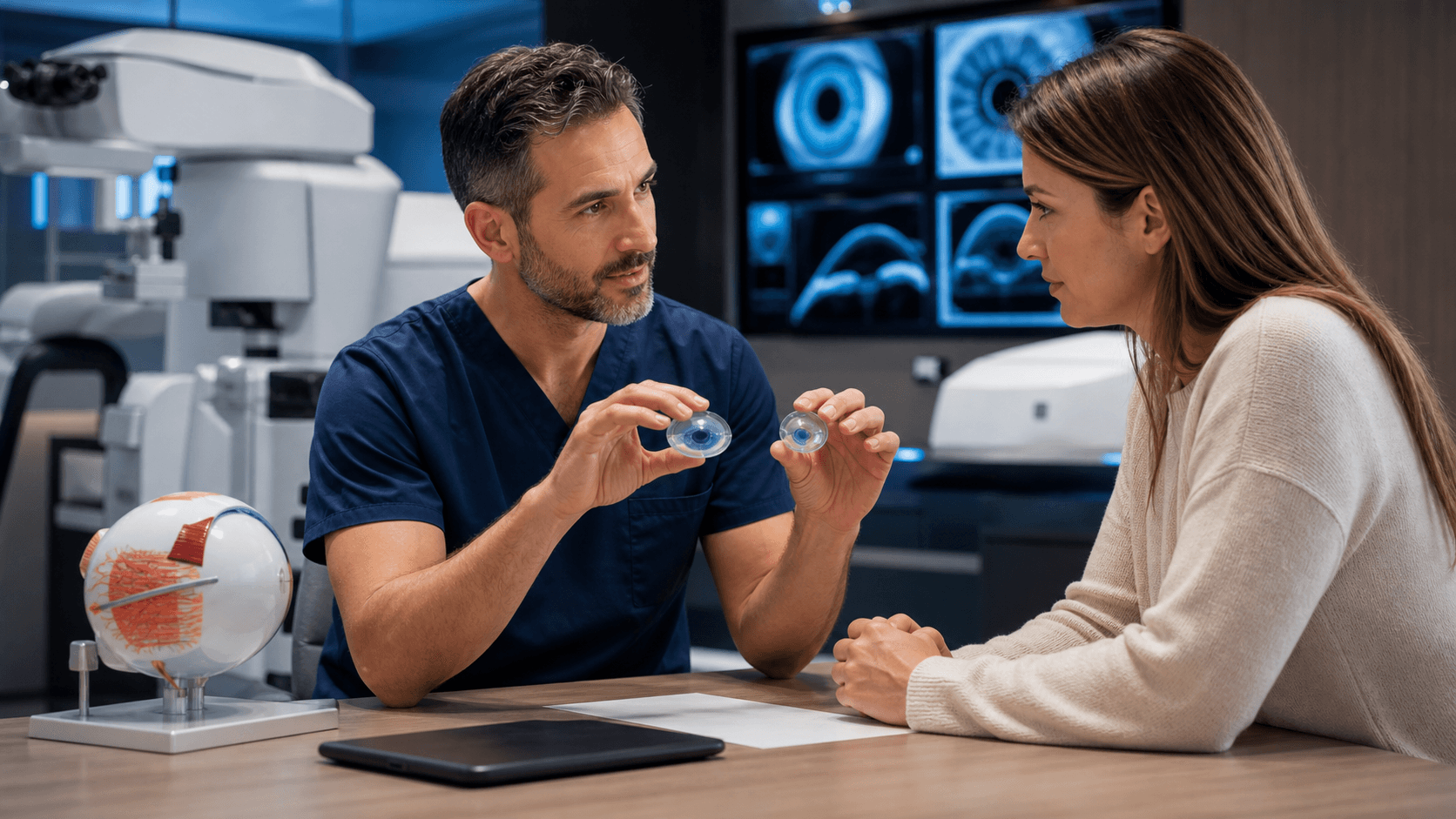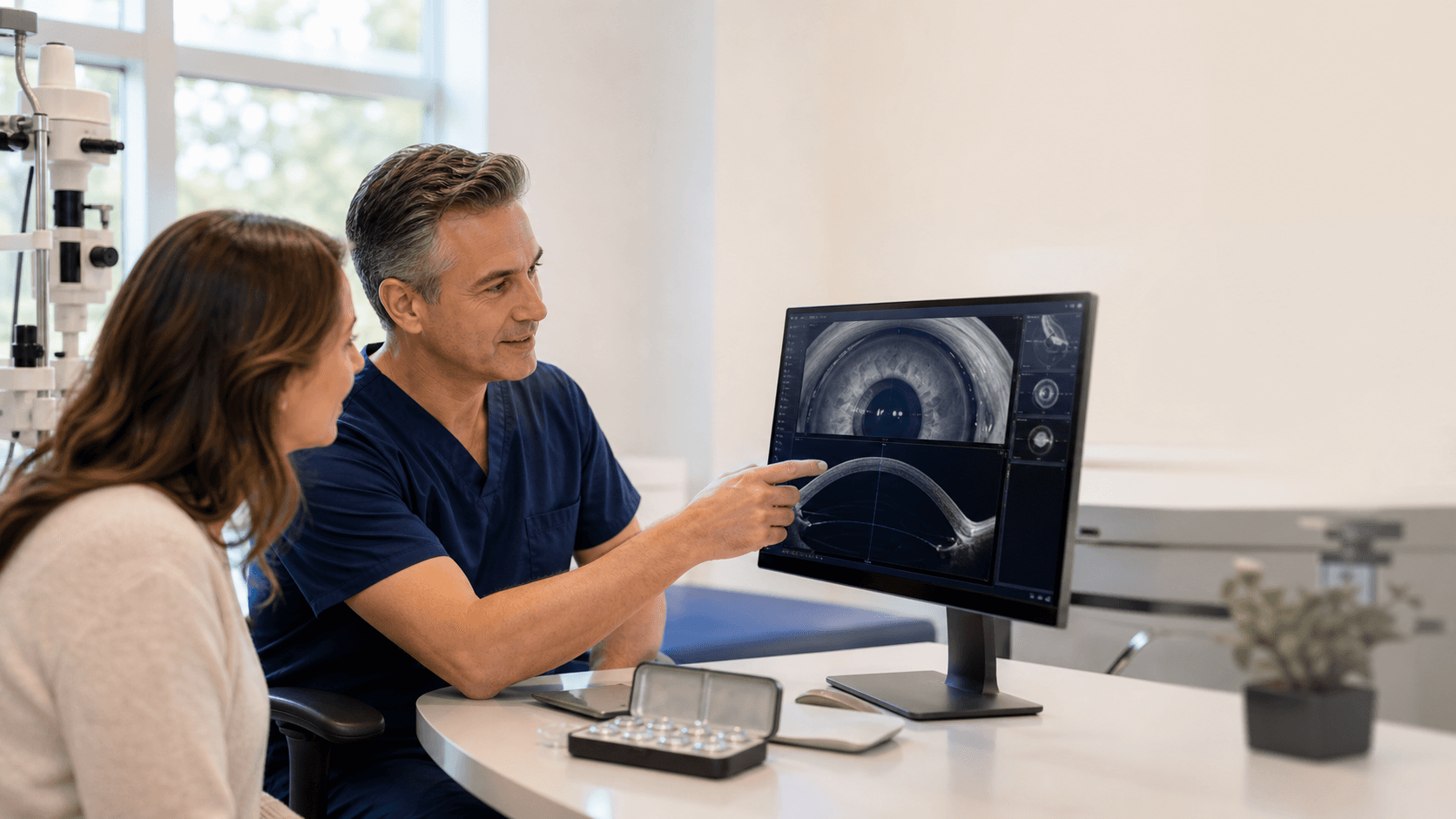
The better question is: who is willing to prove, with measurements, that EVO ICL is actually the safest fit for your eyes?
EVO ICL, often still called Visian ICL or an implantable contact lens by patients, can be excellent for high myopia, thin corneas, dry-eye sensitivity, and some patients who were told they are not LASIK candidates. But it is still surgery inside the eye. A good consultation should feel measured, specific, and honest.
For the procedure itself, start with our main EVO ICL procedure page. Use this article to evaluate judgment, measurements, and follow-up before you book. It focuses on surgeon selection and what a serious workup should include before any lens recommendation.
A strong EVO ICL consultation starts before the lens discussion
The lens is not chosen first. The eye is measured first.
A complete EVO ICL consultation should include:
- Refraction and prescription stability.
- Current FDA age indication review, now 21-60 for EVO/EVO+ ICL/TICL, plus whether the prescription falls within the approved myopia or myopic astigmatism range.
- Corneal thickness and tomography.
- Dry-eye and tear-film evaluation.
- Anterior chamber depth.
- White-to-white and internal sizing measurements.
- Pupil and night-vision discussion.
- Retina and optic nerve review.
- A comparison against LASIK, SMILE, PRK/ASA, and lens-based options.
If the conversation jumps straight from "your prescription is high" to "you need ICL," that is not enough.
High myopia is one reason to consider EVO ICL. It is not the only reason, and it is not the only measurement that matters. Strong EVO ICL pages across Texas usually mention high prescriptions, thin corneas, dry-eye sensitivity, no corneal tissue removal, doctor-removable lens design, quick recovery, and financing. Those are useful starting points, but surgeon selection should go deeper into sizing, anatomy, and whether LASIK, SMILE, PRK, or RLE would be safer.
Why high myopia changes the decision
Patients with high myopia often need more correction than a laser procedure can comfortably provide.
With LASIK, SMILE, or PRK, the cornea is reshaped. More correction usually means more corneal tissue is involved. That can be a problem if the cornea is thin, borderline, irregular, or already affected by dryness.
EVO ICL works differently. It places an implantable Collamer lens behind the iris and in front of the natural lens. The cornea is not reshaped. If a page calls it Visian ICL or an implantable contact lens, the patient question is usually the same: can an internal lens correct high myopia or astigmatism without removing corneal tissue?
That is why EVO ICL can be a strong option for:
- Higher nearsighted prescriptions.
- Thin or borderline corneas.
- Patients with dry-eye sensitivity.
- Patients who want to avoid removing corneal tissue.
- Some patients with myopia and astigmatism who fit Toric EVO ICL measurements.
But the word "can" matters. EVO ICL is not automatic. The internal eye anatomy has to be right.
How should a surgeon explain toric planning?
If you have astigmatism, the surgeon should not treat it like a footnote.
Toric EVO ICL may correct myopia with astigmatism when the prescription, eye measurements, and lens fit are appropriate. That requires careful planning because uncorrected astigmatism can leave blur even if the nearsightedness is treated well.
Ask direct questions:
- Is my astigmatism regular or irregular?
- Does it come from the cornea, the internal lens, or both?
- Am I a Toric EVO ICL candidate?
- Would PRK, LASIK, or SMILE treat this more simply?
- What amount of residual astigmatism is realistic?
The best answer may still be EVO ICL. But you should understand why. Our toric EVO ICL guide explains the lens-specific measurements; use this section to assess how clearly a surgeon explains and documents the plan.
Dry eye should be part of the surgeon-selection conversation
Many people looking for EVO ICL are doing so because contact lenses became uncomfortable or LASIK raised dry-eye concerns.
That makes the tear-film exam important. EVO ICL does not remove corneal tissue, which can make it attractive for dry-eye-sensitive patients, but dry eye still matters before any vision correction procedure.
Dry eye can affect measurements, comfort, healing, and satisfaction. A surgeon who treats dry eye seriously before surgery is protecting the result.
If your exam shows meibomian gland dysfunction, blepharitis, ocular rosacea, or contact lens dry eye, the right move may be to stabilize the surface first. Our dry eye treatment page explains how we evaluate those drivers.
The best EVO ICL surgeon should still talk about LASIK, SMILE, and PRK
One sign of a strong refractive surgeon is that the recommendation includes alternatives.
For some patients, All-Laser LASIK is simpler. For others, SMILE LASIK may be a flapless laser option. For thin corneas or active careers, ASA/PRK can still be appropriate. For patients over 40, lens-based options may enter the conversation.
EVO ICL should win because the measurements support it, not because it is the only technology in the room.
You want a surgeon who can say:
- "EVO ICL is safer for your correction because..."
- "PRK is enough for your cornea because..."
- "LASIK is reasonable because..."
- "None of these is right until we treat the surface or confirm stability."
That kind of answer is better than a sales pitch.
What to ask before choosing an EVO ICL surgeon
Bring these questions to the consultation:
- What makes me a candidate or not a candidate for EVO ICL?
- Is my prescription within the treatment range you are comfortable with?
- Is my anterior chamber deep enough?
- Would I need Toric EVO ICL for astigmatism?
- Are my corneas healthy enough for LASIK or PRK instead?
- Is dry eye affecting my measurements?
- What are the risks specific to my anatomy?
- What follow-up schedule do you use?
- What is included in the quote?
- If I were your family member, which procedure would you recommend and why?
The last question is blunt. It should produce a real answer.
Why this matters in Plano and DFW
Plano, Dallas, Frisco, McKinney, Allen, and the surrounding North Texas area have plenty of refractive surgery options. That is good for patients.
It also means provider pages can blur together. "Top EVO ICL surgeon" pages often talk about technology, convenience, and financing. Those details matter, but they do not replace diagnostic judgment.
At Visionary Eye Surgery, Dr. Shehzad Batliwala personally performs the consultation, planning, surgery, and follow-up. The goal is not to push every patient toward EVO ICL. The goal is to decide whether EVO ICL, LASIK, SMILE, PRK, or another option best fits the measurements.
How to compare credential claims without getting distracted
Some EVO ICL surgeons highlight trainer roles, FDA-trial experience, high surgical volume, special sizing methods, or national teaching activity. Those can be meaningful signals. They still need to translate into a better visit for your own eyes.
- Will the surgeon personally review your topography, anterior chamber depth, angle anatomy, endothelial cell health, retina status, and lens-sizing plan?
- Will the recommendation compare EVO ICL against LASIK, SMILE, PRK/ASA, and lens-based options instead of assuming ICL is the answer?
- If you have astigmatism, will the plan explain Toric EVO ICL, residual cylinder expectations, and whether the astigmatism is regular enough for a lens-based correction?
- If you have high myopia, will the exam include retina and optic-nerve review before surgery is scheduled?
- If you are traveling from Dallas, Austin, Houston, San Antonio, Oklahoma, or elsewhere in Texas, will the office help review records before asking you to make multiple trips?
For Visionary Eye patients, the defensible differentiators are clear: board-certified ophthalmology training, WCRSVS certification, Dean McGee residency, ICL training at the Zaldivar Institute, a full LASIK/SMILE/PRK/EVO/RLE procedure range, and one surgeon leading consultation, surgery, and follow-up. Use the EVO ICL procedure page for candidacy, the PRK vs EVO ICL guide for thin-cornea decisions, and Dr. Shehzad Batliwala's profile for training and scope.
For patients traveling from elsewhere in Texas, the same rule applies. A Houston, Austin, San Antonio, Waco, Oklahoma, or out-of-town patient should not travel for a brand name alone. They should travel because the practice can review records in advance, cluster diagnostics and surgery when appropriate, and clearly explain whether EVO ICL is safer than LASIK or PRK for their eyes.
What should separate one EVO ICL surgeon from another?
Many provider pages mention the same broad benefits of EVO ICL: suitability for some high prescriptions and thin corneas, less effect on the corneal surface, and fast recovery. Those benefits are real, but they do not prove that one eye is a good ICL candidate.
A strong EVO ICL consultation should separate five issues before surgery is scheduled:
- Sizing and vault planning: anterior chamber depth, angle anatomy, white-to-white or internal sizing, and the expected vault after the lens is placed.
- Toric EVO ICL planning: whether astigmatism is regular, whether it fits Toric EVO ICL, and how residual astigmatism would be handled.
- High-myopia retinal review: very nearsighted patients need retina and optic-nerve review, not just a glasses prescription check.
- Dry-eye and cornea review: ICL avoids corneal tissue removal, but the surface still affects measurements and comfort.
- Procedure choice: the surgeon should be able to explain why EVO ICL, LASIK, SMILE, PRK/ASA, RLE, or no surgery is the better fit.
Bottom line
If you are comparing an EVO ICL surgeon in Plano, look for a surgeon who measures first and recommends second.
EVO ICL can be powerful for high myopia, thin corneas, dry-eye sensitivity, and some astigmatism patients. But the right answer comes from eye anatomy, not a label.
Start with our EVO ICL procedure page, compare PRK vs EVO ICL, review out-of-town planning, or book a consultation to find out whether EVO ICL actually fits your eyes.
Related resources
Your exam can clarify which options fit your eyes. Visit our Plano team from anywhere in DFW.
Book a free visit