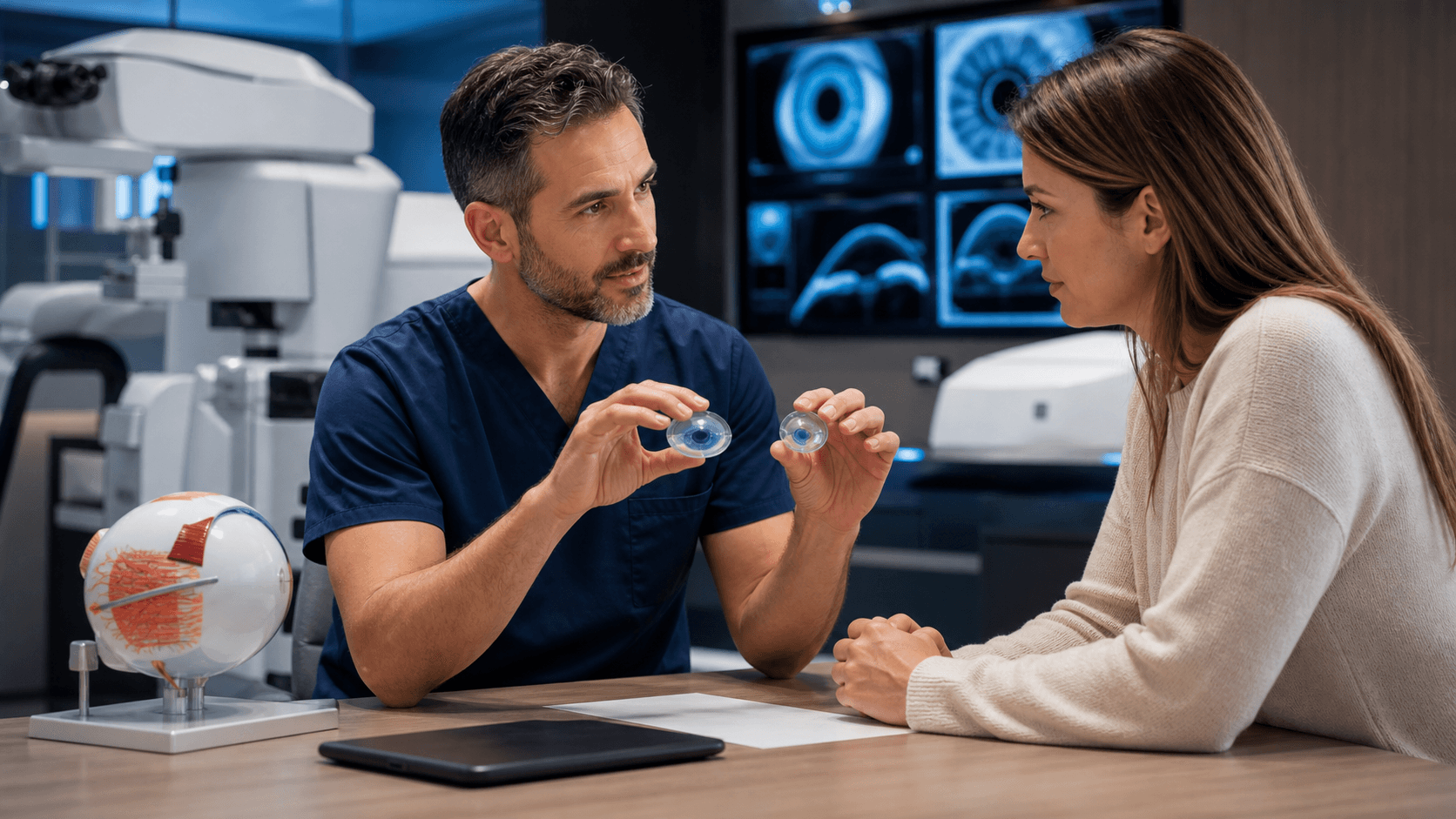
If you were told you are not a LASIK candidate, the next question is usually simple: is PRK or EVO ICL better for my eyes?
The honest answer is that neither procedure wins for everyone. PRK and EVO ICL solve different anatomy problems.
PRK is a laser procedure on the surface of the cornea. EVO ICL, also described by some patients as Visian ICL or an implantable contact lens, is a lens-based procedure inside the eye. PRK can be excellent for some thin-cornea patients. EVO ICL is often stronger for high prescriptions, dry-eye sensitivity, or eyes where removing more corneal tissue is not the best long-term move.
Quick comparison
| Question | PRK / ASA | EVO ICL |
|---|---|---|
| Main idea | Reshapes the cornea from the surface | Adds an implantable Collamer lens behind the iris |
| Best fit | Thin corneas with a prescription still safe for laser correction | High myopia, thin corneas, dry-eye sensitivity, or larger corrections |
| Corneal tissue removed? | Yes | No |
| Recovery | More surface healing; vision sharpens over days to weeks | Many patients notice clear vision within 24 hours |
| Reversible? | No, the corneal reshaping is permanent | The lens is designed to stay long term but can be removed or exchanged |
| Astigmatism | Can correct many levels of astigmatism | Toric EVO ICL can correct myopic astigmatism |
The decision starts with measurements, not preference.
The four-question split for PRK vs EVO ICL
Patients comparing PRK and EVO ICL usually need four questions answered before a recommendation makes sense:
- Is the cornea regular and stable enough for any elective vision correction?
- If the cornea is stable, is there enough tissue for surface laser correction?
- Would dry-eye sensitivity make corneal healing less predictable?
- Does the internal eye anatomy safely fit an implantable Collamer lens?
That split keeps PRK from being treated as the automatic answer for every thin cornea and keeps EVO ICL from being recommended just because the prescription is high. A patient with mild myopia, stable maps, and adequate corneal thickness may still be a PRK/ASA candidate. A patient with high myopia, contact-lens dryness, borderline tissue, or strong astigmatism may need the EVO ICL discussion sooner.
One important distinction: a thin but regular cornea is different from a cornea with progressive steepening, irregular astigmatism, or suspected keratoconus. If mapping shows that pattern, the first next step may be a keratoconus evaluation, corneal cross-linking, or a broader cornea surgeon evaluation, not choosing between PRK and EVO ICL.
When PRK makes sense
PRK, also called ASA in our practice, can be a strong answer when the cornea is too thin for LASIK but still healthy enough for surface laser correction.
In PRK, the surgeon does not create a LASIK flap. The surface cells are gently removed, the laser reshapes the cornea, and the surface heals over several days. That flapless design is why PRK has remained useful for certain thin-cornea patients, contact-sport athletes, and people whose work makes a flap undesirable.
PRK may fit when:
- Your prescription is mild to moderate.
- Your corneal thickness and shape still leave a safe laser plan.
- You want a cornea-based procedure but are not a LASIK candidate.
- You can accept a slower visual recovery.
- Your dry eye is controlled enough for surface healing.
PRK is not "worse LASIK." It is a different laser strategy. The tradeoff is recovery. PRK usually takes more patience than LASIK because the corneal surface has to heal.
When EVO ICL makes sense
EVO ICL is often the more elegant option when the issue is not just thin corneas, but the amount of correction required.
The EVO ICL is an implantable Collamer lens placed behind the iris and in front of the natural lens. It changes how light focuses without reshaping the cornea. That matters for patients with higher myopia because larger laser corrections require more corneal tissue removal. If you have seen the terms Visian ICL, implantable contact lens, or implantable Collamer lens, they usually point to this same lens-based category rather than a corneal laser procedure.
EVO ICL may fit when:
- Your prescription is high.
- Your cornea is thin or borderline for laser correction.
- You have dry-eye sensitivity and want to avoid corneal tissue removal.
- You want a lens-based option that can be removed or exchanged if needed.
- Your eye anatomy has enough internal space for the lens.
FDA records now include the expanded 21-60 U.S. age indication for EVO/EVO+ ICL/TICL, but age alone still does not approve surgery. Candidacy depends on stable refraction, adequate anterior chamber depth, appropriate angle anatomy, endothelial health, and myopia or myopic astigmatism within the approved treatment range. That is why the consultation has to include measurements inside the eye, not just a glasses prescription.
The thin-cornea question
Patients often hear "thin cornea" and assume PRK is automatically the next step.
Sometimes it is. Sometimes it is not.
The real question is: thin compared with what correction?
A mildly nearsighted patient with a thin but regular cornea may still be a good PRK candidate. A very nearsighted patient with the same corneal thickness may be a better EVO ICL candidate because the laser plan would require too much tissue removal.
That is why a serious refractive consultation includes:
- Corneal thickness.
- Corneal shape and tomography.
- Prescription strength.
- Tear film and dry-eye testing.
- Pupil size and night-vision concerns.
- Internal eye measurements for ICL sizing.
When the map shows keratoconus or ectasia
If the issue is keratoconus, progressive corneal thinning, or post-LASIK/PRK ectasia risk, PRK and EVO ICL are no longer the first decision.
The first decision is whether the cornea is stable. A keratoconus specialist evaluation looks at prior maps, current tomography, pachymetry, prescription change, contact-lens tolerance, allergies, eye rubbing, and surface inflammation. If the cornea is still changing, CXL in Plano may need to come before any elective vision-correction discussion. If the cornea is stable but too irregular for comfortable vision, CTAK or specialty lenses may enter the sequence.
That distinction protects patients from treating a structural cornea problem like a simple glasses-prescription problem.
Dry eye can change the answer
PRK avoids a LASIK flap, but it is still a corneal surface procedure. If the ocular surface is already inflamed or unstable, surface healing can be less comfortable and less predictable.
EVO ICL leaves the cornea structurally untouched, which can make it attractive for patients who already struggle with contact lens dryness or fluctuating vision.
That does not mean every dry-eye patient should choose ICL. It means dry eye should be treated as part of the decision, not as an afterthought.
Recovery and consultation planning
PRK recovery and EVO ICL recovery feel different because the healing target is different. With PRK, the corneal surface has to close, smooth, and stabilize before vision becomes crisp. Recovery planning should include work, driving, screens, exercise, UV protection, bandage contact lens timing, and several weeks of visual sharpening.
With EVO ICL, the early visual recovery is often faster, but the consultation has to confirm internal eye space, endothelial health, vault expectations, and lens sizing. A good refractive consultation should still compare both options when the cornea is thin, the prescription is high, or dry eye makes surface healing less predictable.
Why patients comparing EVO ICL surgeons should look for choice, not sales pressure
If a surgeon only offers one main procedure, every patient starts to look like a candidate for that procedure.
For PRK vs EVO ICL, look for a practice that can offer both laser and lens-based correction, then explain why one is safer for your measurements. If the comparison points toward EVO ICL, evaluate the surgeon by diagnostic depth and planning rather than slogans. A good consultation should make the tradeoffs obvious:
- If PRK is enough, you should hear that.
- If EVO ICL protects more corneal tissue, you should hear that.
- If neither is right yet, you should hear that too.
At Visionary Eye in Plano, the goal is not to sell one technology. It is to match your anatomy to the option that gives the best long-term risk-benefit profile.
Related resources
- LASIK, EVO ICL, PRK, SMILE, and RLE comparison
- Keratoconus diagnosis and treatment planning
- Corneal cross-linking in Plano
- CTAK for stable keratoconus
- Cornea surgeon evaluation
- ASA / Advanced PRK
Bottom line
Choose PRK when the cornea can safely support surface laser correction and you are comfortable with slower recovery.
Choose EVO ICL when the prescription, cornea, or dry-eye profile makes corneal tissue removal less attractive.
The right answer comes from measurements. If you want a direct comparison for your eyes, start with the vision correction self test, review ASA / Advanced PRK, compare EVO ICL, or book a free vision correction consultation.
Medically Reviewed by Dr. Shehz, DO
Dr. Shehzad Batliwala, DO—better known as Dr. Shehz—is a board-certified ophthalmologist and eye surgeon who brings both technical precision and genuine compassion to every patient he treats.
Explore this content with AI
Open this article in your preferred AI assistant for a plain-English summary, action steps, and questions to ask before booking a consultation.
Want a direct answer about your eyes? A complimentary consultation gives you a clear, written recommendation.