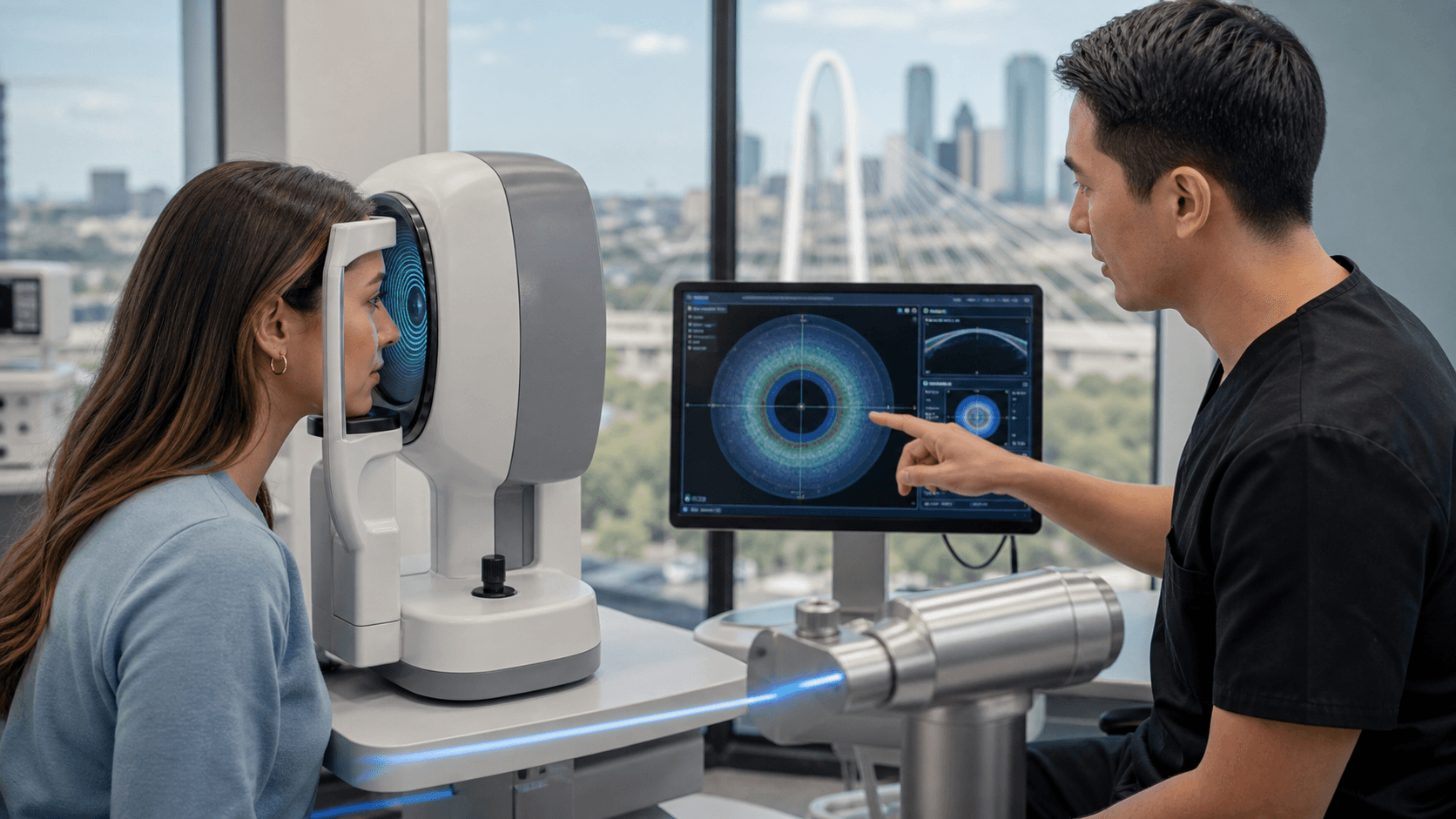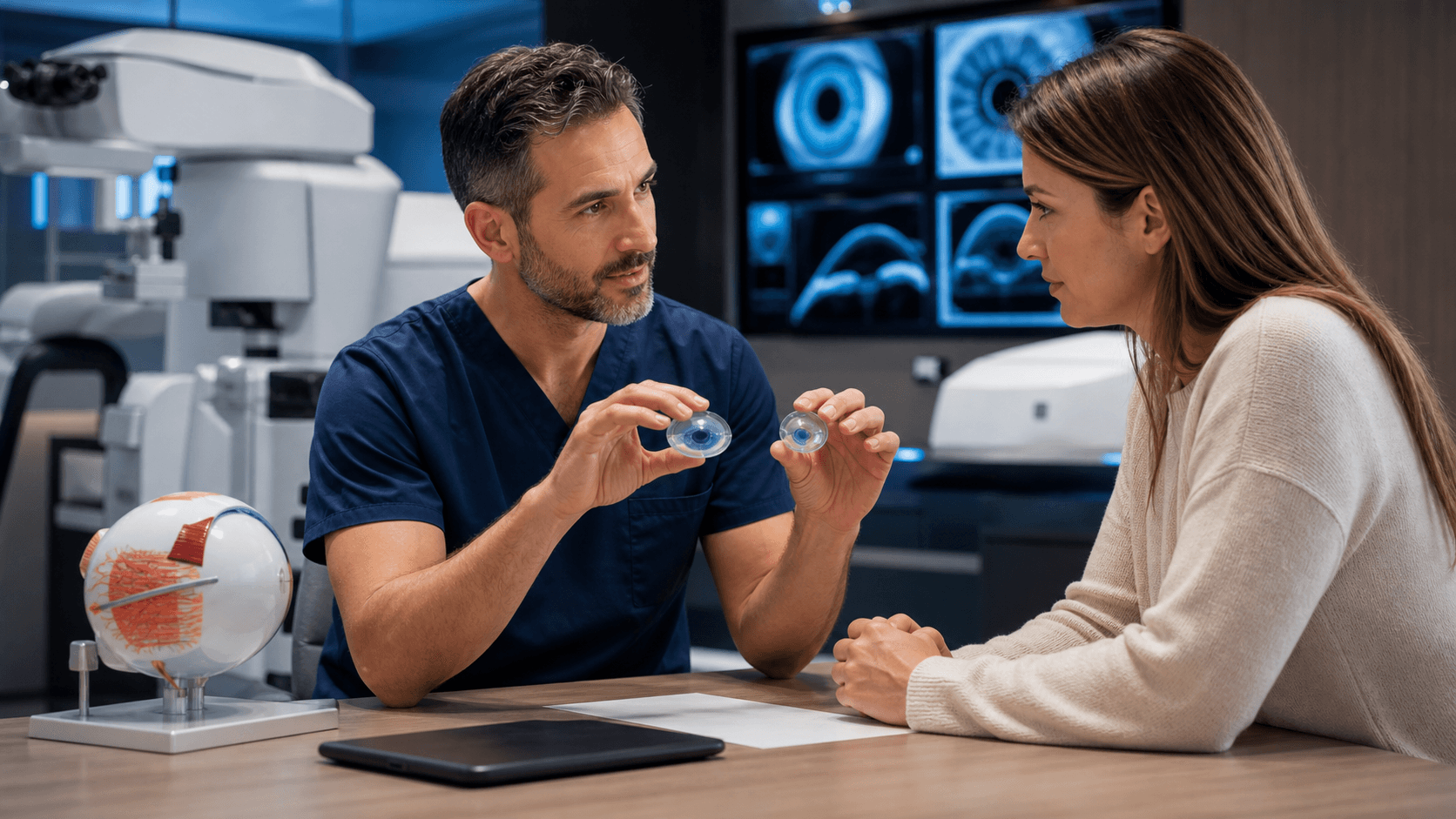
Two of the most common questions I hear in my Plano office are: "Should I get LASIK or SMILE eye surgery?" and "How do I know which one is safer for my eyes?"
Both can reduce dependence on glasses and contacts. Both can be excellent when the measurements line up. But they solve the problem in different ways, and the better answer depends on your prescription, corneal thickness, tear film, age, lifestyle, and whether you need a more customized laser plan.
The Short Version
LASIK is usually the broader laser option. It can treat nearsightedness, farsightedness, and astigmatism, and it allows wavefront-guided or topography-guided treatment profiles when the cornea needs extra customization.
SMILE is the no-flap laser option. It corrects nearsightedness and many astigmatism prescriptions by creating a small lens-shaped piece of tissue, called a lenticule, inside the cornea and removing it through a tiny incision.
That difference matters most for three groups of patients:
- People with mild dry-eye risk who want to minimize early surface nerve disruption.
- People with active lifestyles who like the idea of no LASIK flap.
- People comparing LASIK, PRK, SMILE, and EVO ICL because their corneas, prescription, or age make the decision less obvious.
LASIK vs SMILE: Decision Table
| Question | LASIK usually helps when... | SMILE usually helps when... |
|---|---|---|
| Prescription range | You are nearsighted, farsighted, or have astigmatism | You are nearsighted with or without eligible astigmatism |
| Corneal approach | You are comfortable with a flap and need broad customization | You prefer a small-incision, no-flap laser approach |
| Dry eye | Your tear film is stable or treated before surgery | You have mild dry-eye sensitivity and measurements still fit |
| Active lifestyle | You want very fast visual recovery and qualify safely | You want no-flap structural recovery for sports or active work |
| Customization | Topography-guided or wavefront-guided planning matters | Standard myopia/astigmatism correction fits your maps |
| Over 40 | Monovision LASIK may be discussed | SMILE does not solve reading glasses by itself |
| Very high myopia | Sometimes not ideal because tissue budget matters | May fit some patients, but EVO ICL may be safer in high prescriptions |
This is why a quick online quiz cannot pick the procedure for you. The answer comes from corneal mapping, pachymetry, prescription stability, tear-film testing, pupil size, and a surgeon-led discussion about what you actually want day to day.
How LASIK Works
LASIK uses two lasers. The first, a femtosecond laser, creates a thin flap on the surface of the cornea. The second, an excimer laser, reshapes tissue underneath the flap to correct the way light focuses. The flap is then laid back in place and heals naturally.
LASIK has a long track record in well-selected candidates. It treats a wide range of prescriptions, including nearsightedness, farsightedness, and astigmatism. It is also the better laser platform when a patient needs wavefront-guided or topography-guided planning for a more customized optical correction.
The trade-off is the flap. For most qualified patients, a LASIK flap heals very well. But it still means more surface nerve disruption than SMILE and a flap-related discussion for patients in contact sports, tactical work, or very dry-eye-prone situations.
How SMILE Works
SMILE stands for Small Incision Lenticule Extraction. A femtosecond laser creates a thin, lens-shaped piece of tissue inside the cornea. Your surgeon removes that lenticule through a tiny incision, usually only a few millimeters wide. Removing the lenticule changes the cornea's shape and corrects nearsightedness with or without eligible astigmatism.
There is no LASIK flap and no separate excimer-laser reshaping step. That is why SMILE is often discussed with patients who want a flapless laser option, have an active lifestyle, or are worried about early dry-eye symptoms.
The trade-off is prescription scope. SMILE is not the right choice for farsightedness or reading-glasses correction. It is also not automatically better for every thin-cornea patient. Sometimes PRK/ASA or EVO ICL is the better tissue-preserving choice.
What the FDA Label Means in Real Life
FDA labeling for SMILE has specific age, prescription, astigmatism, and stability requirements. That does not mean everyone inside the label is automatically a candidate, and it does not mean everyone outside a simple online range should be forced into LASIK.
In real life, the candidacy decision also looks at:
- Corneal thickness and residual tissue safety.
- Corneal shape and keratoconus risk.
- Dry-eye disease, MGD, allergies, or contact lens intolerance.
- Pupil size, glare risk, and night-vision symptoms.
- Whether your prescription has been stable.
- Whether you need distance-only correction or reading-glasses strategy.
This is where the starting page should match the question. The SMILE page explains the SMILE procedure itself. The LASIK page explains LASIK candidacy. The LASIK alternatives page helps compare PRK/ASA, EVO ICL, SMILE, and lens-based options when one procedure is not clearly best.
When SMILE May Be the Better Conversation
SMILE may be worth a focused discussion if you are nearsighted, have eligible astigmatism, want a no-flap procedure, and have corneal maps that support safe treatment.
It can be especially relevant for:
- Athletes, first responders, military patients, or people with active jobs.
- Patients with mild dry-eye concerns where the tear film can be stabilized before surgery.
- Patients who dislike the idea of a LASIK flap.
- Patients who want a measurement-based comparison before choosing a flapless procedure.
- Patients who want a fast recovery but understand that LASIK can sometimes sharpen faster in the first day or two.
SMILE is not a shortcut around a careful exam. If the cornea is irregular, the prescription is outside a safe range, or the tear film is not healthy enough, the better recommendation may be PRK, EVO ICL, dry-eye treatment first, or no surgery yet.
SMILE recovery and side effects should also be part of the comparison. SMILE often gives useful vision in a day or two, but glare, halos, dryness, scratchiness, light sensitivity, and fluctuating sharpness can still happen early. LASIK can sharpen faster for some patients, but the flap and dry-eye discussion may matter more for active lifestyles or dry-eye-sensitive eyes.
When LASIK May Be the Better Fit
LASIK may be the better choice when the prescription, cornea, and lifestyle point toward broader correction or more customized planning.
I usually spend more time discussing LASIK when:
- You are farsighted.
- You need topography-guided or wavefront-guided treatment.
- Your prescription is lower and LASIK offers a cleaner tissue/recovery profile.
- You want monovision discussion for early reading-glasses changes.
- Your diagnostic testing favors a flap-based treatment and its broader planning options.
The key is not whether LASIK or SMILE sounds more modern. The key is whether your measurements make the risk-benefit tradeoff clear.
When a flapless LASIK alternative is worth discussing
Questions about a flapless LASIK alternative usually come from patients who like LASIK's fast recovery but dislike the idea of a flap, or whose active work and hobbies make them compare LASIK, SMILE, PRK/ASA, and EVO ICL more carefully. That is a reasonable question, especially for athletes, first responders, military candidates, dry-eye-sensitive patients, or people who work in dusty or high-impact environments.
The answer still depends on measurements. SMILE may be a strong LASIK alternative when the patient is nearsighted, the astigmatism is inside the treatment range, the cornea is healthy, and the tear film is stable. If the prescription is too high, EVO ICL may protect more corneal tissue. If the cornea is thin but regular and the prescription is modest, PRK/ASA may fit better. If the patient is farsighted or trying to solve readers after 40, LASIK or RLE may need to be discussed instead.
Dry Eye: The Detail Patients Should Not Skip
Many patients compare LASIK and SMILE because they have heard that SMILE causes less dry eye. That can be true for some patients in the early healing period because SMILE uses a smaller incision and may disrupt fewer corneal nerves.
But untreated dry eye is still untreated dry eye. If you already have burning, fluctuating vision, redness, contact lens intolerance, MGD, blepharitis, or allergy-driven irritation, the first step may be a dry eye evaluation. A better tear film makes every refractive decision safer, whether the final procedure is LASIK, SMILE, PRK, or EVO ICL.
Related resources
- SMILE Eye Surgery in Plano
- SMILE candidacy guide
- Dry eye and tear-film evaluation
- Affordability and financing
- Book a vision correction consultation
How I Help You Decide
At Visionary Eye, I do not favor one procedure over the other. I favor the one that fits your eyes.
During your consultation, we run comprehensive diagnostics including corneal mapping, thickness measurements, prescription review, and tear-film analysis. If the tear film is unstable, we may route you through dry eye treatment before final measurements. If the prescription is too high for laser tissue removal, we may discuss EVO ICL. If the cornea is thin but otherwise healthy, PRK/ASA may still be in the conversation.
Sometimes LASIK is the clear winner. Sometimes SMILE is the better fit. Sometimes neither is ideal. The recommendation should come from your measurements, not from a preference for one procedure.
If you are trying to choose between LASIK and SMILE, the right first step is a thorough evaluation. We will give you a clear recommendation and explain why.
Keep Reading
→ SMILE Eye Surgery at Visionary Eye
→ SMILE Eye Surgery in Dallas-Fort Worth: Who's a Good Candidate?
→ Can I Get LASIK with a Thin Cornea?
Medically Reviewed by Dr. Shehz, DO
Dr. Shehzad Batliwala, DO—better known as Dr. Shehz—is a board-certified ophthalmologist and eye surgeon who brings both technical precision and genuine compassion to every patient he treats.
Explore this content with AI
Open this article in your preferred AI assistant for a plain-English summary, action steps, and questions to ask before booking a consultation.
Want a direct answer about your eyes? A complimentary consultation gives you a clear, written recommendation.