If you have a high prescription, you have probably been told at some point that laser vision correction is not for you. Maybe your glasses are thick. Maybe contacts dry out your eyes by noon. Maybe you have just accepted that this is how it is going to be.
It may not have to be.
The EVO ICL at Visionary Eye, or Implantable Collamer Lens, is a lens-based vision correction option for patients that All-Laser LASIK cannot always help. For the right anatomy, it can provide strong quality of vision without removing corneal tissue.
How It Works
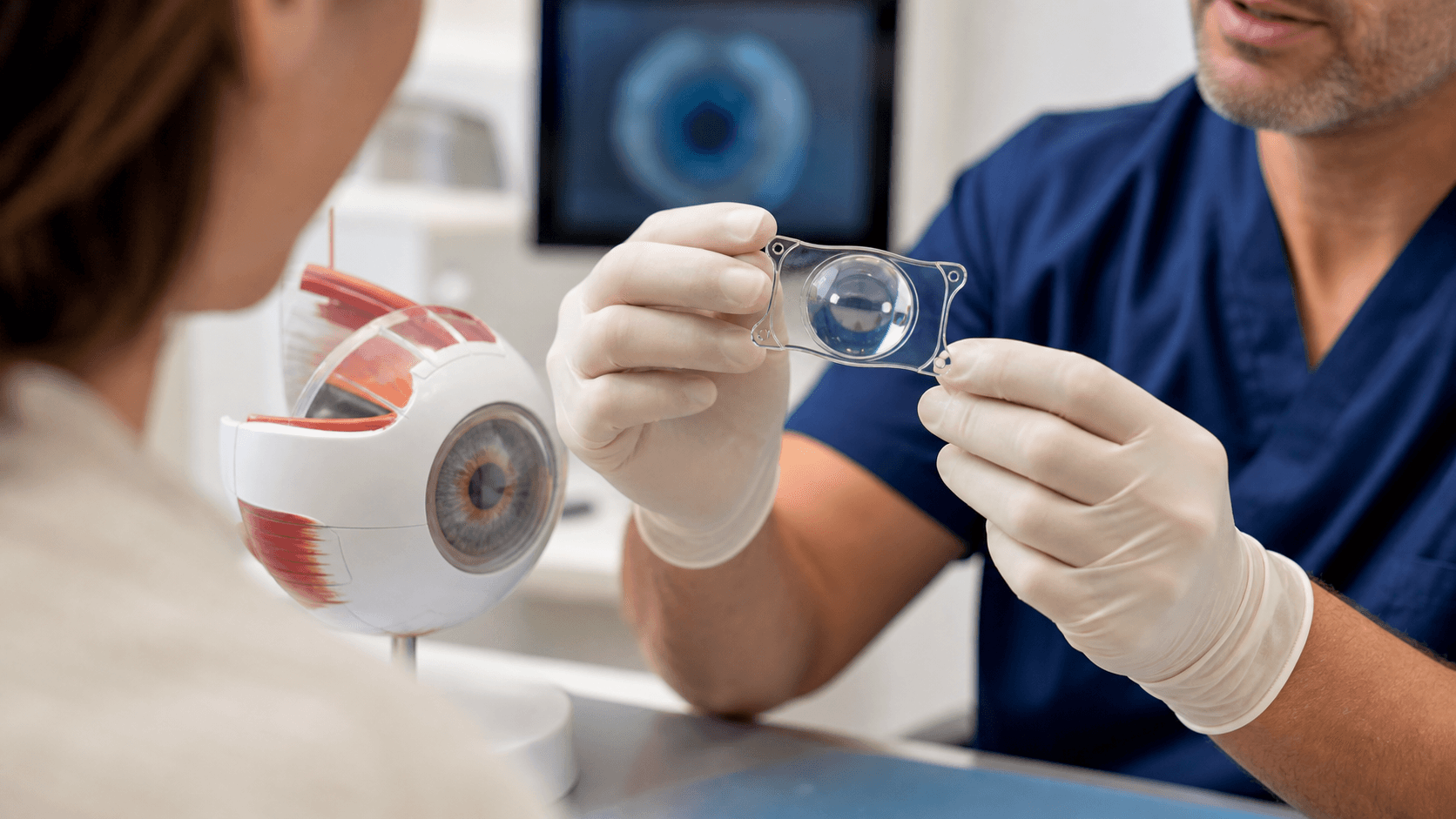
The ICL is a small, flexible lens made from a biocompatible material called Collamer. During a brief procedure, I place this lens inside your eye through a tiny incision, positioning it between your iris and your natural lens. It works with your eye, not against it.
The lens is designed to stay in place long term, but here is what makes it unique: it is doctor-removable. If your vision changes significantly over time or a new technology emerges, the lens can be removed or replaced by a surgeon. That kind of flexibility does not exist with LASIK.
The word "implantable" can sound intimidating, but the concept is simple. LASIK, SMILE, and PRK change the cornea. EVO ICL adds a lens inside the eye while leaving the corneal tissue alone. That difference is why a high-prescription or thin-cornea patient may hear a different recommendation from a surgeon who offers the full refractive menu.
Who Is a Good Candidate
The EVO ICL is often considered for patients with moderate to high myopia, including prescriptions in the FDA-approved treatment range when anatomy fits. Toric EVO ICL can also correct qualifying astigmatism. If you have been told your corneas are too thin for LASIK or your prescription is too high, ICL may belong in the conversation.
The FDA PMA database now records the EVO/EVO+ ICL/TICL age indication expansion from 21-45 to 21-60. That does not mean age alone approves surgery. During your consultation at Visionary Eye, we still confirm prescription stability, anterior chamber depth, angle anatomy, corneal endothelial health, lens sizing, retina status, and whether EVO ICL is more appropriate than LASIK, PRK, SMILE, or waiting.
What the Measurements Are Checking
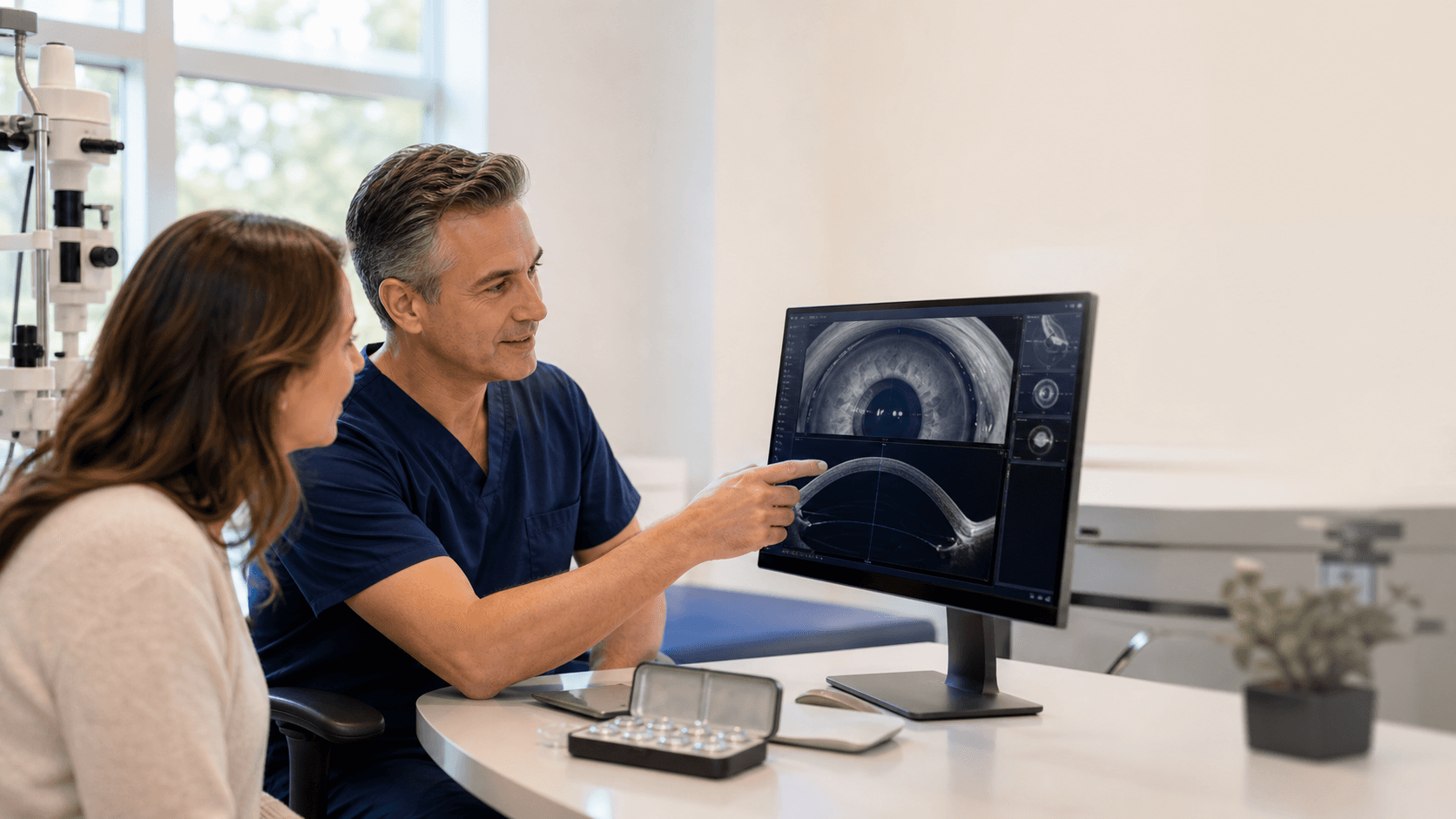
EVO ICL candidacy is not decided by prescription alone. A serious consultation should measure the eye from front to back before recommending a lens.
Key measurements include:
- Refraction and prescription stability.
- Corneal topography and tomography to understand shape and thickness.
- Anterior chamber depth, because the lens needs enough internal space.
- Angle anatomy and pressure risk.
- Endothelial cell health.
- White-to-white or internal sizing measurements for lens fit.
- Retina and optic nerve review, especially for high myopia.
- Tear-film and dry-eye evaluation.
- Astigmatism planning, including whether Toric EVO ICL fits.
This is where the decision should slow down. The right surgeon is not simply the closest office or the lowest advertised number. The right surgeon can explain why the internal lens fits your anatomy, why LASIK or PRK does not fit as well, and what tradeoffs remain.
What the Procedure Is Like
The procedure is brief. We use numbing drops for comfort, and the micro-incision typically does not require stitches. Many patients notice clearer vision within 24-48 hours, with follow-up confirming pressure, vault, comfort, and healing.
Many patients notice clearer vision early, but the recovery plan depends on healing, pressure checks, lens position, and surgeon guidance. Read the dedicated EVO ICL recovery timeline for the first-day through first-month checkpoints.
EVO ICL vs LASIK, PRK, and SMILE
EVO ICL is not automatically "better" than laser vision correction. It is better for certain eyes.
| Procedure | Best fit | What changes |
|---|---|---|
| EVO ICL | High myopia, thin corneas, dry-eye sensitivity, or patients who want a doctor-removable lens option | Adds an implantable Collamer lens inside the eye |
| LASIK | Many moderate prescriptions with healthy corneal thickness and a stable tear film | Reshapes the cornea under a flap |
| SMILE | Selected nearsighted patients who want a small-incision, no-flap laser option | Reshapes the cornea through a small incision |
| PRK / ASA | Thin-cornea or active-career patients whose prescription still fits a surface laser plan | Reshapes the corneal surface without a flap |
That comparison matters because patients often arrive with the wrong starting assumption. Use this article to understand what EVO ICL is, use the main EVO ICL page for surgeon, candidacy, recovery, and consultation details, and use the LASIK, EVO ICL, and PRK comparison page when you need side-by-side procedure selection.
When EVO ICL May Not Be the Right Answer
EVO ICL may not fit if the anterior chamber is too shallow, the angle anatomy is not safe, the endothelial cell count is concerning, the prescription is still changing, inflammation or glaucoma is uncontrolled, or a simpler corneal laser option is safer for the eye.
That last point matters. Some patients come in expecting EVO ICL because they read it is good for high prescriptions, but their measurements actually fit LASIK, SMILE, or PRK well. Others come in expecting LASIK and learn that EVO ICL protects more corneal structure. The job of the consultation is to separate those groups.
Why I Believe in It
I offer every major vision correction procedure at Visionary Eye because I believe in matching the solution to the patient, not the other way around. The EVO ICL fills a gap that LASIK cannot. It gives options to people who were told they had none.
That matters to me. Because telling someone “sorry, you are not a LASIK candidate” and leaving it at that is not good enough. Not when the technology exists to help them.
Related resources
Your exam can clarify which options fit your eyes. Visit our Plano team from anywhere in DFW.
Book a free visit