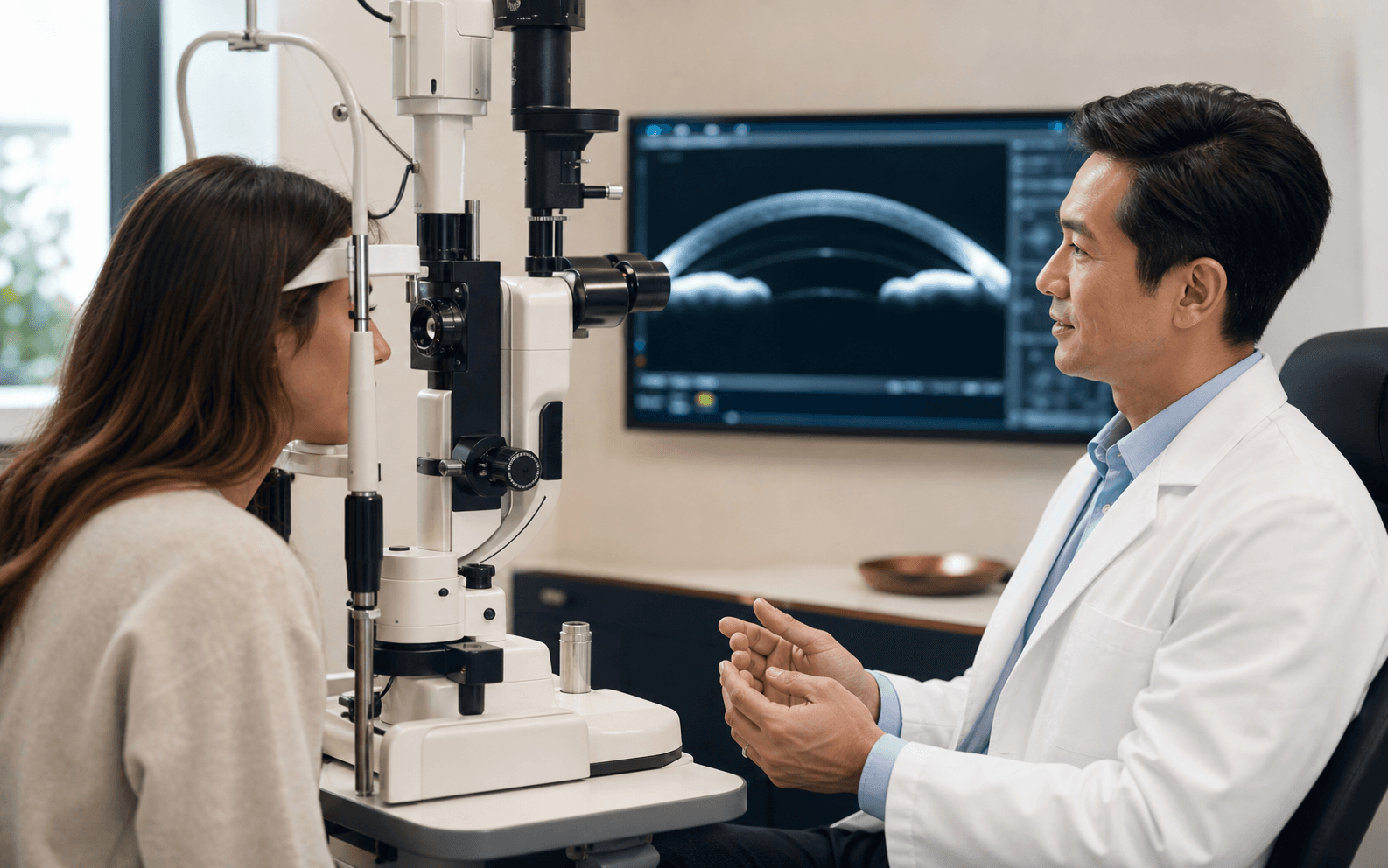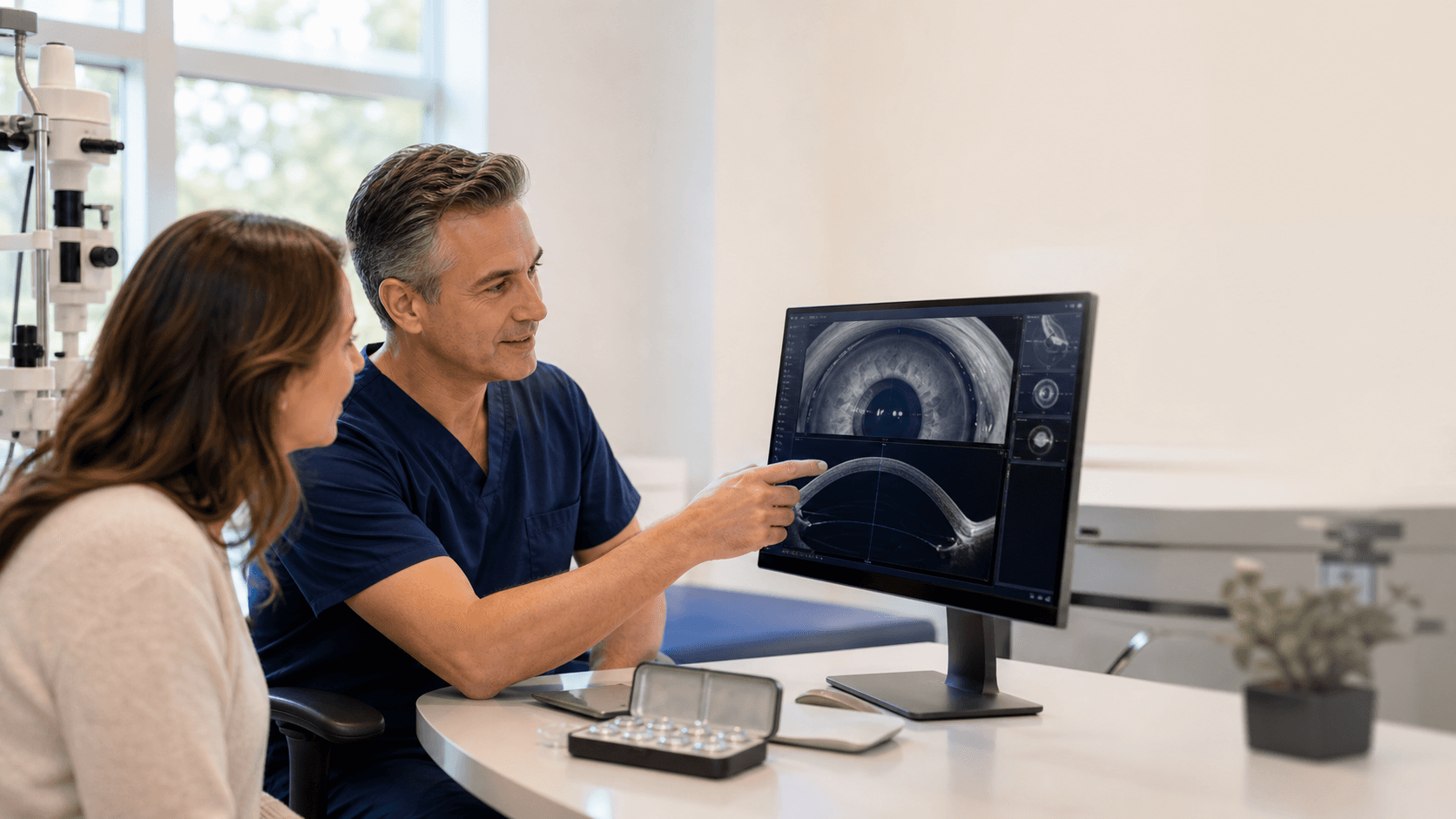
EVO ICL can provide excellent vision for the right patient, especially when a high prescription or corneal anatomy makes laser vision correction less suitable. It is still surgery inside the eye, and a useful consultation should cover possible visual side effects and medical risks without minimizing them.
Halos and glare are among the questions Plano patients ask most often. They are real possibilities, particularly in dim light, but they are not the whole safety discussion. Lens sizing, pupil behavior, pressure, the natural lens, and the corneal endothelium also matter.
What do halos and glare look like?
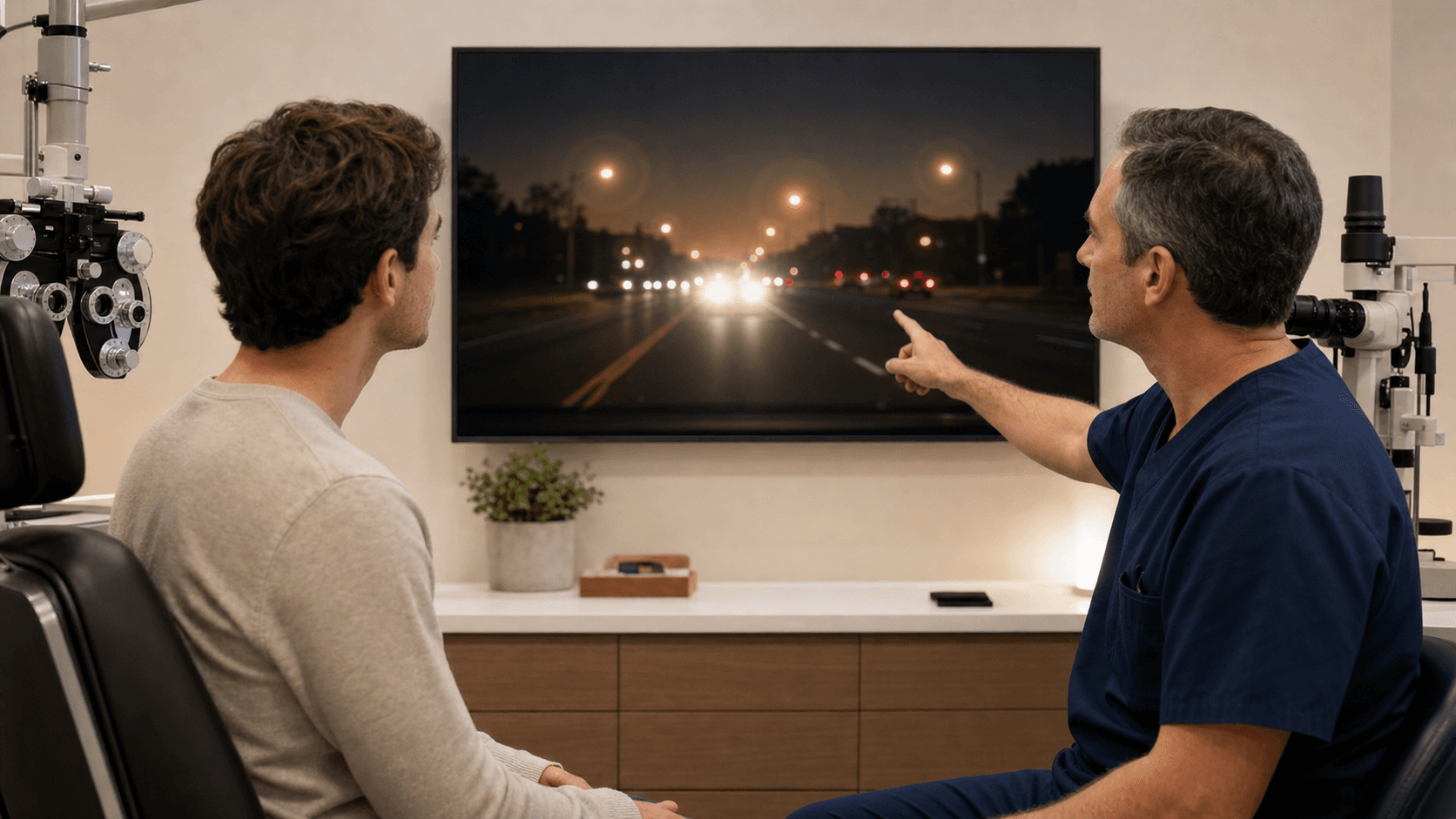
A halo is a ring or glow around a point of light. Glare is scattered brightness that can reduce comfort or contrast. Starbursts appear as rays around lights. A patient may notice one, several, or none of these effects.
They are often most noticeable around:
- Oncoming headlights.
- Streetlights and traffic signals.
- Bright signs against a dark background.
- Indoor lights in a dim room.
Early visual symptoms can change as the eye heals and the brain adapts. A persistent or worsening symptom deserves an examination rather than an assumption that it is "normal."
Why can EVO ICL affect night vision?
In dim conditions, the pupil becomes larger. If the pupil extends beyond the effective optical zone, peripheral light can behave differently from light passing through the center. The FDA-approved EVO ICL labeling notes that patients whose dilated pupil is larger than the lens optic may have increased risk of glare or other visual symptoms under low-light conditions.
That is one reason candidacy involves more than confirming the prescription. Your surgeon should consider pupil size, lens model and power, internal eye measurements, astigmatism, the ocular surface, and whether another procedure offers a better balance for your priorities.
Night driving is also affected by issues unrelated to the implant, including residual prescription, dry eye, retina problems, and normal contrast sensitivity. A complete evaluation separates these possibilities.
Do halos always go away?
No surgeon should promise that every halo will disappear. Some early symptoms become less noticeable with healing and neuroadaptation. Some persist. The pattern, severity, and effect on daily life matter.
Before surgery, tell your surgeon if:
- You drive professionally or spend substantial time on dark roads.
- Night sports, aviation, military duties, or public-safety work are important to you.
- You already have significant glare or poor night vision in glasses or contacts.
- Your work depends on high contrast in dim environments.
These details can change how the tradeoffs are weighed.
What other EVO ICL risks should be discussed?
The FDA lists potential complications of phakic intraocular lenses that include glare and halos, increased eye pressure, cataract, endothelial cell loss, inflammation, infection, retinal detachment, lens movement, and the need for another procedure. The likelihood and relevance of each risk vary by the patient's eyes and medical history.
Important areas of screening and follow-up include:
Eye pressure and angle anatomy
The lens sits behind the iris, so the front of the eye must have enough space and the drainage angle must be appropriate. Pressure is measured after surgery because an increase may require treatment.
Vault and lens sizing
Vault is the space between the EVO ICL and the natural lens. The goal is an appropriate separation, not simply "more" or "less." Sizing uses internal measurements and is checked after implantation.
The natural lens
EVO ICL does not remove the natural lens. Cataract development is a known potential risk, which is one reason the natural lens is evaluated before surgery and monitored afterward.
Endothelial cell health
Endothelial cells help keep the cornea clear. Cell density and internal anatomy are part of candidacy because the implant is inside the front portion of the eye.
Retina health
Patients with high myopia can have retinal risks regardless of vision-correction surgery. A retinal examination helps identify concerns that may need monitoring or treatment.
How Visionary Eye Surgery evaluates risk
At a Plano EVO ICL consultation, the decision should connect each measurement to a reason. Testing may include:
- Refraction and prescription stability.
- Corneal topography and tomography.
- Anterior chamber depth and angle assessment.
- Endothelial cell count.
- Internal sizing measurements.
- Dilated pupil assessment.
- Eye pressure.
- Dilated retina and natural-lens examination.
- Tear-film and dry-eye evaluation.
The result may be EVO ICL, but it may also be LASIK, SMILE, PRK, a lens-based procedure later in life, or no surgery. Offering several technologies makes it possible to recommend based on the eye rather than forcing every patient into one procedure.
EVO ICL vs LASIK for night vision
Both EVO ICL and laser vision correction can involve glare, halos, or night-vision symptoms. The mechanism and risk profile are not identical.
EVO ICL places a lens inside the eye and preserves corneal tissue. LASIK reshapes the cornea under a flap. PRK reshapes the corneal surface without a flap. SMILE changes corneal shape through a small incision. Your prescription, corneal thickness and shape, pupil behavior, tear film, age, and daily needs determine which comparison is relevant.
Use our EVO ICL versus LASIK guide for the broader treatment decision. For thin corneas or high prescriptions, see PRK versus EVO ICL.
What if night vision changes after surgery?
Report the symptom and describe it precisely:
- Is it a ring, ray, haze, double image, or general loss of contrast?
- Does it happen in one eye or both?
- Is it improving, stable, or worsening?
- Does blinking or lubricating the eye change it?
- Does it affect driving or work?
An examination can check vision, prescription, pressure, corneal surface, inflammation, lens position, and other causes. Sudden vision loss, severe pain, marked redness, nausea with visual symptoms, new flashes or floaters, or a curtain-like shadow should prompt urgent contact with the surgical team.
A better question than "Is EVO ICL safe?"
The better question is whether EVO ICL is an appropriate risk-benefit match for your specific eyes. FDA approval defines an indicated use, but it does not replace individual screening.
If you are deciding whether the implant fits your prescription and anatomy, begin with what EVO ICL is and who it is for. If you are planning time away from work or exercise, read the EVO ICL recovery timeline.
Schedule a consultation for a measurement-based recommendation at Visionary Eye Surgery in Plano.
Medical sources
Your exam can clarify which options fit your eyes. Visit our Plano team from anywhere in DFW.
Book a free visit