EVO ICL is intended to provide vision correction for as long as the lens remains safely and appropriately positioned in the eye. It does not have a routine replacement date like a disposable contact lens.
That does not mean a surgeon should promise that one implant will stay untouched for the rest of every patient's life. The lens may remain in place for many years, but the eye continues to age. Prescription changes, presbyopia, cataracts, pressure, lens position, and corneal endothelial health can all affect the long-term plan.
The accurate answer is therefore: EVO ICL is a long-duration implant, but it requires lifelong eye care and may eventually need removal or exchange.
Does the EVO ICL lens wear out?
The FDA patient information states that EVO ICL provides correction as long as the lens remains in the eye. It is not designed as a short-term implant with a scheduled expiration date.
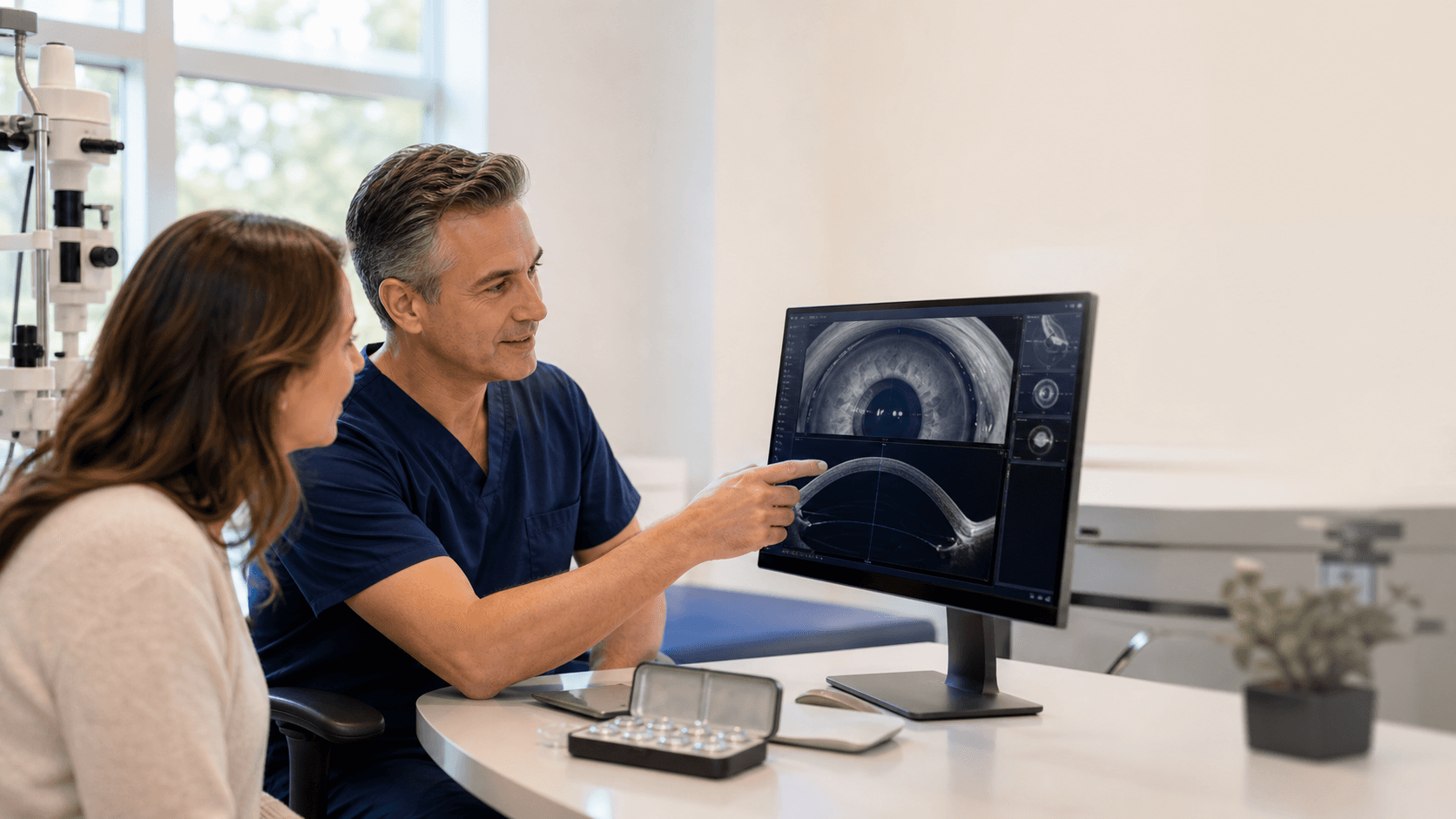
The more important question is whether the eye remains a healthy match for the implant. The lens sits behind the iris and in front of the natural crystalline lens. Follow-up checks the structures around it, not just whether distance vision is still clear.
Permanent does not mean the eye stops changing
Several natural changes can happen even when the implant itself remains stable.
Presbyopia
EVO ICL corrects nearsightedness, with or without qualifying astigmatism. It does not stop the natural lens from becoming less flexible with age. A patient corrected for distance may still need reading glasses as presbyopia develops.
Prescription change
The procedure is planned after the prescription has been stable, but no refractive procedure freezes the eye forever. A later change may create some residual nearsightedness, farsightedness, or astigmatism.
Cataract
A cataract is clouding of the natural lens. Cataract risk increases with age in the general population, and the FDA labeling also identifies cataract as a risk after ICL implantation. Older age and higher myopia can matter. Regular examinations look for lens changes before they significantly affect daily vision.
Retina and glaucoma risk
People with high myopia can have increased retinal and glaucoma risks independent of EVO ICL. Clear vision through the implant does not replace dilated retinal examinations, pressure checks, or other monitoring recommended for the underlying eye.
Why might EVO ICL be removed or exchanged?
Removal or exchange is not routine, but it may be considered for reasons such as:
- Cataract surgery on the natural lens.
- Lens sizing or vault that is not appropriate.
- Position or rotation concerns, particularly with a toric implant.
- Pressure or angle problems that do not resolve with other management.
- Inflammation or another medical complication.
- A meaningful residual prescription when another plan is more appropriate.
- A change in eye health that alters the risk-benefit balance.
The decision is individual. A removable implant is not the same as a risk-free or consequence-free procedure. Removal and exchange are intraocular surgeries with their own risks, and returning to the exact preoperative condition cannot be guaranteed.
What happens to EVO ICL when cataract surgery is needed?
When a visually significant cataract develops, the surgeon generally plans around both lenses. The FDA patient booklet explains that the ICL and cataractous natural lens may be removed, followed by placement of a new intraocular lens as part of cataract surgery.
The new lens calculation uses measurements of the eye and a discussion of the patient's current visual goals. The plan later in life may be different from the plan chosen in the twenties or thirties because reading vision, retina health, glaucoma, corneal health, and daily tasks have changed.
EVO ICL does not prevent future cataract surgery. It becomes part of the history the cataract surgeon must evaluate.
What long-term follow-up should check
The FDA advises regular eye care for as long as a phakic intraocular lens remains implanted. Follow-up may include:
- Vision and refraction.
- Eye pressure.
- The space between the ICL and natural lens, often called vault.
- Lens position and toric alignment when applicable.
- The natural lens for cataract change.
- Corneal endothelial cell health.
- The drainage angle and front-of-eye anatomy.
- A dilated retinal examination when indicated.
The schedule is set by the treating clinician and may become more frequent if a measurement changes. A patient who sees clearly can still have a finding that deserves monitoring.
What the long-term evidence can and cannot promise
It is reasonable to describe EVO ICL as a long-term vision-correction option. It is not reasonable to turn that into a guarantee of lifetime implantation or lifetime 20/20 vision.
The current U.S. EVO labeling includes important uncertainty about some risks beyond the available follow-up period. It notes that long-term effects on the corneal endothelium and the rate of cataract related to implantation, removal, or replacement are not fully established beyond the cited study periods.
That uncertainty is a reason for informed consent and monitoring, not a reason to assume that every patient will have a complication. A useful consultation should explain both the intended durability and the limits of the evidence.
EVO ICL longevity versus LASIK longevity
Neither procedure stops normal aging.
LASIK permanently changes corneal shape, but later prescription changes and presbyopia can still affect vision. EVO ICL leaves corneal tissue in place and uses an implant that can be removed, but it adds the long-term responsibilities of an intraocular lens.
The better comparison is not which procedure uses the word "permanent." It is which risk profile fits the prescription, cornea, tear film, internal eye anatomy, age, and priorities.
Read EVO ICL versus LASIK for the broader decision, or review EVO ICL risks and night vision for the safety discussion.
Planning EVO ICL care across DFW
Patients outside Plano should choose the city guide that handles travel and visit planning, then use the main EVO ICL procedure page for clinical ownership. Dedicated guides are available for patients researching from Frisco, McKinney, Allen, Richardson, Dallas, and Fort Worth.
If your city does not have a separate EVO ICL page, use its service-area guide for directions and the main procedure page for candidacy. This keeps one clear clinical owner while still answering local visit questions.
Questions to ask before choosing a long-term implant
- What measurements show that my eye can safely fit the lens?
- How will you choose the size and check vault afterward?
- Which findings could lead to repositioning, exchange, or removal?
- What is the follow-up schedule after the first year?
- How will you monitor endothelial cells, pressure, cataracts, and retina health?
- What happens if my prescription or near vision changes?
- How would future cataract surgery be planned?
For a measurement-based recommendation, schedule an EVO ICL consultation at Visionary Eye Surgery.
Medical sources
Your exam can clarify which options fit your eyes. Visit our Plano team from anywhere in DFW.
Book a free visit