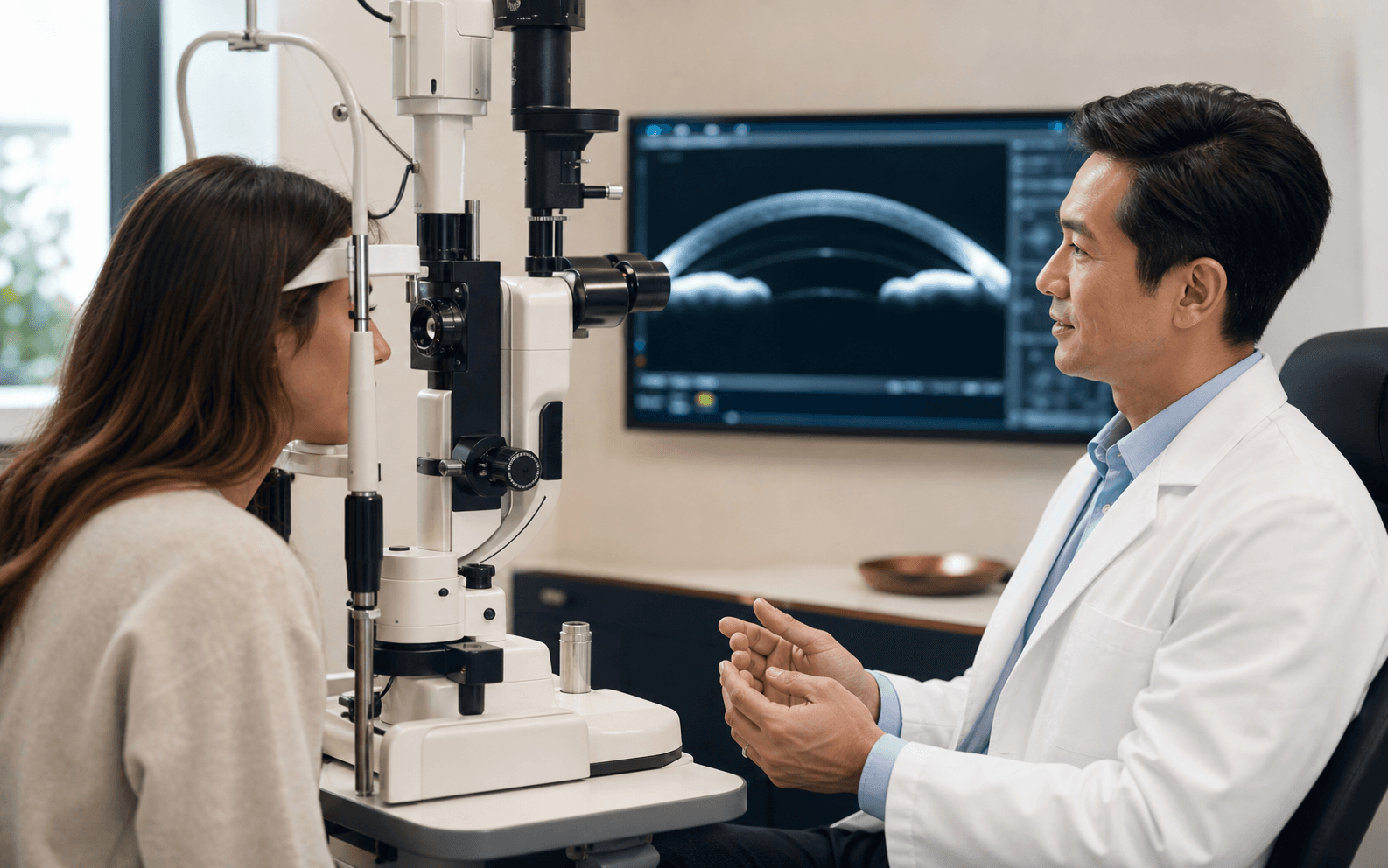
Being older than 45 is no longer automatically outside the US indicated age range for EVO ICL. The FDA approved an expansion from ages 21–45 to 21–60 on November 14, 2025. That change makes a new consultation worth discussing for some patients previously told they were too old, but it does not establish individual candidacy.
For patients in Dallas-Fort Worth, two questions still need separate answers: can an implantable lens safely correct the distance prescription, and what will happen to reading vision? Start with our EVO ICL procedure page for the treatment overview.
Why are different age limits still online?
The original 2022 EVO approval specified ages 21–45. The later FDA supplement, P030016/S048, expanded that range. An older patient booklet or clinic article may accurately describe the earlier approval while giving an outdated answer to today's age question.
Ask which current labeling the practice uses and how it applies to your examination. An online age cutoff should not substitute for checking the actual device indication. The expansion also does not mean that every type of prescription or every older eye qualifies.
Does EVO ICL remove the need for reading glasses?
EVO ICL is implanted while the natural lens remains in place. It corrects specified nearsighted prescriptions, with a toric version for eligible myopic astigmatism. It does not restore the natural lens's age-related loss of near focusing, called presbyopia.
That matters if you currently take off your distance glasses to read. After correcting distance vision, you may need readers for close work. Improved distance clarity and greater dependence on readers can occur together without meaning that the distance correction has failed.
For a patient in Dallas who wants to see road signs and menus, the consultation should discuss those as separate goals. Bring the glasses you use for each task and describe the distances at which you work.
What needs checking besides age?
The team evaluates prescription stability, anterior-chamber depth, corneal endothelial health, pressure, the natural lens, and other ocular findings. Lens sizing and anatomy matter because the implant occupies space inside the eye. These are measurements, not things that can be judged from the strength of your glasses alone.
Cataract changes, glaucoma concerns, or other disease may alter the recommendation. Ask whether your current visual difficulty comes mainly from the prescription, the natural lens, the ocular surface, or something else. More than one factor may be involved.
How does the discussion differ from RLE?
EVO ICL adds an implant while retaining the natural lens. Refractive lens exchange removes and replaces that lens. These approaches have different implications for near vision, future cataract care, anatomy, and surgical risk.
An older patient with a clear natural lens and significant myopia does not automatically need RLE. Conversely, an expanded EVO age range does not make EVO preferable when lens changes or other findings favor a different approach. Ask the surgeon to explain why keeping or replacing the natural lens fits your eyes.
Both are intraocular procedures with risks. EVO ICL removal requires another operation, and removal does not guarantee restoration of the eye's original condition. Keep the decision focused on the overall risk-benefit balance, including glasses or contacts as alternatives.
Prepare a two-distance consultation checklist
- What result is realistic for distance vision?
- Which near tasks will still require readers?
- Is my natural lens clear, and is presbyopia already affecting me?
- Do my measurements meet current implant requirements?
- How would future cataract surgery be managed?
- Why would you recommend EVO ICL, RLE, laser correction, or waiting?
Patients traveling from Frisco, Allen, or Arlington should confirm the evaluation and follow-up schedule before choosing a procedure date. Visionary Eye's treatment planning takes place through its Plano practice; regional service coverage does not imply a separate office in those cities.
What is the next useful step?
Request a candidacy assessment that includes both distance and near goals. Bring prior records if an earlier consultation excluded you based on age, and ask which findings besides age informed that decision.
Our EVO visit-planning guide explains the practical commitment, while the EVO longevity guide covers future monitoring. A change in labeling is a reason to update the conversation, not a promise of a particular result.
Sources
- FDA: EVO/EVO+ age-range expansion, P030016/S048
- FDA: original EVO ICL indication and anatomical requirements
- STAAR Surgical: EVO ICL patient information
The age discussion follows the later FDA supplement; older labeling must be read together with subsequent amendments. Personal eligibility requires an examination.
Your exam can clarify which options fit your eyes. Visit our Plano team from anywhere in DFW.
Book a free visit