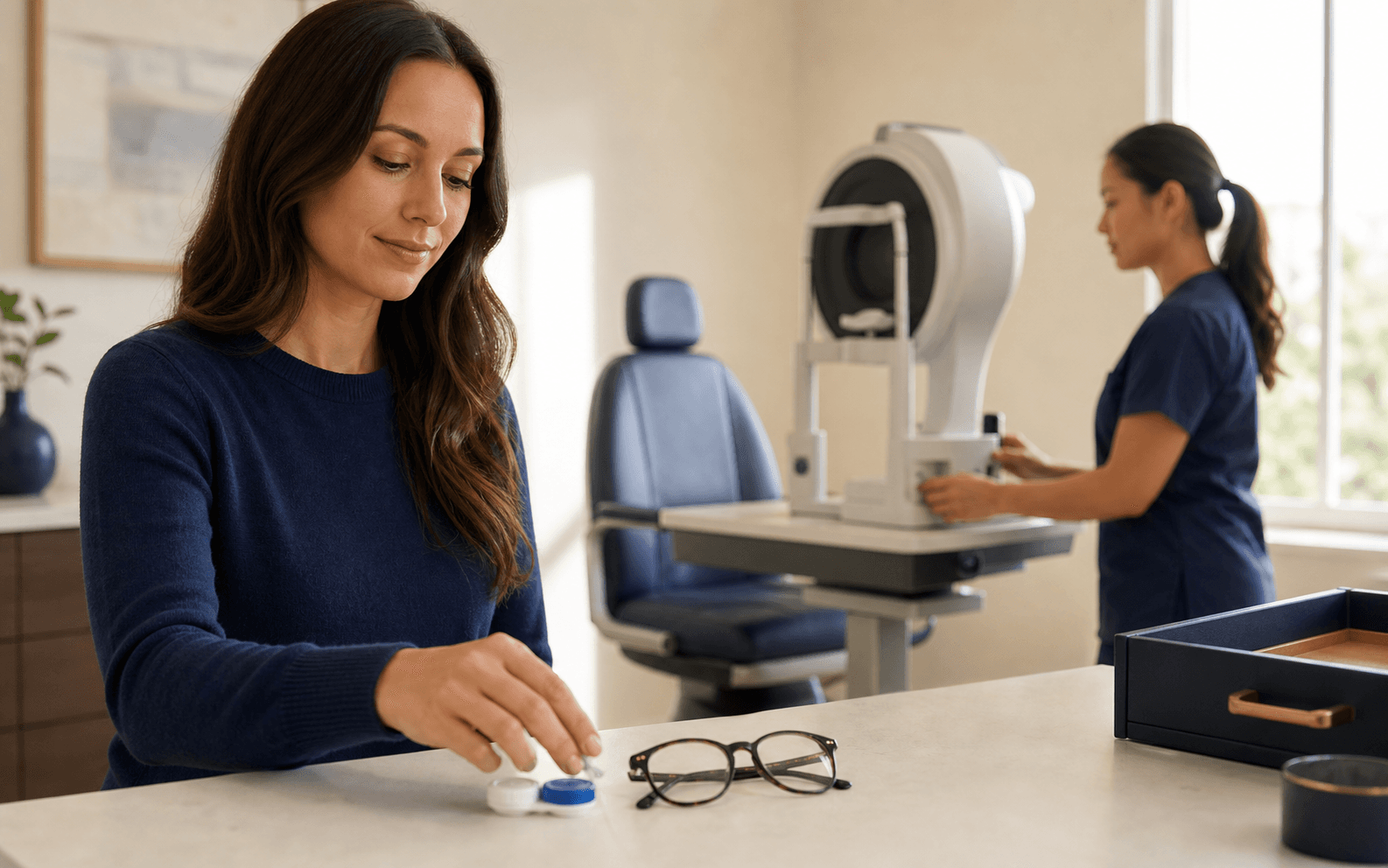
Contact lenses can temporarily change the shape and surface of the cornea. That matters because LASIK, SMILE, PRK, and EVO ICL evaluations depend on repeatable measurements, not just the prescription printed on a contact-lens box.
The safest short answer is: follow the removal schedule given by the clinic that will perform your testing. The timing can change with the lens material, whether the lens corrects astigmatism, how long you have worn it, and whether the first measurements are stable.
Do not guess and do not use a generic online timeline as a substitute for your surgeon's instructions. Call before the visit if the office has not told you when to switch to glasses.
A practical contact-lens timing guide
The U.S. Food and Drug Administration gives the following examples before a LASIK baseline evaluation:
| Contact-lens type | FDA example before the baseline evaluation | Why more time may be needed |
|---|---|---|
| Soft spherical lenses | 2 weeks | Dry eye, long daily wear, or changing maps may require repeat testing |
| Toric soft lenses | At least 3 weeks | A lens that corrects astigmatism can have a larger effect on corneal measurements |
| Rigid gas-permeable lenses | At least 3 weeks | Rigid lenses can reshape the cornea and may require serial maps until stable |
| Hard lenses | At least 4 weeks | Long-term wear can require a longer period and more than one stable examination |
These are FDA patient-education examples, not a universal prescription. Instructions can differ by lens design, device labeling, surgeon protocol, and the purpose of the visit. Some offices separate an initial conversation from the final measurement visit so a patient does not have to stop contacts before learning whether surgery is worth pursuing.
Why contacts affect LASIK measurements
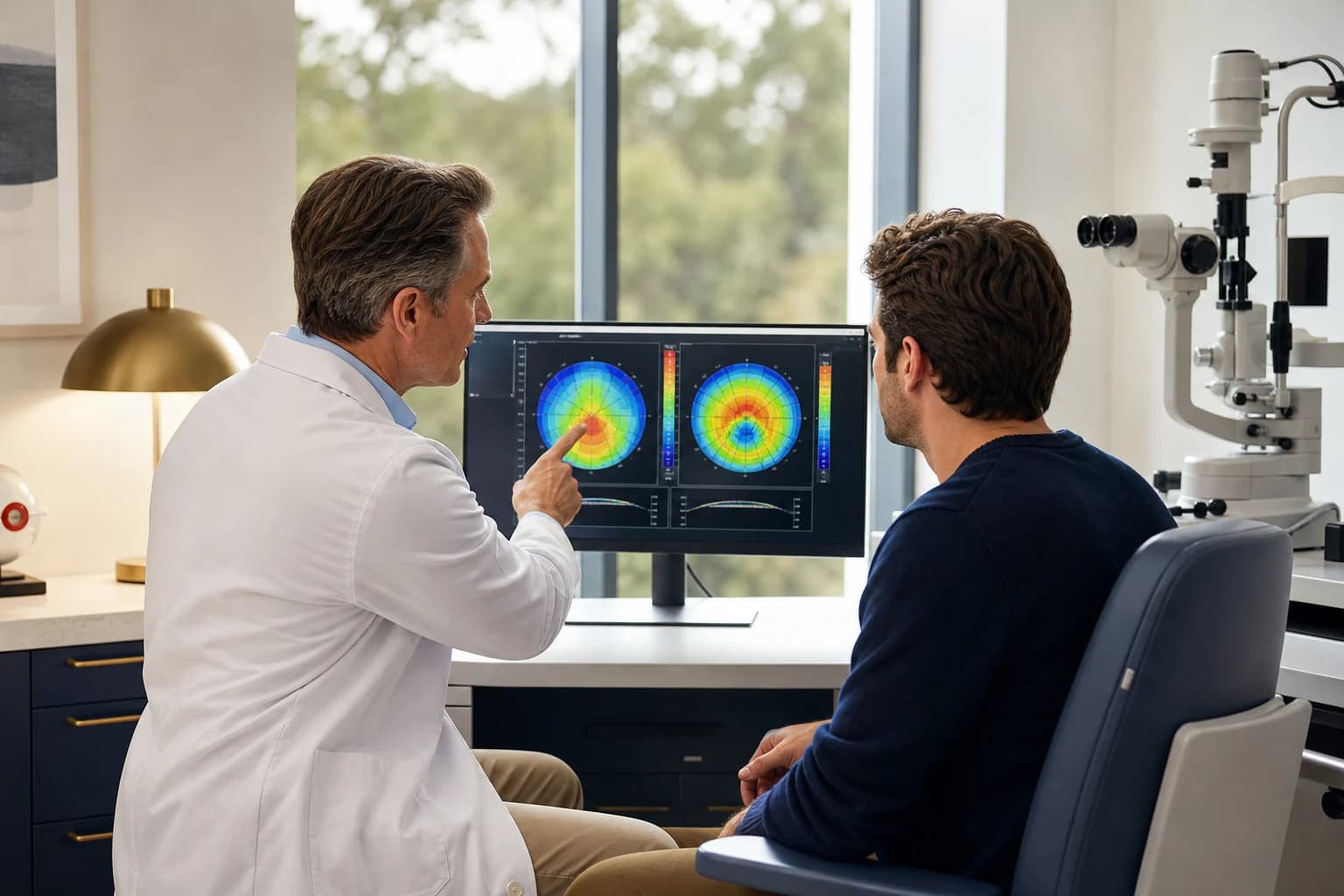
LASIK planning uses the cornea's natural curvature, thickness, shape, and optical pattern. A contact lens rests on the tear film over the cornea. Over time, it can temporarily alter curvature, mask an irregular area, or make the surface less stable.
If the cornea has not returned to a repeatable baseline, testing can produce:
- A prescription that changes between visits.
- Corneal maps that do not agree.
- An inaccurate estimate of how much tissue a laser treatment would remove.
- An astigmatism amount or axis that shifts.
- Dry-eye findings that make the optical surface unreliable.
The goal is not simply to leave contacts out for a certain number of days. The goal is to show that the measurements have stabilized.
Does the same rule apply to SMILE and PRK?
Yes, the same principle applies. LASIK, SMILE, and PRK use different surgical approaches, but all three reshape the cornea. Reliable refraction and corneal mapping are therefore central to the candidacy decision and treatment plan.
The comparison also needs to screen for findings that may make a corneal laser procedure less suitable, such as irregular topography, keratoconus risk, an unstable prescription, or an unhealthy tear film. Leaving contacts out helps the surgeon see the cornea rather than the temporary effect of the lens.
Use the laser vision correction overview to compare the procedures, or review the focused LASIK, EVO ICL, and PRK guide before the measurement visit.
Why contacts still matter before an EVO ICL evaluation
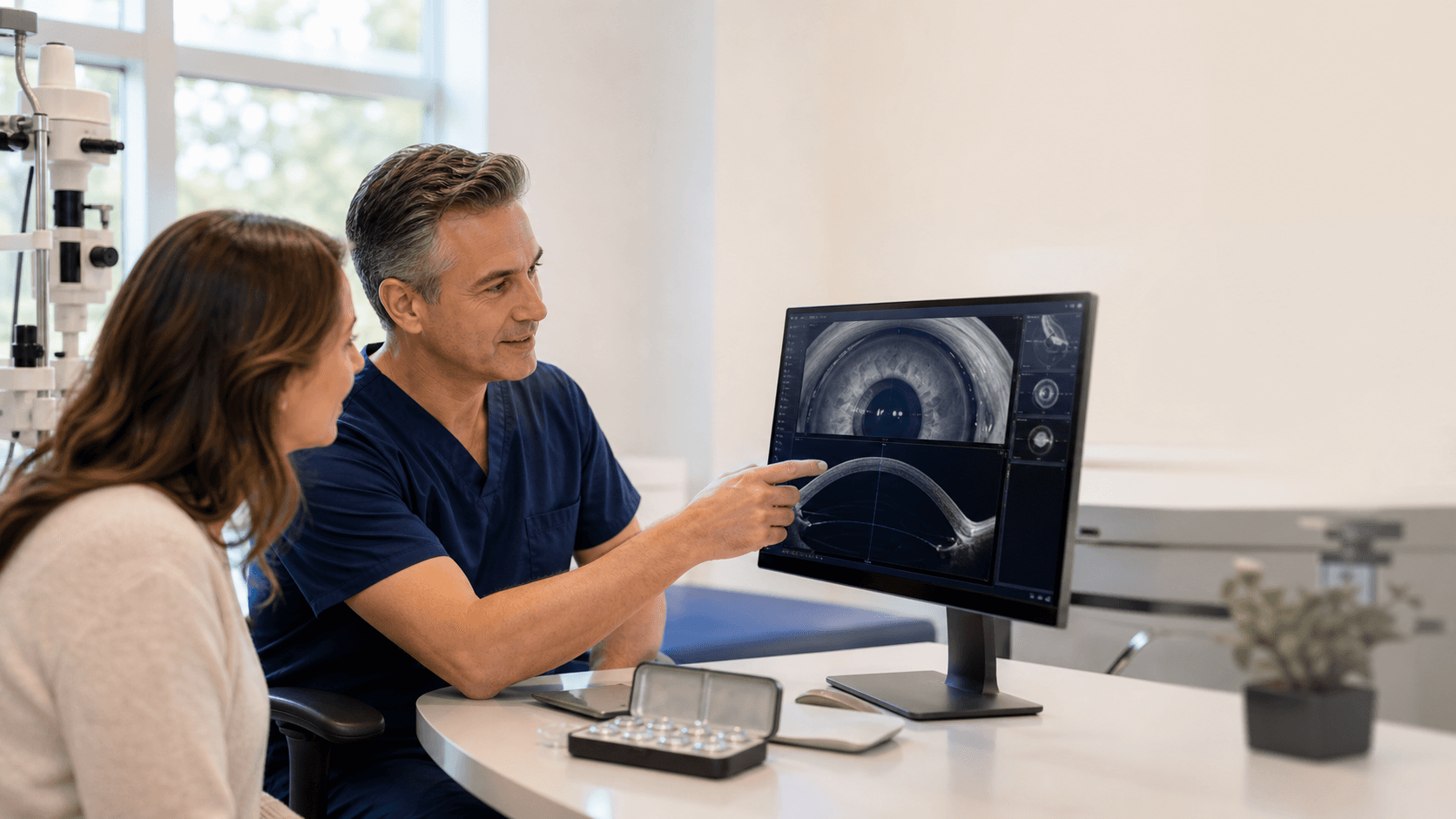
EVO ICL does not remove corneal tissue, but its evaluation still includes refraction, corneal maps, and an ocular-surface assessment. Those tests help confirm the true prescription, rule out corneal disease, and compare EVO ICL with LASIK, SMILE, or PRK.
EVO ICL planning also requires internal measurements such as anterior chamber depth, angle anatomy, endothelial cell density, and sizing data. Removing contacts does not replace those tests. It helps make the full comparison more reliable.
If you are exploring an implantable lens because of high myopia or thin corneas, start with the EVO ICL procedure page and bring your current prescription history to the visit.
Consultation versus final preoperative testing
Patients often use the word "consultation" for two different appointments:
- An initial discussion or screening that explains possible procedures.
- The diagnostic workup used to establish candidacy and plan treatment.
The second appointment needs measurements that can be trusted. Ask the clinic which kind of visit you are booking and whether being in contacts will mean returning for repeat maps.
Useful questions include:
- Should I stop contacts before the first visit or only before final testing?
- Does my lens count as soft spherical, soft toric, hybrid, scleral, RGP, or hard?
- How should I function in glasses if my prescription is very high?
- Will the measurements be repeated before surgery?
- What happens if the maps are still changing?
What if you cannot function without contacts?
Tell the clinic before removing them. Patients with high prescriptions may need updated glasses, workplace adjustments, or a testing schedule planned around days off. Do not shorten the contact-free interval on your own because driving, work, or childcare became difficult.
If your glasses are old, bring them anyway and ask whether a temporary updated pair is sensible. The office may also be able to structure the first discussion separately from the definitive testing. The right solution depends on how much vision you have in glasses and which lens type you wear.
What if you wore contacts by mistake?
Be honest about the last day and time you wore each lens. The clinic can decide whether to proceed with part of the exam, reschedule the measurements, or compare results at a second visit.
Trying to hide recent lens wear can create a false sense of precision. A delayed plan is better than a treatment based on a distorted baseline.
Prepare for a DFW vision-correction visit
Patients coming from Frisco, McKinney, Allen, Richardson, Dallas, Fort Worth, or another DFW community should confirm the contact-lens schedule before planning the drive. A complete refractive evaluation may include dilation, so also ask whether you should bring a driver.
Use the service-area page nearest you for practical visit information:
- Frisco, McKinney, Allen, and Prosper.
- Dallas, Richardson, Addison, and Carrollton.
- Irving, Arlington, Denton, and Fort Worth.
The city page handles travel intent. The procedure page remains the source for candidacy and treatment details, which prevents local pages and educational articles from competing for the same job.
The measurement, not the calendar, decides readiness
A contact-free interval is a starting point. Stable refraction, repeatable corneal maps, a healthy enough surface, and a complete eye examination determine whether the data are ready for surgical planning.
Before booking, contact Visionary Eye Surgery with the exact brand and type of contact lens you wear. The team can give you the clinic-specific schedule and explain whether the first visit includes final diagnostic testing.
Medical sources
Your exam can clarify which options fit your eyes. Visit our Plano team from anywhere in DFW.
Book a free visit