One surgeon, full accountability.
The physician who evaluates your nerve damage is the one who selects and places the device. No handoff between exam room and operating room.
Richardson's corporate corridor means you're used to efficiency — but glaucoma care shouldn't be rushed. Patients from Canyon Creek, Cottonwood, Prairie Creek, and the US-75 tech corridor drive 15 minutes north to Plano for a surgeon who sets the pressure goal first, then chooses the device to reach it.
"Keep using your drops and we'll see you in six months" is not a treatment plan. Along the US-75 corridor — Cisco, Texas Instruments, Blue Cross Blue Shield, MetLife — that answer tends to send people looking for the data instead.
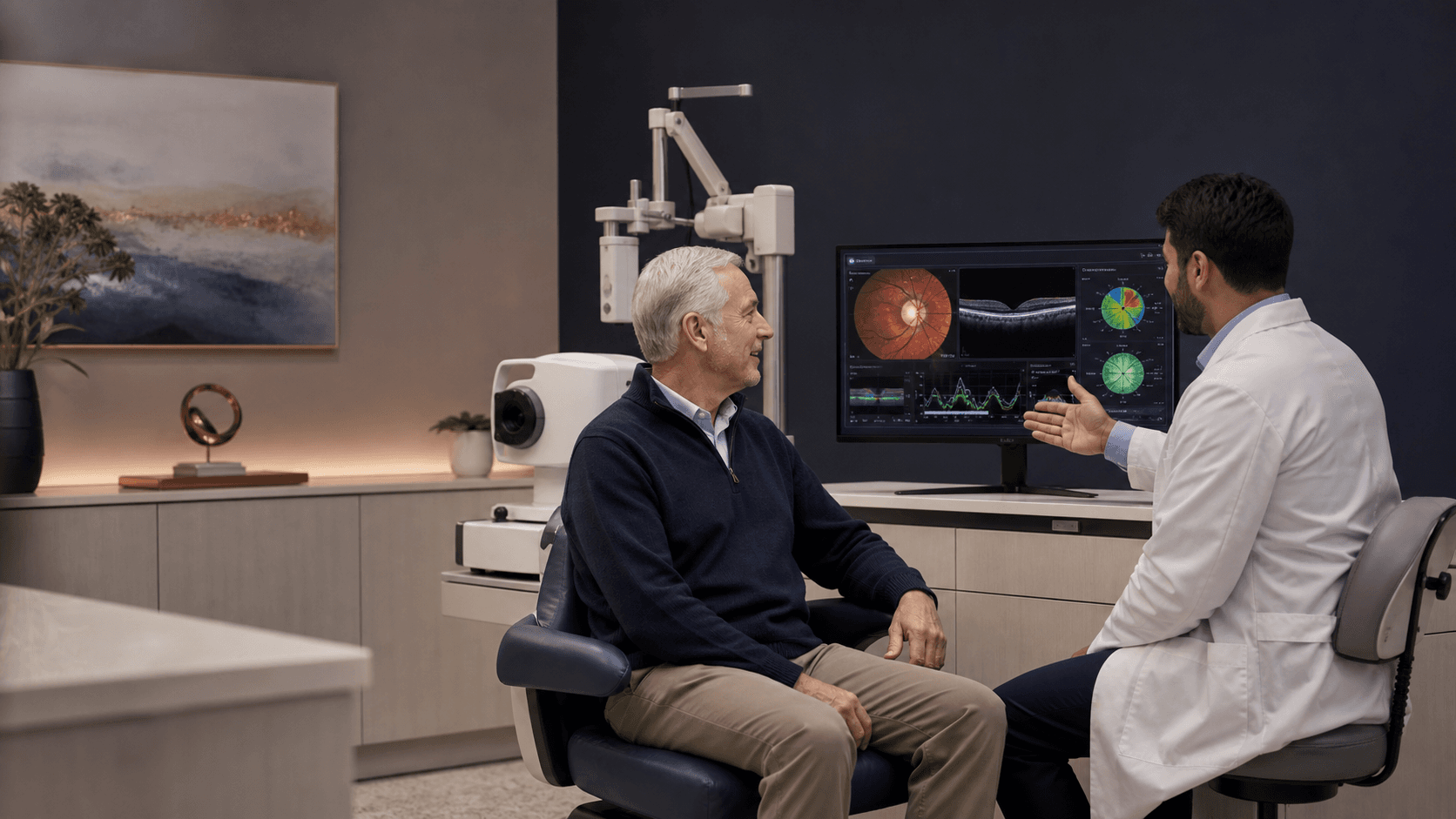
The consultation starts with fresh imaging: gonioscopy to assess drainage angle structure, OCT to measure optic nerve cupping and retinal nerve fiber layer thickness, and automated visual field testing. Dr. Shehz compares it against your prior records, which our team transfers directly from your Richardson provider, to establish a progression rate and set a target pressure accounting for your age, nerve reserve, and risk tolerance.
We frequently see the same profile here: professionals in their 50s and 60s caught between early glaucoma and early cataracts. For them MIGS combined with cataract surgery is often the efficient path — one procedure, one anesthesia, one recovery, with a pressure-lowering device placed while the eye is already open. Which device fits, iStent through iDose, depends on angle anatomy, pressure target, and drop burden.
The same rigor a Richardson engineer would expect from any technical briefing. Applied to their own optic nerve.
The physician who evaluates your nerve damage is the one who selects and places the device. No handoff between exam room and operating room.
Your target pressure is set by nerve status, progression rate, and life expectancy — not by which device is in stock. The plan is explained with the same rigor you'd expect in any technical decision.
Our team contacts your Richardson provider, pulls your OCT baselines and visual field series, and has everything ready before your consultation so nothing is repeated unnecessarily.
Glaucoma is not a single disease — it is a family of optic neuropathies where elevated or fluctuating intraocular pressure damages the optic nerve over time, gradually narrowing the visual field. Because peripheral vision disappears first and painlessly, most patients don't notice the loss until it's significant. That's why glaucoma is called the 'silent thief of sight,' and why a proactive treatment plan matters more than waiting for symptoms.
Traditional management starts with prescription eye drops — one, two, sometimes three or four bottles a day. Drops work for many patients, but compliance is imperfect, side effects accumulate, and the daily burden grinds. Selective laser trabeculoplasty (SLT) offers a drop-free alternative for some, while advanced disease may require filtration surgery such as trabeculectomy or tube shunt. Between drops and traditional surgery sits MIGS: minimally invasive glaucoma surgery.
MIGS procedures — iStent, Hydrus, goniotomy, canaloplasty, Durysta, and iDose — use tiny devices or micro-incisions to lower pressure with less tissue disruption than traditional surgery, often at the same time as cataract removal. They don't replace traditional surgery for advanced glaucoma, but for mild-to-moderate disease they can meaningfully reduce drop burden, stabilize pressure, and protect remaining nerve fiber. The right device depends on your angle anatomy, pressure history, optic nerve status, and whether cataract surgery is already in the plan.
Which device fits depends on your pressure readings, nerve health, drop burden, and whether cataract surgery is part of the plan. Dr. Shehz walks through each option with you at consultation.
One of the smallest medical devices ever made, iStent is placed during cataract surgery to create a permanent opening in the trabecular meshwork, improving the natural outflow of aqueous humor and reducing intraocular pressure for mild-to-moderate open-angle glaucoma.
Hydrus is a flexible, crescent-shaped micro-stent that scaffolds open a large section of Schlemm's canal — the eye's natural drainage channel — during cataract surgery, providing a broader pressure-lowering effect than a single-point bypass.
Goniotomy removes a strip of diseased trabecular meshwork to restore direct drainage into Schlemm's canal. No implant is left behind, and it can be performed alone or combined with cataract surgery depending on the clinical picture.
Canaloplasty dilates and opens the full 360 degrees of Schlemm's canal using a microcatheter, restoring the eye's natural outflow system without leaving a permanent implant. It may suit patients whose angle anatomy supports a canal-based approach.
Durysta is a biodegradable implant placed inside the eye that slowly releases bimatoprost over months, reducing pressure without the burden of daily drop administration. It is a medication-delivery option, not a drainage device.
iDose TR is a tiny titanium implant placed inside the eye that continuously delivers travoprost directly to the trabecular meshwork, offering sustained pressure control and reducing or eliminating daily drop use for appropriate patients.
Every quote below is a real, public Google review — part of the 5.0-star rating across 92 reviews on our profile.
Dr. Shez is the most informative and detail oriented LASIK doctor I have met in my entire life. With other LASIK doctors, the volume of patients they have is so high that they don't take the time to discuss with you what your options are. Dr. Shez on the other hand took over an hour the first time I visited and made sure to explain to me the variety of… Read full review
I had a great experience with Visionary Eye Surgery and Dr. Shehz throughout my LASIK journey. From the consultation to the follow-ups, the staff was professional, patient, and reassuring every step of the way. Even when I had a healing complication with one eye early on, they took care of it immediately, stayed in close contact with me, and made sure I… Read full review
I had lasik and it was the easiest process! No pain and Dr. Shehz is amazing! I definitely recommend visionary eye and should have done this years ago.
US-75 north from Richardson — about 15 minutes to the Plano flagship. Exit at Independence Parkway, ground floor with free patient parking.
8080 Independence Pkwy, Suite 155
Plano, TX 75025
The first visit is a comprehensive glaucoma evaluation with fresh imaging — OCT, visual field, gonioscopy, and pressure measurement. Plan on about 90 minutes. Bring your medication list, prior test results, and insurance card. Many Richardson patients schedule around their work day and return to the office the same morning.
Open Monday–Friday 8:00–5:00 and Saturday 9:00–3:00, with English- and Spanish-speaking staff. Questions before booking? Call 214-972-2020 and a human answers.
Don't see your question? Call 214-972-2020 or book a visit and ask Dr. Shehz directly.
Talk to our team, no pressure, no sales pitch. We answer the question, not the upsell.
Richardson patients with both glaucoma and cataracts often benefit from combining MIGS with premium cataract surgery — one trip to the OR, one recovery, and a pressure-lowering device placed during the same procedure. Dr. Shehz performs both in the same Plano facility.
Explore cost, recovery, and candidacy at your own pace.
Learn how glaucoma, contrast sensitivity, and visual-field testing can affect cataract lens selection, with consultation questions for DFW patients.
Read articleCompare SLT laser and glaucoma eye drops by pressure goals, angle anatomy, daily medication burden, side effects, follow-up, and when both may be needed.
Read articleUnderstand the difference between ocular hypertension, a glaucoma suspect, and glaucoma, plus the pressure, OCT, field, cornea, and angle tests that guide follow-up.
Read articleBook a glaucoma consultation, bring your records and drop list, and get a written pressure-lowering plan before any device is chosen. About 15 minutes north on US-75. Call 214-972-2020 or book online.