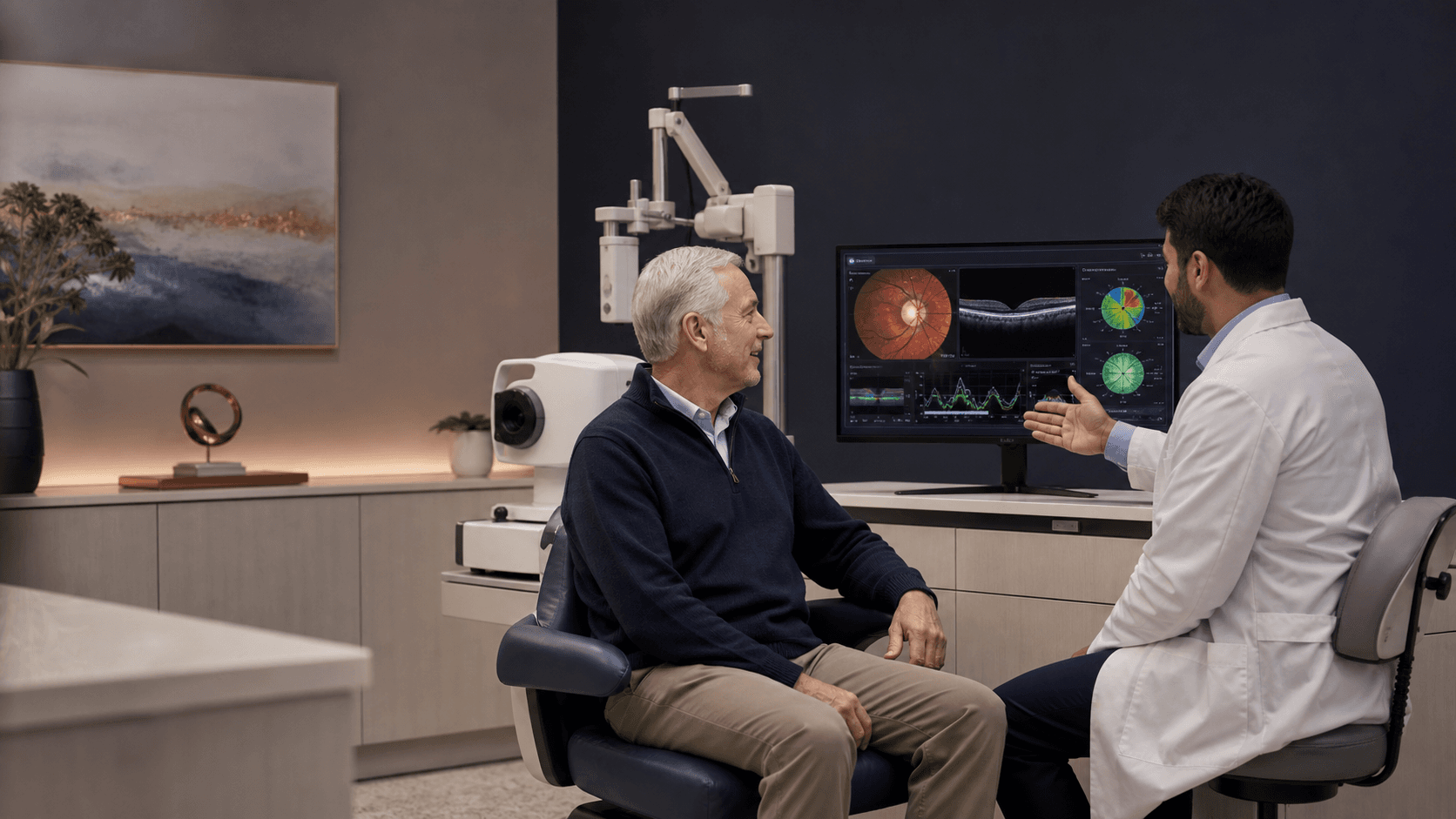
Selective laser trabeculoplasty, or SLT, and prescription eye drops can both lower eye pressure in selected patients with open-angle glaucoma or ocular hypertension. Neither restores optic-nerve tissue that has already been lost. The goal is to reduce the chance of further damage by reaching and maintaining an individualized target pressure.
SLT is an office-based laser treatment to the eye's natural drainage tissue. Drops lower pressure through medication used at home. Some patients can begin with either approach. Others need drops, SLT, or both based on angle anatomy, pressure level, disease stage, prior response, other health conditions, and what they can use consistently.
SLT vs. glaucoma drops at a glance
| Decision point | SLT laser | Glaucoma eye drops |
|---|---|---|
| How it lowers pressure | Improves outflow through the trabecular meshwork | Reduces fluid production, improves outflow, or both depending on the drug |
| Daily action | No daily laser action after treatment | Medication must be used on schedule |
| Where treatment occurs | Ophthalmology office with a special lens and laser | At home, with periodic office monitoring |
| When the effect is judged | Pressure response develops over follow-up | Response is checked after starting or changing medication |
| Duration | Effect can fade and may be repeatable in selected eyes | Continues while the medication remains effective and is used correctly |
| Common limitations | Not every angle or glaucoma type responds | Irritation, cost, technique, adherence, and systemic contraindications can matter |
| Can both be used? | Yes | Yes |
This comparison is about early pressure-lowering treatment. It is separate from MIGS glaucoma surgery, which involves an incision, implant, or drainage procedure and has a different candidacy discussion.
How SLT works
The trabecular meshwork sits in the drainage angle where fluid leaves the front of the eye. During SLT, the eye is numbed with drops and a special contact lens is placed on it. The laser applies low-energy treatment to the drainage tissue. The pressure-lowering effect develops over time rather than instantly.
SLT is commonly considered for open-angle glaucoma and ocular hypertension. The angle must be visible and suitable for treatment. It is not a universal answer for every glaucoma mechanism, closed or scarred angle, pressure emergency, or advanced disease.
After treatment, the pressure is checked because a short-term rise can occur. Follow-up then determines whether SLT reached the target and whether existing drops should continue, change, or eventually be reduced. Patients should not stop medication on their own after laser treatment.
How glaucoma drops work
Glaucoma medications use different mechanisms. Some improve drainage. Others reduce how much fluid the eye produces. A clinician may start with one medication and add or change treatment if the pressure remains above target or the drug is not workable.
Drops can be a strong first choice when:
- The patient prefers medication over a procedure.
- Angle anatomy does not favor SLT.
- The clinician needs a medication response before choosing another step.
- Pressure requires a treatment plan that SLT alone is unlikely to meet.
- Prior SLT did not provide enough or lasting reduction.
The practical issue is that glaucoma is often symptom-free. Drops usually do not make vision feel clearer, so the benefit depends on using them even when the patient feels no difference.
What the LiGHT trial adds to the discussion
The multicenter LiGHT trial compared an SLT-first pathway with an eye-drop-first pathway for treatment-naive open-angle glaucoma and ocular hypertension. At six years, 69.8% of eyes that began with SLT remained at or below their target pressure without medical or surgical treatment. The trial also reported less disease progression and fewer trabeculectomies in the SLT-first arm, with no serious laser-related adverse events.
Those results support SLT as a legitimate first-line option for selected patients. They do not mean that nearly 70% of every clinic's patients will stay drop-free, that SLT is risk-free, or that medication is a poor choice. The trial had defined eligibility, treatment pathways, and follow-up. An individual response still depends on baseline pressure, angle anatomy, diagnosis, target pressure, and disease severity.
When SLT may fit better
SLT may be useful when the angle is open and treatable and the patient wants to reduce daily medication burden. It can also be considered when:
- Drops cause burning, redness, allergy, or worsening ocular-surface symptoms.
- Remembering doses is difficult.
- Hand strength, tremor, arthritis, or vision makes bottle technique unreliable.
- Refill access or medication cost repeatedly interrupts treatment.
- The patient uses several drops and a simpler plan may be possible.
- A prior SLT response suggests repeat treatment could be reasonable.
Laser does not remove the need for monitoring. Pressure can rise again, and glaucoma can progress even when a single reading looks acceptable.
When eye drops may fit better
Drops may be preferred when the drainage angle is not suitable for SLT, the patient wants to avoid laser, or the clinician needs a pressure-lowering strategy that can be changed quickly. Medication can also be added after SLT if the laser response is incomplete or fades.
The choice of medication is individualized. Asthma or lung disease, slow heart rate, pregnancy, medication interactions, allergy, corneal disease, and ocular-surface health can affect which classes are appropriate. A glaucoma visit should review the full medication list rather than treating the eye in isolation.
The overlooked issue: can the treatment work in daily life?
An effective medication that stays in the bottle is not an effective treatment. At the same time, a convenient laser that does not lower pressure enough is not adequate care.
A practical review should include:
- The actual target pressure and why it was chosen.
- Pressure history at different visits and times.
- OCT and visual-field evidence of stability or progression.
- Angle examination and corneal thickness.
- Drop technique, missed doses, refill gaps, cost, and side effects.
- Ocular-surface symptoms and preservative exposure.
- Prior laser or surgery response.
- Cataract status and whether a combined procedure is relevant later.
The glaucoma suspect and ocular hypertension guide explains why a higher pressure reading is not the whole diagnosis.
If SLT is recommended, use the SLT recovery guide to plan transportation, medication instructions, and pressure checks after treatment.
When neither SLT nor one bottle is enough
Some eyes need combination medication, sustained-release treatment, MIGS, or referral-level glaucoma surgery. The decision depends on how much pressure reduction is required and whether damage is progressing.
MIGS can be considered for selected mild-to-moderate open-angle glaucoma, often when cataract surgery is already planned. It is not simply a stronger version of SLT. The MIGS versus glaucoma drops guide covers the point at which an incisional option enters the discussion.
Advanced or rapidly progressing glaucoma may need a lower target pressure than SLT or MIGS can reliably provide. In that situation, the safest plan may be a different operation or subspecialty referral.
Questions to bring to a glaucoma visit
- What type and stage of glaucoma do I have?
- What is my target pressure, and what evidence supports it?
- Is my drainage angle suitable for SLT?
- How likely is SLT to reduce my current medication burden?
- Should I continue my drops before and after laser?
- When will pressure be checked after treatment?
- What is the plan if SLT does not lower pressure enough?
- Are my dry-eye symptoms related to the medication or preservative?
- Do my OCT scans or visual fields show progression?
At a Plano glaucoma evaluation, the useful answer may be drops, SLT, both, continued monitoring, or a surgical discussion. The choice should follow the optic nerve, pressure goal, drainage angle, and patient's ability to carry out the plan.
Sources
Your exam can clarify which options fit your eyes. Visit our Plano team from anywhere in DFW.
Book a free visit