Most people do not want glaucoma surgery.
They want to know whether surgery is actually necessary.
That is the right instinct. Glaucoma care should move in steps: measure the optic nerve risk, set a pressure goal, try the least invasive option that is likely to work, and keep watching the visual field over time.
This article explains when drops, SLT laser, MIGS, sustained-release medication, cataract surgery, or traditional glaucoma surgery may enter the conversation. For procedure details, use the MIGS glaucoma surgery page. If the diagnosis or pressure goal is still unclear, start with the glaucoma specialist in Plano page or the glaucoma overview.
The question is not just your eye pressure number
Eye pressure matters, but it is not the whole story.
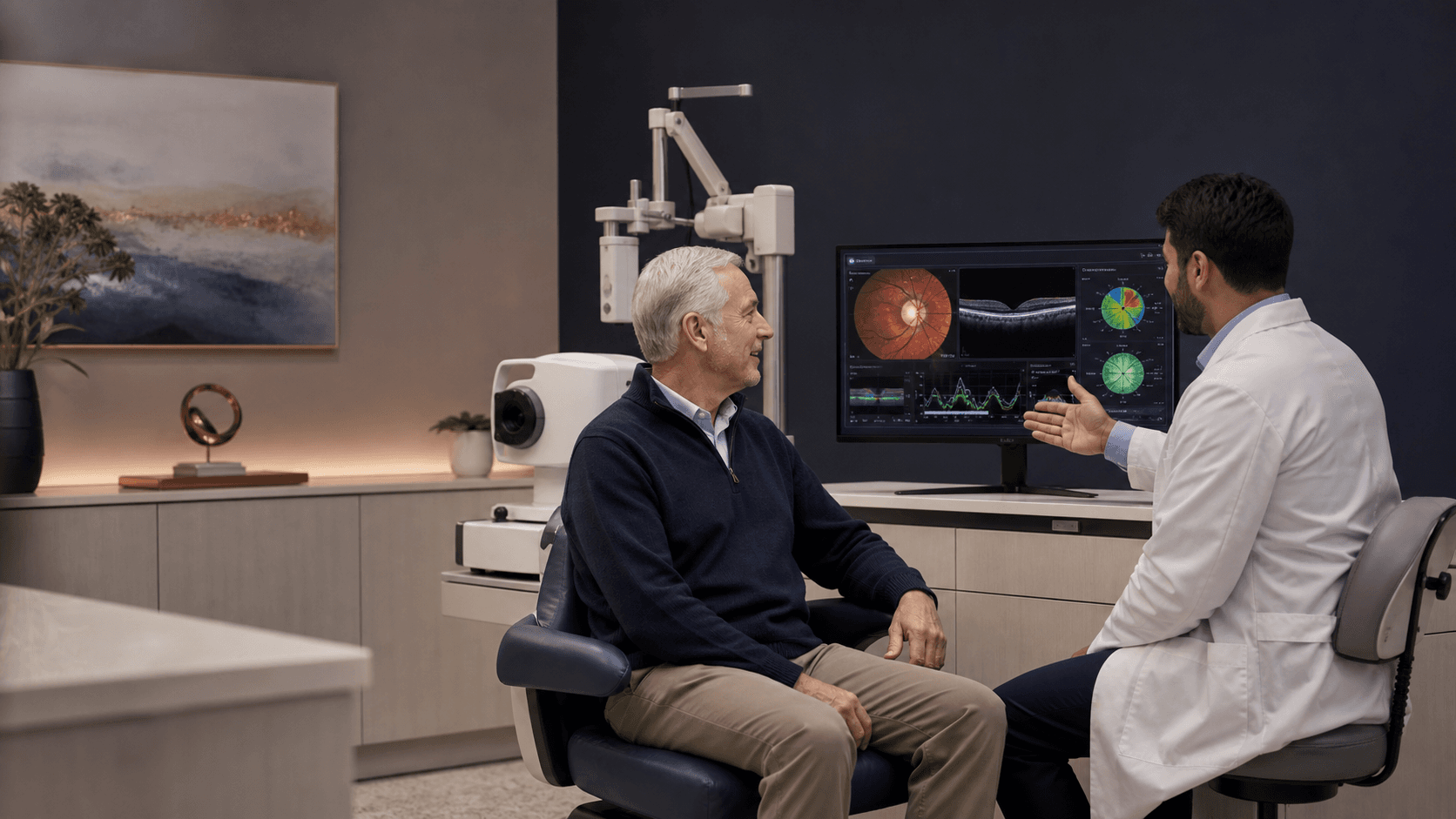
A useful glaucoma evaluation looks at:
- Your pressure history, not one isolated reading.
- OCT optic nerve imaging.
- Visual field testing.
- Corneal thickness.
- Drainage-angle anatomy.
- Cataract status.
- Current and prior glaucoma drops.
- Side effects, allergies, redness, and dry eye from drops.
- Family history and rate of change.
Two patients can both have pressure of 21 and need different plans. One may be stable with monitoring. Another may be losing visual field and need a lower target pressure quickly.
That is why a good glaucoma surgeon consultation starts with the pressure goal.
When drops may still be enough
Glaucoma drops are still useful for many patients.
Drops may be enough when:
- The optic nerve is stable.
- Visual fields are not worsening.
- Pressure is at or near the target.
- The patient can use drops reliably.
- The drops are tolerated without major redness, burning, allergy, or cost problems.
The downside is that glaucoma is long-term. A plan that depends on perfect daily drop use can fail if the drops irritate the eyes, are forgotten, become unaffordable, or are difficult to place correctly.
Where SLT laser fits
Selective laser trabeculoplasty, often called SLT, can help lower pressure by improving the eye's natural drainage function.
SLT may be discussed when:
- A patient wants to reduce drop dependence.
- Drops are causing irritation.
- Adherence is difficult.
- The eye has open-angle anatomy.
- The pressure goal is realistic for laser treatment.
SLT is not the same as MIGS. It is an in-office, no-incision laser procedure, not an implant or surgical drainage procedure. Some patients do well with SLT for a meaningful period. Others still need drops, MIGS, or another pressure-lowering step later. That is why a drop-reduction discussion should compare SLT, medication changes, sustained-release implants, and MIGS before jumping straight to surgery.
When MIGS should be discussed
MIGS stands for minimally invasive glaucoma surgery; some sources call the same category micro-invasive glaucoma surgery or M.I.G.S. It is a family of procedures designed to lower pressure with less tissue disruption than traditional glaucoma surgery.
MIGS may be worth discussing when:
- Drops are not controlling pressure well enough.
- Drops cause redness, burning, allergy, or surface disease.
- The schedule is hard to follow.
- There is mild-to-moderate open-angle glaucoma.
- Cataract surgery is already being planned.
- The pressure target fits what MIGS can reasonably achieve.
- The drainage angle anatomy is appropriate.
At Visionary Eye Surgery, MIGS options include iStent, Hydrus Microstent, goniotomy, canaloplasty, Durysta, and iDose TR.
These do not all work the same way. Some improve drainage through glaucoma stents or angle-based treatment. Some deliver medication inside the eye. Some are commonly paired with cataract surgery. The correct choice depends on anatomy, pressure goal, medication burden, and cataract timing.
Cataract timing can change the plan
Many MIGS procedures are often combined with cataract surgery because the eye is already being treated surgically.
That can make sense when:
- Cataracts are affecting vision.
- Glaucoma is mild to moderate.
- The drainage angle is open.
- The pressure goal fits a MIGS-level intervention.
- The patient wants to reduce drops after cataract surgery.
Combined cataract and MIGS surgery can reduce the number of procedures and may reduce medication burden. But cataract timing should not be forced just to access MIGS. The cataract and glaucoma plan should both make sense.
Where Durysta and iDose fit
Durysta and iDose TR are medication-delivery options placed inside the eye.
They may fit patients whose main issue is daily drop burden, drop intolerance, or adherence. They still require careful testing.
Durysta is a biodegradable bimatoprost implant designed to release medication for about 3 to 4 months and is currently limited to a single implant per eye without retreatment. iDose TR is a travoprost intracameral implant approved for open-angle glaucoma or ocular hypertension, with official patient information describing pressure control shown up to 3 years. Corneal endothelial testing and routine monitoring are built into candidacy and readministration decisions.
That means these are not casual convenience procedures. They are medical options for pressure control when the eye fits the safety profile.
When traditional glaucoma surgery is still needed
MIGS is not the answer for every glaucoma patient.
Traditional glaucoma surgery may be needed when:
- Glaucoma is advanced.
- The target pressure must be very low.
- Visual fields are worsening despite treatment.
- Prior MIGS, laser, or drops have not worked.
- The anatomy does not fit MIGS.
- The surgeon believes a stronger pressure-lowering procedure is safer for the optic nerve.
That can include procedures such as trabeculectomy, tube shunt surgery, or other glaucoma operations. These are more intensive than MIGS, but they still matter for patients whose glaucoma needs stronger pressure control.
When another glaucoma review may help
A second opinion is reasonable when the reason for surgery, pressure target, evidence of progression, or choice between drops, SLT, MIGS, and traditional surgery is unclear. Bring your pressure history, medication list, OCT scans, visual fields, cataract notes, and prior surgical records so the review can compare evidence over time. Our dedicated glaucoma second-opinion guide explains which records and tests matter and what the visit should answer.
How to compare glaucoma surgery options in Texas
Many glaucoma surgery conversations in Texas list the same procedures: drops, selective laser trabeculoplasty, SLT, iStent, Hydrus, canaloplasty, goniotomy, Durysta, iDose, trabeculectomy, and tube shunts. The gap is usually not the device list; it is whether the plan explains which pressure problem each option is meant to solve.
The consultation that helps most is the one that explains the decision order:
- First, confirm the diagnosis and pressure trend.
- Then compare OCT, visual field, corneal thickness, and drainage-angle findings.
- Then decide whether the problem is pressure level, drop adherence, drop irritation, cataract timing, or advanced disease.
- Then choose monitoring, drops, SLT, sustained-release medication, MIGS, cataract-combined treatment, or traditional glaucoma surgery referral.
A confident recommendation should explain why the optic nerve needs intervention now and what would make a less invasive option insufficient.
Sources and clinical references
- Glaucoma surgery overview - National Eye Institute
- Hydrus Microstent FDA Summary of Safety and Effectiveness Data
These sources support general clinical context. A target pressure and treatment plan require examination and review of pressure, OCT, and visual-field history.
Related resources
- MIGS glaucoma surgery
- Glaucoma specialist in Plano
- Book glaucoma evaluation
- Glaucoma overview
- Glaucoma exam guide
- MIGS vs glaucoma drops
- Glaucoma second-opinion guide
- MIGS recovery timeline
Bottom line
You may need glaucoma surgery if pressure is not at target, the optic nerve is changing, visual fields are worsening, drops are not tolerated, or cataract timing creates an opportunity for a combined MIGS plan.
You may not need surgery yet if pressure is controlled, the optic nerve is stable, and drops or laser are working.
The safest answer comes from a pressure-goal evaluation, not from choosing a device name online.
Start with our MIGS glaucoma surgery page, compare MIGS vs glaucoma drops, review the glaucoma specialist in Plano page, or prepare for a glaucoma second opinion if your pressure, drops, or cataract timing are unclear.
Your exam can clarify which options fit your eyes. Visit our Plano team from anywhere in DFW.
Book a free visit