If you have cataracts and glaucoma, the timing question matters.
Many patients first hear about MIGS when cataract surgery is being planned. That can be confusing. Are you having cataract surgery? Glaucoma surgery? Both? Do you need an implant? Is this a way to stop drops?
This guide focuses on one narrow decision: can MIGS be done with cataract surgery in Plano, and when should that be discussed? For Texas patients traveling for a second opinion, the same decision depends on cataract status, glaucoma stage, pressure goal, and whether prior records support a clustered Plano visit.
For the main pressure-lowering procedure path, start with our MIGS glaucoma surgery page. If your diagnosis or pressure goal is still unclear, start with the glaucoma specialist in Plano page. If your first issue is cloudy vision, review premium cataract surgery in Plano.
Why cataract timing changes the MIGS conversation
Cataract surgery removes the cloudy natural lens and replaces it with an intraocular lens.
MIGS, or minimally invasive glaucoma surgery, is designed to lower eye pressure with less tissue disruption than traditional glaucoma surgery. Some MIGS procedures are commonly considered at the same time as cataract surgery because the eye is already being treated surgically.
That does not mean every cataract patient with glaucoma needs MIGS.
It means cataract timing creates a practical moment to ask:
- Is the glaucoma mild or moderate?
- Is the angle open enough for angle-based MIGS?
- Is the optic nerve stable or changing?
- What pressure goal are we trying to reach?
- How many drops are being used now?
- Are drops causing redness, allergy, dry eye, or cost problems?
- Would cataract surgery alone likely lower pressure enough?
- Would a combined plan reduce future medication burden?
The answer depends on testing, not on the device name.
Who may fit combined cataract and MIGS
Combined cataract and MIGS may be discussed when a patient has visually significant cataracts plus open-angle glaucoma or ocular hypertension where the pressure goal fits a minimally invasive option.
It may be more relevant when:
- Daily drops are difficult to use consistently.
- Drops cause burning, allergy, redness, or ocular surface disease.
- Pressure is close to goal but still needs help.
- The optic nerve or visual field needs better protection.
- Cataract surgery is already appropriate based on vision symptoms.
- The drainage angle anatomy supports the procedure being considered.
This is often where iStent, Hydrus, goniotomy, canaloplasty, or other angle-based options enter the discussion.
It is not the right path for every eye. Advanced glaucoma, very low target pressure, narrow or scarred angle anatomy, or rapidly worsening visual fields may require a different plan.
iStent vs Hydrus vs goniotomy vs canaloplasty
Patients often ask which MIGS device is best. The better question is which drainage problem the eye has and what pressure goal is realistic.
iStent places tiny stents into the eye's natural drainage pathway. Hydrus Microstent also works through the natural drainage system and scaffolds a portion of Schlemm's canal.
Goniotomy opens part of the trabecular meshwork without leaving a permanent stent. Canaloplasty is designed to improve flow through the canal system.
These are not interchangeable just because they are all called MIGS. Candidacy depends on drainage angle anatomy, disease stage, cataract timing, medication burden, and the pressure target.
Why iStent and Hydrus are often tied to cataract surgery
iStent and Hydrus are the names many patients hear first because they are commonly discussed during cataract planning.
That timing matters for two reasons.
First, cataract surgery already uses a tiny clear-corneal incision. For appropriate open-angle glaucoma patients, an angle-based MIGS step can often be added through that surgical access instead of creating a separate outside-eye incision.
Second, iStent and Hydrus are designed for a milder-to-moderate pressure goal. They are not meant to replace every glaucoma operation. Hydrus is an 8 mm microstent that scaffolds Schlemm's canal and helps fluid reach more of the natural drainage system. iStent creates a microscopic bypass into the drainage pathway. Goniotomy and canaloplasty use a no-permanent-stent approach for selected eyes.
The advantage is not just convenience. By working inside the eye and avoiding conjunctival tissue disruption, cataract-combined MIGS may preserve future glaucoma-surgery options if the disease ever needs stronger pressure lowering later.
The limitation is equally important. If the optic nerve needs a very low target pressure, if the angle anatomy is not suitable, or if visual fields are worsening quickly, MIGS may not be strong enough. In that situation, adding a small device during cataract surgery can be the wrong move, and referral-level glaucoma surgery should be discussed instead.
Where Durysta and iDose fit
Durysta and iDose TR are different from angle surgery.
They are medication-delivery options placed inside the eye for selected open-angle glaucoma or ocular hypertension patients. These may be discussed when the main problem is drop burden, drop intolerance, or adherence rather than cataract timing alone.
Some patients need a drainage procedure. Some need a medication-delivery strategy. Some need drops, SLT laser, cataract surgery alone, or referral-level glaucoma surgery. The exam should separate those paths.
When drops, SLT, or medication delivery may be better
Not every glaucoma patient with cataracts needs a drainage procedure.
If the main problem is missed drops, redness, burning, allergies, dexterity, or cost, the best next step may be a cleaner drop plan, SLT laser, Durysta, or iDose TR rather than iStent or Hydrus. Durysta and iDose are medication-delivery options placed inside the eye for selected open-angle glaucoma or ocular hypertension patients. They belong in the conversation when the eye responds to medication but the daily-drop routine is failing.
That is why the cataract visit should ask two separate questions: does the drainage system need help, and does the medication routine need help? The answers can point to different treatments.
When cataract surgery alone may be enough
Cataract surgery by itself can sometimes lower eye pressure modestly, especially in certain eye anatomy patterns.
That may be enough when glaucoma risk is low, pressure is already close to target, visual fields are stable, and drop burden is manageable. It may not be enough when the optic nerve is changing, pressure needs to be substantially lower, or daily drops are failing.
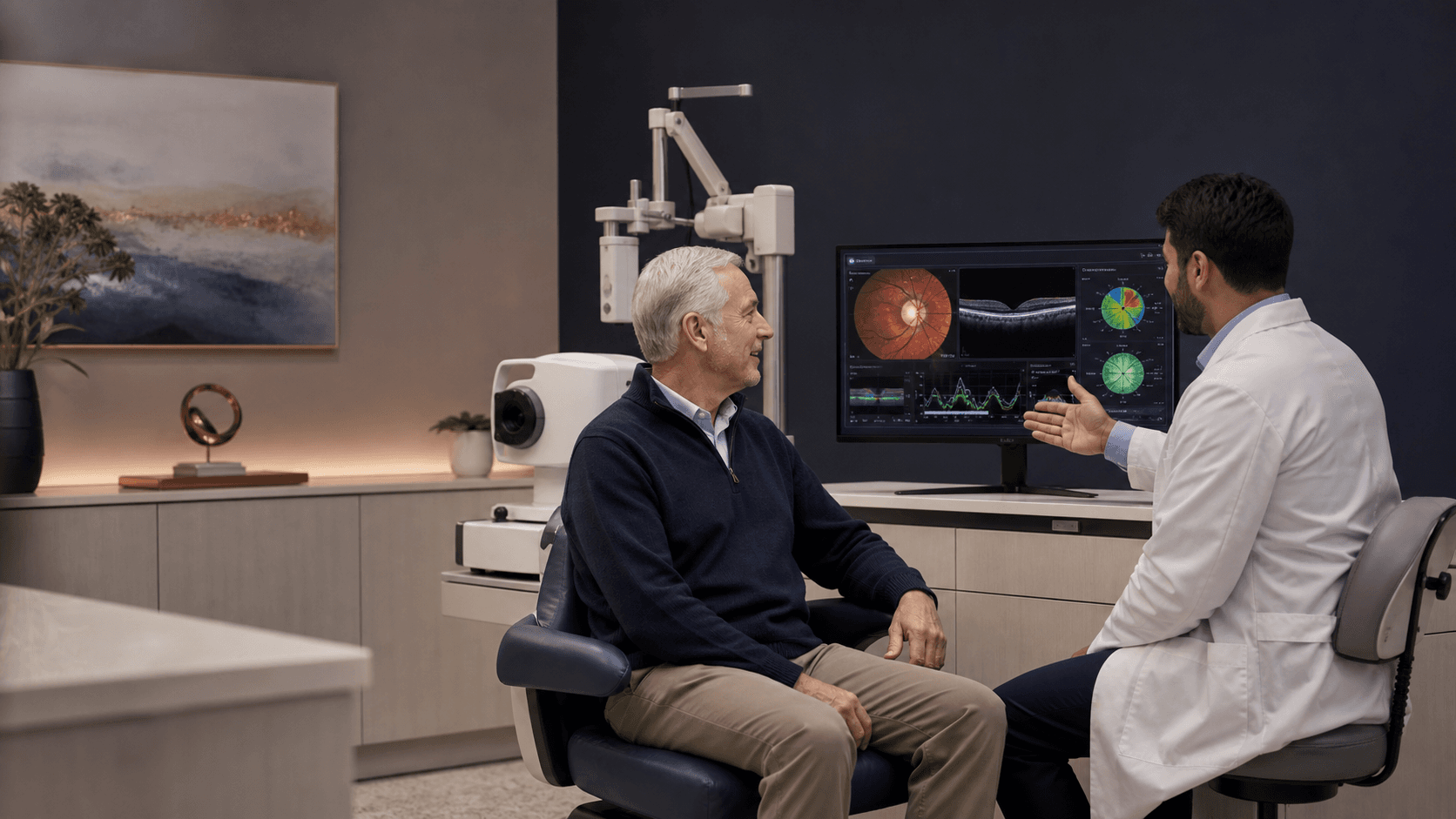
This is why a cataract consultation for a glaucoma patient should not only discuss lens choices. It should review pressure history, OCT, visual fields, corneal thickness, drainage angle, current medications, and the target pressure.
Questions to ask before combined surgery
Before agreeing to combined cataract and MIGS surgery, ask:
- What is my target pressure?
- Is my glaucoma mild, moderate, or advanced?
- Is my angle open enough for this MIGS option?
- What are we expecting cataract surgery alone to do?
- What are we expecting MIGS to add?
- Which drops might I still need after surgery?
- What would make traditional glaucoma surgery more appropriate?
- How will the premium cataract lens decision affect the glaucoma plan?
- What is covered by insurance and what is out of pocket?
Good answers should be specific to your eye.
Sources and clinical references
- Glaucoma surgery overview - National Eye Institute
- Hydrus Microstent FDA Summary of Safety and Effectiveness Data
These sources support general clinical context. Device eligibility and cataract timing require an individual examination.
Related resources
- MIGS glaucoma surgery
- MIGS device overview
- Hydrus Microstent
- iStent
- Glaucoma specialist in Plano
- Dallas MIGS glaucoma surgery guide
Bottom line
MIGS can often be discussed when cataract surgery is already being planned, but it should not be added casually.
The decision depends on glaucoma stage, pressure goal, drainage angle anatomy, medication burden, cataract timing, and whether a minimally invasive procedure is likely to protect the optic nerve enough.
Start with MIGS glaucoma surgery in Plano, review glaucoma specialist care, or compare premium cataract surgery if cloudy vision is part of the same decision.
Your exam can clarify which options fit your eyes. Visit our Plano team from anywhere in DFW.
Book a free visit