If your upper lids look heavier than they used to, the first question is usually not "which procedure should I book?"
The better starting point is this: is the concern cosmetic eyelid skin, true eyelid droop, brow position, under-eye fullness, dry eye, or something affecting vision?
For the focused service page, start with ZipLyft cosmetic eyelid rejuvenation. If your main symptoms are burning, watering, redness, crusting, or fluctuating vision, start with dry eye treatment or IPL eye treatment instead.
What patients usually mean by an eyelid lift
People use "eyelid lift" to describe several different concerns:
- Hooded upper lids that make the eyes look tired.
- Extra upper-lid skin that sits on the lashes.
- Under-eye bags or lower-lid fullness.
- A low brow that pushes skin downward.
- True ptosis, where the eyelid muscle does not lift the lid well.
- Red, irritated eyelids that make the eyes look swollen.
- Heavy lids that interfere with peripheral vision.
Those concerns can look similar in a selfie. They can require very different plans.
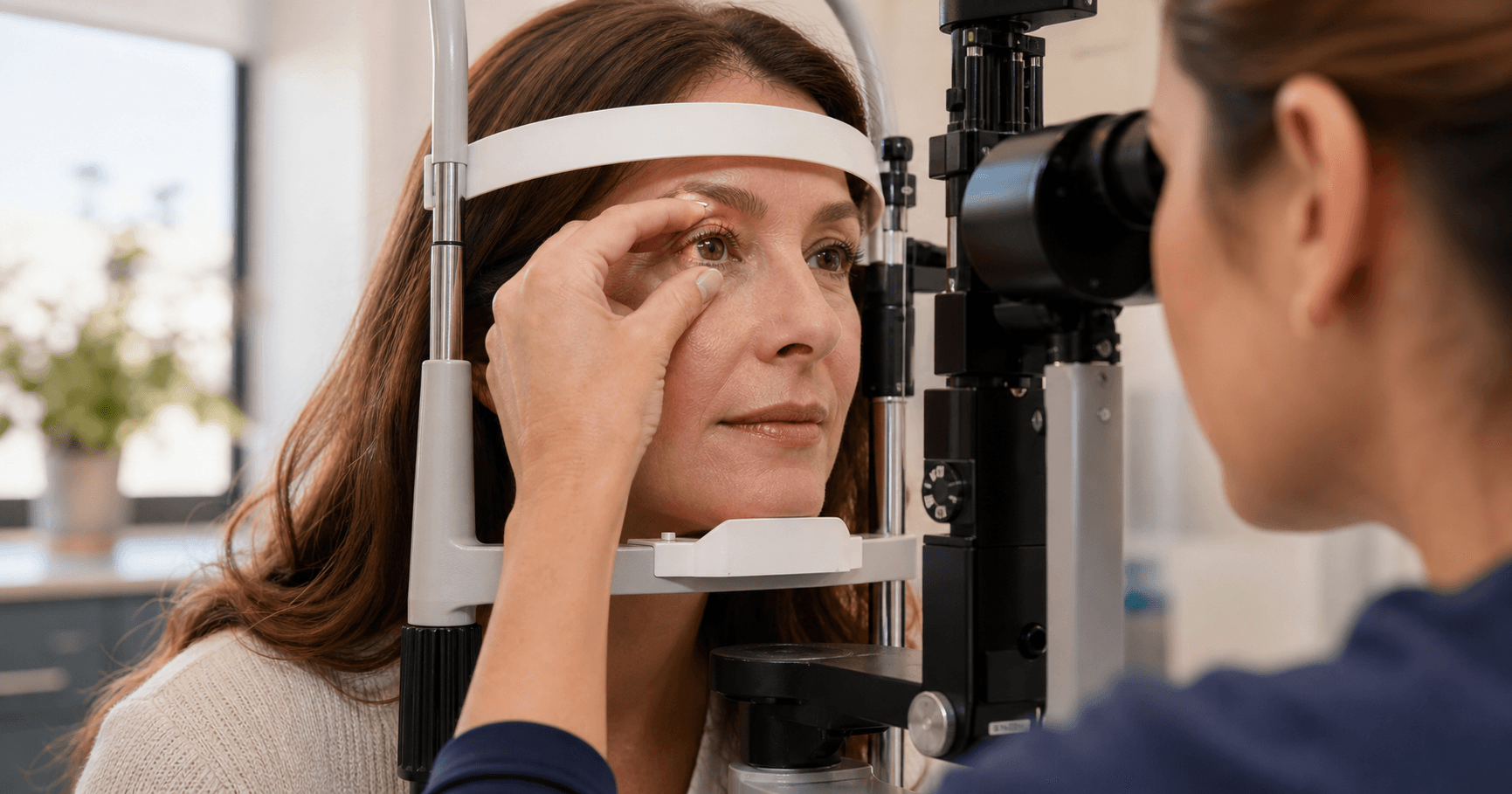
That is why a cosmetic eyelid consultation should look at eyelid skin, brow position, lid height, lash position, tear-film comfort, dry eye history, contact lens tolerance, prior eye surgery, and whether the concern is cosmetic, functional, or both.
What the consultation should document
A serious eyelid lift consultation should not start and end with a photo comparison.
It should document:
- Whether the concern is upper-lid skin, true ptosis, brow descent, lower-lid fullness, or eyelid inflammation.
- Whether the patient wants cosmetic refresh, functional vision-field improvement, or both.
- Whether dry eye, blepharitis, MGD, ocular rosacea, contact lens intolerance, or prior eye surgery changes timing.
- Whether external photos, lid measurements, or visual-field testing are needed because the concern may be functional rather than cosmetic.
- Whether ZipLyft, traditional blepharoplasty, ptosis repair, brow evaluation, dry-eye treatment, or no procedure is the right next step.
That documentation matters because the consult is not just about a procedure name. It is about separating eyelid appearance from medical eyelid disease, tear-film safety, and vision-correction timing.
Where ZipLyft fits
ZipLyft is presented at Visionary Eye as a cosmetic eyelid rejuvenation option. It is separate from SMILE LASIK, LASIK, EVO ICL, cataract surgery, and dry-eye treatment.
The most natural ZipLyft conversation is usually about upper-lid skin and a refreshed appearance. During consultation, Dr. Shehz reviews whether the eyelid anatomy, eye surface, medical history, and cosmetic goals match what ZipLyft is designed to address.
ZipLyft may be discussed when a patient wants:
- A cosmetic upper-lid refresh.
- Evaluation for tired-looking or hooded upper lids.
- A physician-led alternative conversation before traditional blepharoplasty.
- Clear separation between eyelid appearance and vision-correction planning.
- An explanation of expected recovery, limits, and alternatives before deciding.
It is not something to choose from a photo alone. A patient with active eyelid inflammation, significant dry eye, true ptosis, brow descent, or lower-lid fat concerns may need a different sequence or a different type of eyelid evaluation.
What ZipLyft should not be asked to solve
ZipLyft should stay in the cosmetic eyelid rejuvenation lane.
It is not the best first page when:
- Burning, crusting, redness, or fluctuating vision suggests blepharitis, MGD, or dry eye.
- The eyelid margin itself sits low over the pupil, which raises a ptosis question.
- The brow has dropped and is pushing skin downward.
- Lower-lid bags, laxity, or tear-trough concerns are the main issue.
- The patient needs insurance-style visual-field documentation for functional eyelid surgery.
Those distinctions keep ZipLyft, dry-eye care, and traditional eyelid-surgery information clear for patients. The right first step depends on the anatomy and the symptom, not the closest-sounding phrase.
Where blepharoplasty fits
Blepharoplasty is the traditional surgical eyelid lift category. It can involve removal or repositioning of eyelid skin, muscle, or fat depending on the eyelid and the surgeon's plan.
Upper blepharoplasty is commonly discussed for extra upper-lid skin. Lower blepharoplasty is commonly discussed for under-eye bags or lower-lid fullness. Functional eyelid surgery may be considered when lid position or excess tissue affects the field of vision, though that requires different documentation and exam testing than purely cosmetic treatment.
Traditional blepharoplasty may be a better discussion when:
- The upper lid skin is severe or extends beyond a skin-only cosmetic concern.
- The lower lids have fat bags, laxity, or structural issues.
- There is true ptosis rather than simple skin redundancy.
- Brow position is a major driver of the heavy-lid appearance.
- The eyelid concern affects vision, not only appearance.
- A revision or reconstructive eyelid issue is present.
Visionary Eye does not need every patient to force their concern into one label. The point of the consult is to decide whether ZipLyft, a traditional eyelid-surgery referral, dry-eye care, lid inflammation treatment, or no procedure is the right fit.
ZipLyft vs blepharoplasty: the practical comparison
| Question | ZipLyft conversation | Blepharoplasty conversation |
|---|---|---|
| Main concern | Cosmetic upper-lid rejuvenation | Upper lids, lower lids, functional or structural eyelid issues |
| Planning focus | Skin pattern, lid anatomy, eye comfort, cosmetic goals | Skin, fat, lid position, brow support, ocular surface, functional symptoms |
| Treatment category | Cosmetic eyelid rejuvenation | Traditional eyelid surgery category |
| Best starting point | ZipLyft consultation | Eyelid surgery evaluation or oculoplastic/plastic surgery discussion |
| When to slow down | Dry eye, lid inflammation, unrealistic goals, unclear anatomy | Dry eye, exposure risk, ptosis, brow descent, medical complexity |
The comparison is not "new versus old." It is "which eyelid problem are we actually solving?"
Do eyelid concerns affect LASIK, EVO ICL, or cataract planning?
Cosmetic eyelid rejuvenation and vision correction are separate services, but the eye surface connects them.
If the lids are inflamed, the oil glands are blocked, or the tear film is unstable, measurements for LASIK, PRK, EVO ICL, or cataract surgery may need to wait until the surface is calmer. This is especially important for patients with burning, fluctuating vision, contact lens intolerance, rosacea, blepharitis, or meibomian gland dysfunction.
If your main goal is to reduce glasses or contacts, start with LASIK, EVO ICL, PRK, and SMILE comparison. If your main goal is a fresher eyelid appearance, start with ZipLyft. If both are on your mind, the exam can help decide sequence.
Questions to bring to the consult
Bring a few specific questions rather than trying to self-diagnose from online photos.
- Is my issue extra upper-lid skin, true ptosis, brow position, or lower-lid fullness?
- Is this cosmetic, functional, or both?
- Do I have dry eye, blepharitis, MGD, or ocular rosacea that should be treated first?
- Would ZipLyft address my concern, or should I compare traditional blepharoplasty?
- What changes should I realistically expect?
- What recovery limits matter for work, exercise, makeup, and social events?
- Should eyelid treatment happen before or after LASIK, EVO ICL, or cataract planning?
Those answers are more useful than a generic before-and-after gallery because they connect the plan to your anatomy.
Sources and clinical references
- Eyelid surgery (blepharoplasty) overview - American Society of Plastic Surgeons
- Upper eyelid blepharoplasty clinical overview - American Academy of Ophthalmology EyeWiki
These sources describe traditional blepharoplasty. ZipLyft candidacy and expected results require a practice-specific consultation and ocular-surface examination.
Related resources
- ZipLyft procedure page
- IPL eye treatment
- blepharitis treatment guide
- Dry Eye Clinic in Plano
- LASIK, EVO ICL, PRK, and SMILE comparison
Bottom line
ZipLyft and blepharoplasty belong in the same conversation only when the real concern is eyelid appearance. They are not interchangeable, and neither should be chosen before an eyelid and ocular-surface evaluation.
At Visionary Eye in Plano, the ZipLyft consultation is designed to answer a focused question: whether cosmetic eyelid rejuvenation fits your anatomy, eye comfort, goals, and timing. If another next step is more appropriate, the visit should make that clear before you commit to treatment.
Your exam can clarify which options fit your eyes. Visit our Plano team from anywhere in DFW.
Book a free visit