Few things are more frustrating than finally deciding to get LASIK, working up the courage to schedule a consultation, and then hearing: “You are not a candidate.”
If that happened to you, I want you to know two things. First, the doctor who told you that was probably right to be cautious. LASIK has specific requirements, and not every eye meets them. Second, not being a candidate for LASIK does not mean you are out of options. It means you need a surgeon who knows all the options.
Why Some People Do Not Qualify for LASIK
The most common reasons include thin corneas, very high prescriptions, dry eye conditions, or corneal irregularities. LASIK reshapes the cornea with a laser, and there has to be enough healthy tissue to work with. If there is not, the procedure carries more risk than benefit.
If "corneal irregularities" means suspected keratoconus, progressive thinning, or ectasia risk, the next step should be a keratoconus evaluation, CXL timing review, or broader cornea surgeon evaluation, not simply choosing another elective vision-correction procedure.
That is where the conversation should start, not end.
What LASIK Eligibility Should Measure
LASIK eligibility in Plano should not be decided from your glasses prescription alone. A careful evaluation should explain which measurement created the concern.
A serious LASIK candidate exam should include:
- Refraction and prescription stability.
- Corneal thickness with pachymetry.
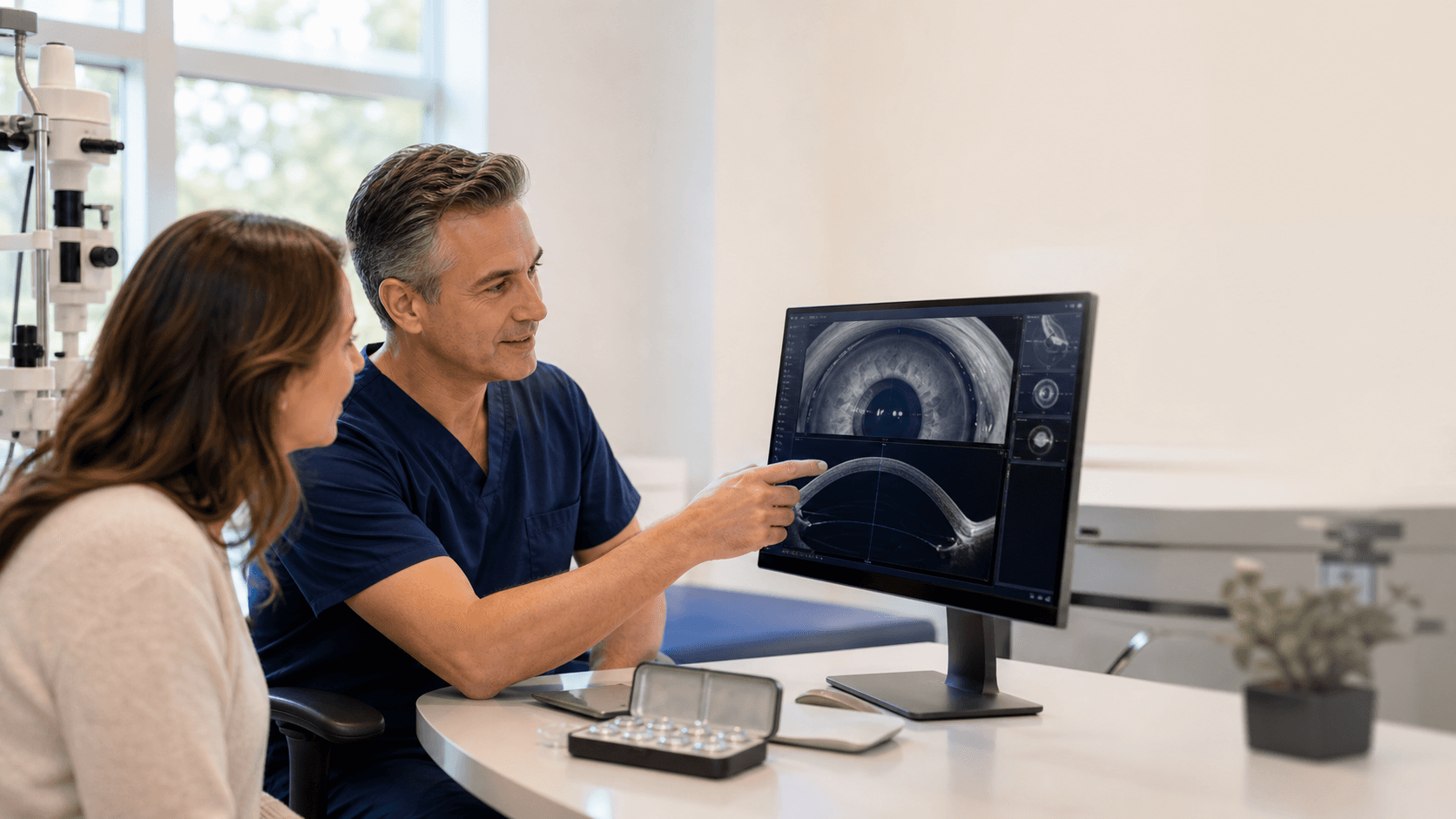
- Corneal topography and tomography to screen for irregular shape or early keratoconus.
- Tear-film and dry-eye evaluation.
- Pupil size and night-vision discussion.
- Retina and optic nerve review when the prescription is high.
- Age, presbyopia, and early lens-change discussion.
- Occupation, contact sports, military, or first-responder risk.
- A comparison of LASIK, SMILE, ASA/PRK, EVO ICL, and lens-based options.
If the answer is simply "you are not a candidate" without the reason, you do not have enough information. The next step depends on whether the issue is corneal thickness, prescription strength, dry eye, irregular maps, age, or something inside the eye.
The Reason You Were Told No Matters
Different "no" answers point to different next steps.
| Why LASIK may not fit | What it may mean | Next direction |
|---|---|---|
| Thin corneas | LASIK would remove too much tissue or leave too little reserve | ASA/PRK, EVO ICL, or no elective corneal laser |
| High prescription | Laser correction may require too much corneal tissue | EVO ICL or PRK vs EVO comparison |
| Dry eye or MGD | LASIK may worsen symptoms or measurements may be unstable | Dry-eye treatment first, then compare LASIK, SMILE, PRK, or EVO ICL |
| Irregular topography | Early keratoconus or ectasia risk may be present | Keratoconus evaluation, CXL timing review, or cornea specialist visit |
| Large pupils or night-vision risk | Glare/halo risk needs to be discussed before surgery | More detailed counseling or a different procedure |
| Age 40+ with near-vision symptoms | Presbyopia or lens changes may be driving the problem | LASIK vs RLE or custom lens replacement discussion |
That is why a second opinion should not be a second sales pitch. It should be a second measurement-based explanation.
EVO ICL: The Implantable Contact Lens
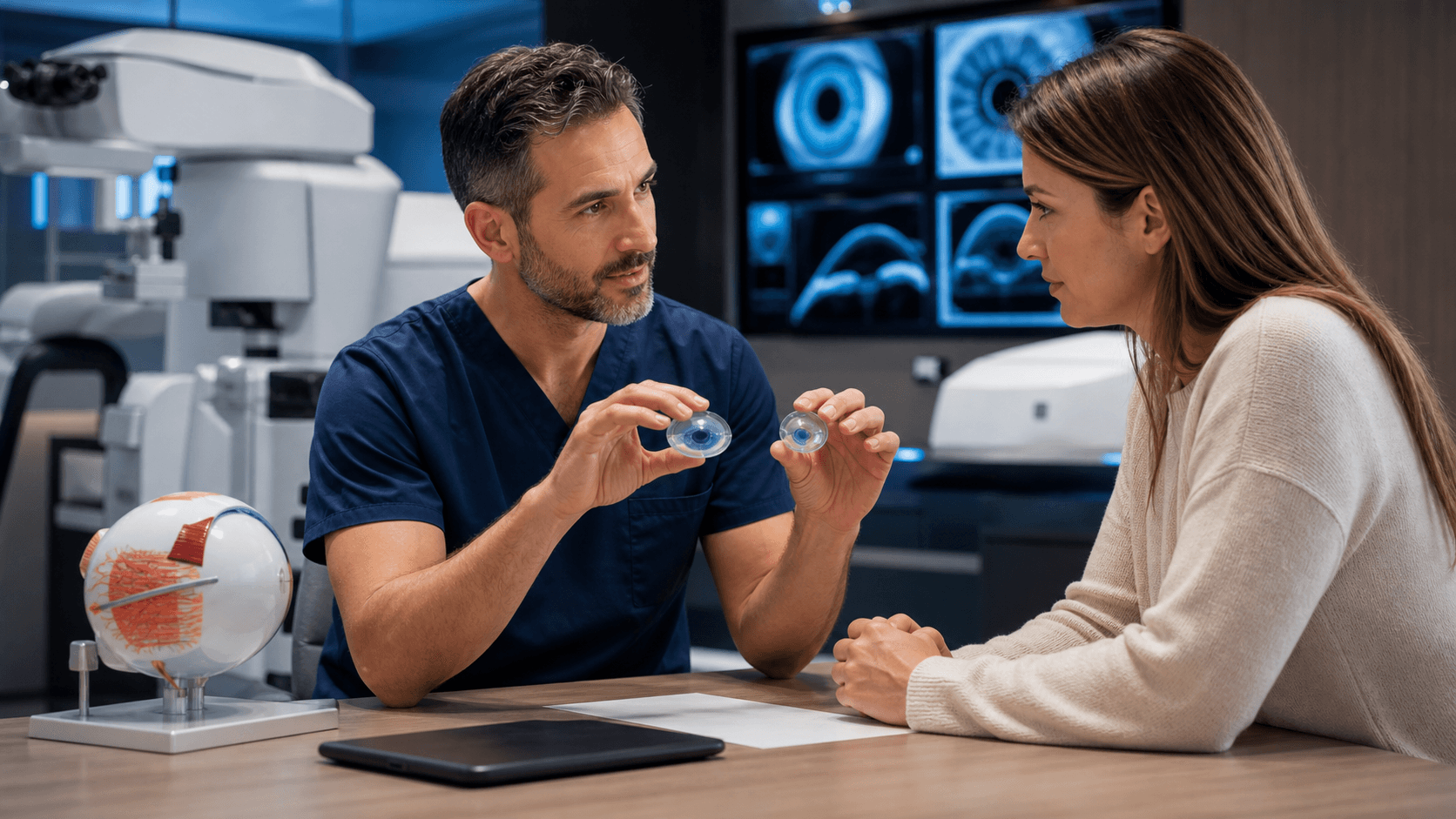
For patients with high prescriptions or thin corneas, the EVO ICL is often a strong alternative. Instead of reshaping the cornea, we place a tiny biocompatible lens inside the eye, between the iris and the natural lens. It corrects vision without removing any corneal tissue.
The procedure is efficient, recovery is often fast, and the lens can be removed or exchanged if needed. For many patients who were told LASIK was off the table, ICL can offer a tissue-sparing path to clearer distance vision.
EVO ICL tends to enter the conversation when the issue is high myopia, thin corneas, dry-eye sensitivity, or a desire to avoid corneal tissue removal. It still requires internal measurements: anterior chamber depth, angle anatomy, endothelial health, lens sizing, prescription stability, and retina review. If your first question was LASIK eligibility Plano but the exam points toward high myopia, the EVO ICL page is the better next guide.
SMILE eye surgery: The Flapless Alternative
SMILE uses a single femtosecond laser to create a tiny lenticule inside the cornea, which is removed through a small incision. There is no LASIK flap, and some patients have less early dry-eye impact because less of the corneal surface is disrupted. For some borderline LASIK candidates, SMILE may be a better fit.
SMILE is not a catch-all substitute for LASIK. It has its own prescription range, corneal-shape requirements, and candidacy rules. Use the SMILE page when the question is small-incision laser correction; use the LASIK alternatives comparison when you are still sorting between SMILE, PRK, EVO ICL, and LASIK.
ASA/Advanced PRK: The Original Surface Treatment
PRK was the first laser vision correction procedure. It does not create a corneal flap at all. The recovery is longer than LASIK, typically a few days of discomfort and a week or two of visual fluctuation, but long-term outcomes can be strong for well-selected eyes. For some patients with thinner corneas, PRK can fit where LASIK does not.
ASA/Advanced PRK still removes corneal tissue, so the exam has to confirm the prescription is safe for a surface-laser plan. If the prescription is high enough that tissue preservation becomes the main concern, PRK vs EVO ICL may be the more honest comparison.
Before You Book Another Consultation
If you are getting a second opinion, bring your prescription history, contact-lens history, prior corneal maps if you have them, dry-eye treatment history, and any notes from the clinic that declined LASIK. Ask the surgeon to answer:
- What exact measurement makes LASIK less ideal?
- Is the issue safety, visual quality, recovery, or long-term fit?
- Would LASIK be reasonable if dry eye were treated first?
- Do my maps suggest keratoconus or another corneal stability issue?
- Is EVO ICL, SMILE, PRK, or RLE a better fit, and why?
- What would you recommend if these were your eyes?
The strongest answer is not always "yes." Sometimes the safest recommendation is to treat dry eye first, monitor corneal stability, or avoid elective surgery for now.
Related resources
- LASIK evaluation and eligibility page
- Thin-cornea LASIK alternatives
- Keratoconus diagnosis and treatment planning
- Corneal cross-linking in Plano
- Cornea surgeon evaluation
- ASA / Advanced PRK
The Visionary Eye Approach
At our Plano office, we do not specialize in one procedure and try to fit every patient into it. We offer LASIK, SMILE, EVO ICL, PRK, and Custom Lens Replacement. That means when you sit in my consultation room, I am not trying to sell you a specific surgery. I am trying to find the right solution for your specific eyes.
If you have been turned away before, come get a second opinion. The answer might be different now. It might also be the same answer with a better explanation. Either way, you should leave understanding why LASIK fits, why it does not, or which alternative protects your eyes better.
Keep Reading
→ EVO ICL: What It Is, How It Works, and Who It Is For
→ Can I Get LASIK with a Thin Cornea?
→ LASIK vs. SMILE: How to Know Which Is Right
→ ASA/Advanced PRK at Visionary Eye
Medically Reviewed by Dr. Shehz, DO
Dr. Shehzad Batliwala, DO—better known as Dr. Shehz—is a board-certified ophthalmologist and eye surgeon who brings both technical precision and genuine compassion to every patient he treats.
Explore this content with AI
Open this article in your preferred AI assistant for a plain-English summary, action steps, and questions to ask before booking a consultation.
Want a direct answer about your eyes? A complimentary consultation gives you a clear, written recommendation.