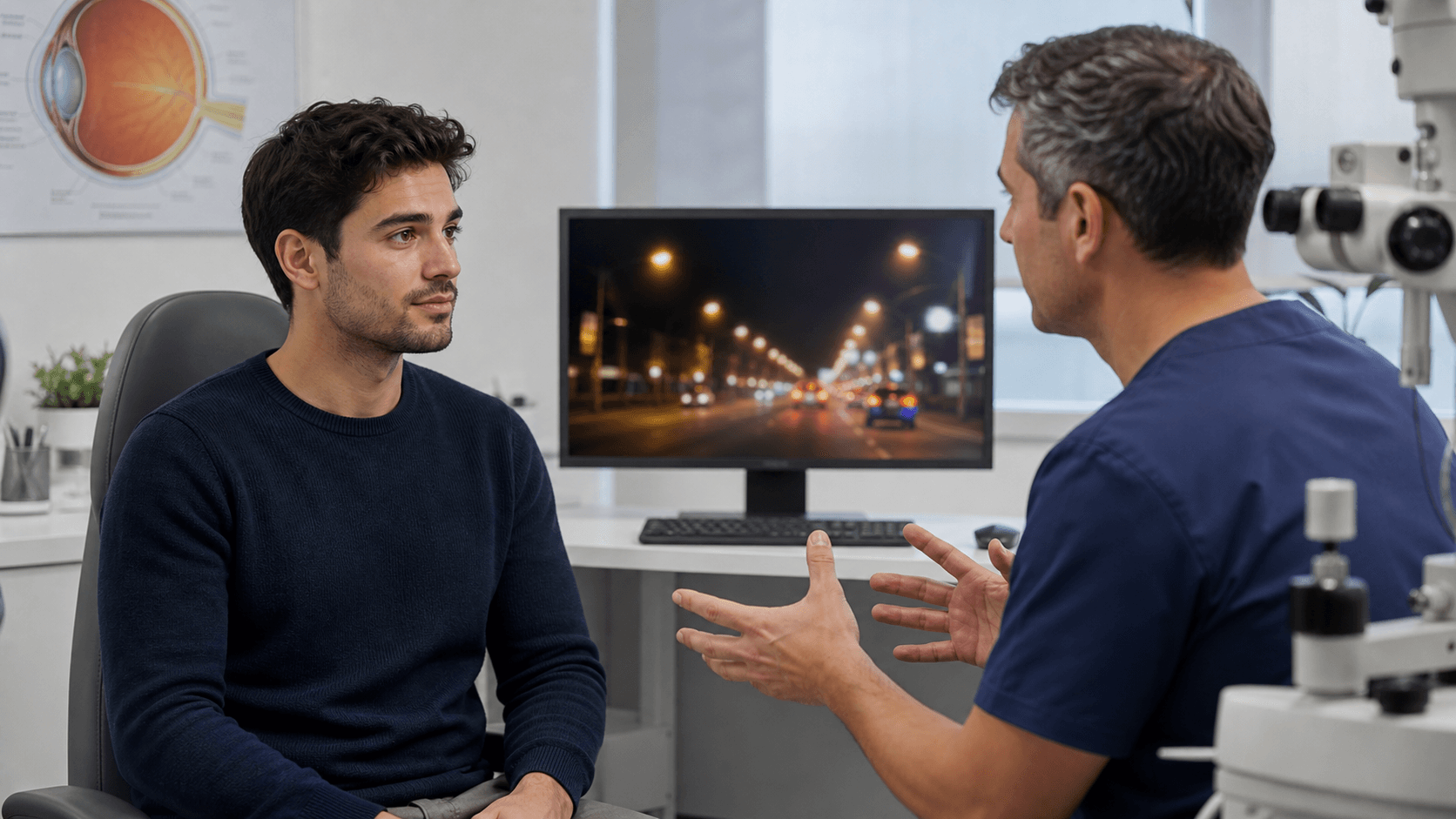
A remaining prescription after SMILE can sometimes be treated, but an enhancement is not automatic and is not simply a repeat of the original operation. The surgeon first needs to identify why vision is not meeting your needs and whether another procedure would offer more benefit than risk.
This guide answers the retreatment question. The SMILE procedure page covers the original operation, while the SMILE recovery guide addresses expected healing rather than a decision to operate again.
Does blurry vision mean SMILE needs an enhancement?
Not necessarily. Fluctuating tear-film quality, healing, a remaining prescription, and other eye conditions can produce different kinds of blur. Near-vision difficulty that appears with age is also different from an uncorrected distance prescription. A procedure aimed at one cause will not automatically fix another.
Describe the task that is difficult: reading a sign, using a monitor, or seeing well in dim light. Explain whether the problem is constant or changes through the day. Bring any glasses that improve it. This gives the surgeon a starting point for assessing the complaint rather than treating an eye-chart number in isolation.
If you develop sudden deterioration, significant pain, redness, new flashes, or a curtain in your vision, seek prompt eye care. Those symptoms should not be treated as a routine enhancement request.
What must be checked before more laser treatment?
A reassessment may include repeated refraction, corneal shape and thickness, the prior treatment parameters, and an examination of the ocular surface. The remaining tissue and the stability of the measurements matter. The team also needs to check whether glasses actually improve the symptom that bothers you.
Bring the original operative report and preoperative and postoperative measurements if another clinic performed your SMILE. Ask the original office how records can be transferred. A new consultation is more useful when the clinician can review the treatment history rather than rely on your memory of the prescription.
The US ZEISS SMILE FAQ describes enhancement selection as dependent on factors including residual correction and remaining corneal tissue. A fixed deadline alone does not establish that another treatment is appropriate.
Which enhancement approaches might be discussed?
Surface laser treatment, such as PRK, is one approach described after SMILE. It involves a different recovery process from the original small-incision procedure. Other published approaches involve creating or converting to a flap before additional laser correction. Suitability, equipment, regulatory status, and surgeon experience must be considered for the specific proposed treatment.
The ZEISS clinical discussion of enhancement approaches describes surface ablation and CIRCLE techniques. It is an international clinical discussion, not a statement that every method is available or approved for every US patient. This article does not claim that Visionary offers each technique.
Ask the surgeon to name the exact proposed procedure, explain why it fits the prior SMILE treatment, and discuss whether its use is on-label or off-label. Also ask how the new recovery and risks differ from the first operation. Our PRK page explains surface treatment, but it cannot determine whether PRK is suitable for a previously treated eye.
When is avoiding another operation reasonable?
Glasses, suitable contact lenses, treatment of an ocular-surface problem, or continued observation may be preferable to more surgery. A small prescription can be inconvenient without making enhancement the right tradeoff. Conversely, a modest measured error may matter greatly for a particular task.
Ask what improvement is realistically expected and what symptoms may remain. More laser treatment should not be presented as a guaranteed solution for glare, halos, or every kind of blur. Review the existing SMILE risk guide and request an explanation specific to retreatment.
What should patients traveling across DFW arrange?
Someone returning from Frisco, Dallas, or Fort Worth should confirm whether the visit is a reassessment only, whether dilation or additional testing is expected, and whether more than one set of measurements may be needed. Do not plan a same-day enhancement simply because you have traveled to the appointment.
Visionary Eye Surgery's practice is in Plano. Before making repeated trips, ask who will review your outside records, where any proposed treatment would occur, and how follow-up and urgent concerns would be handled. Do not assume that your original clinic's enhancement policy applies at a different practice.
Which questions should be answered in writing?
Leave with the diagnosis behind the symptoms, the proposed treatment or observation plan, and an explanation of the main tradeoffs. Ask what fees include, whether medications and follow-ups are separate, and what happens if the result still falls short.
An enhancement policy is not a promise that every patient can safely have another operation. Its timing, eligibility conditions, and exclusions need to be understood before scheduling. Contact the team to ask about a records-based reassessment, rather than choosing a procedure name before an examination.
Keep Reading
Explore this content with AI
Open this article in your preferred AI assistant for a plain-English summary, action steps, and questions to ask before booking a consultation.
Want a direct answer about your eyes? A complimentary consultation gives you a clear, written recommendation.