Choosing Between LASIK, PRK, SMILE, EVO ICL, and RLE in Texas
If you’re comparing vision correction surgery in Plano, Frisco, Allen, McKinney, Dallas-Fort Worth, or elsewhere in Texas, you’ve probably discovered something overwhelming: there are dozens of procedures, hundreds of surgeons, and countless claims about who offers the “best” LASIK, custom lens replacement, or cataract surgery.
The Cookie-Cutter Problem in Modern Refractive Surgery
Here’s what most people don’t realize: Your eyes are as unique as your fingerprint. Yet many high-volume refractive surgery centers in Texas treat vision correction like an assembly line. Same procedure, same lens, different patient.
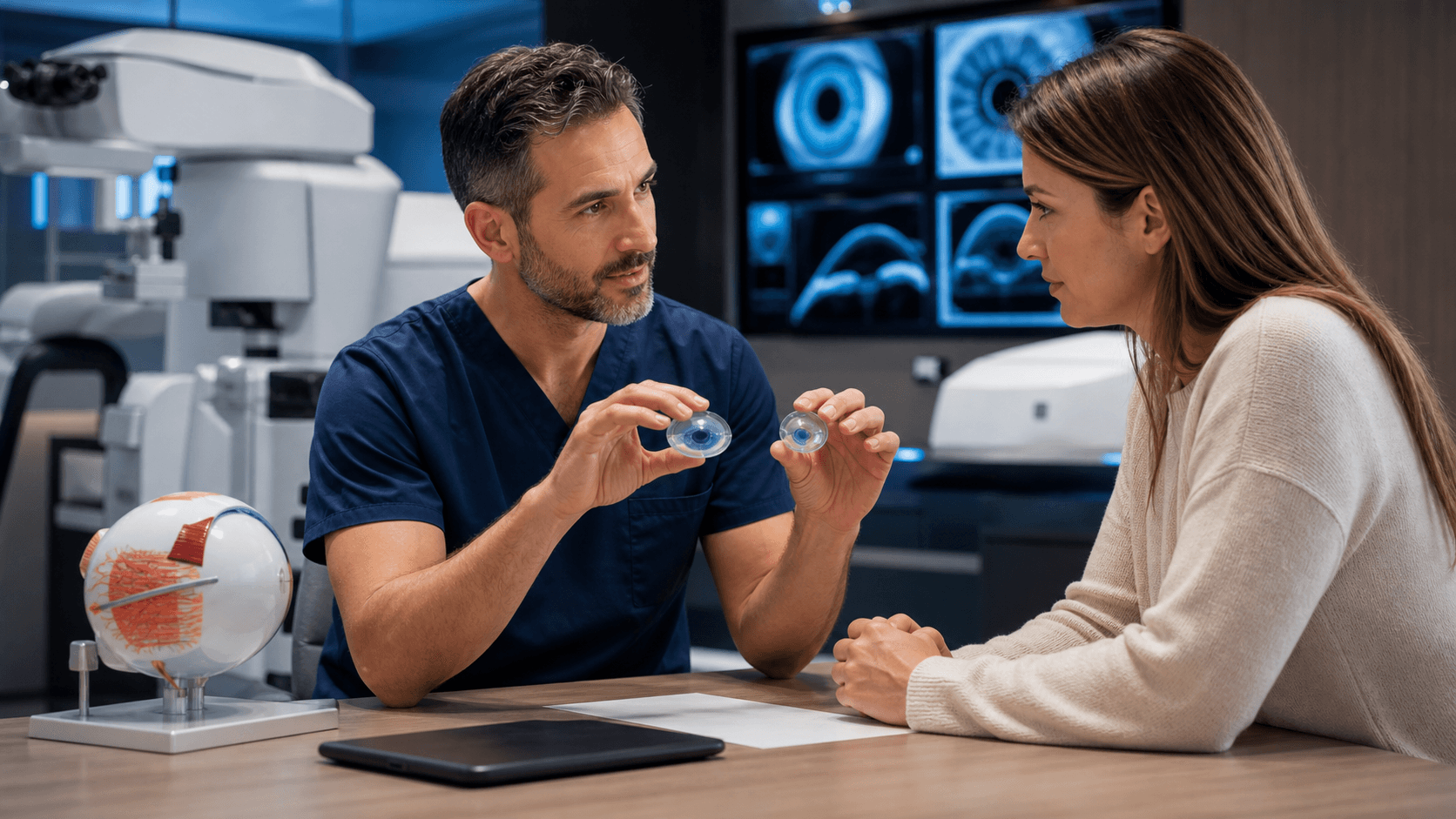
At Visionary Eye in Plano, we reject the cookie-cutter approach. Whether you’re considering LASIK, PRK, ICL (Implantable Collamer Lens), CLR (Clear Lens Replacement), RLE (Refractive Lens Exchange), or custom cataract surgery, the real question isn’t “What’s the best procedure?”-it’s “What’s the best procedure for your eyes?”
The 3 Non-Negotiables When Choosing a Vision Correction Surgeon in North Texas
1. Board Certification Through the World College of Refractive Surgery and Visual Sciences
Not all ophthalmologists are trained equally. When you’re entrusting someone with your vision, you want a surgeon who has pursued the highest level of specialized training in refractive surgery.
Board certification through the World College of Refractive Surgery and Visual Sciences represents a commitment to excellence that goes beyond basic ophthalmology training. This credential means your surgeon:
- Has completed rigorous advanced training specifically in laser vision correction, ICL surgery, and premium lens implantation
- Stays current with the latest innovations in LASIK technology, femtosecond laser techniques, and custom wavefront-guided treatments
- Adheres to the highest international standards for patient safety and surgical outcomes
When comparing surgeons, do not look only at convenience. Review the credentials and clinical experience that matter for the procedure you are considering.
2. Modern Diagnostic Technology: Topography, Tomography, and Biometry
Here’s where most refractive surgery consultations fall short: Inadequate diagnostics lead to suboptimal outcomes.
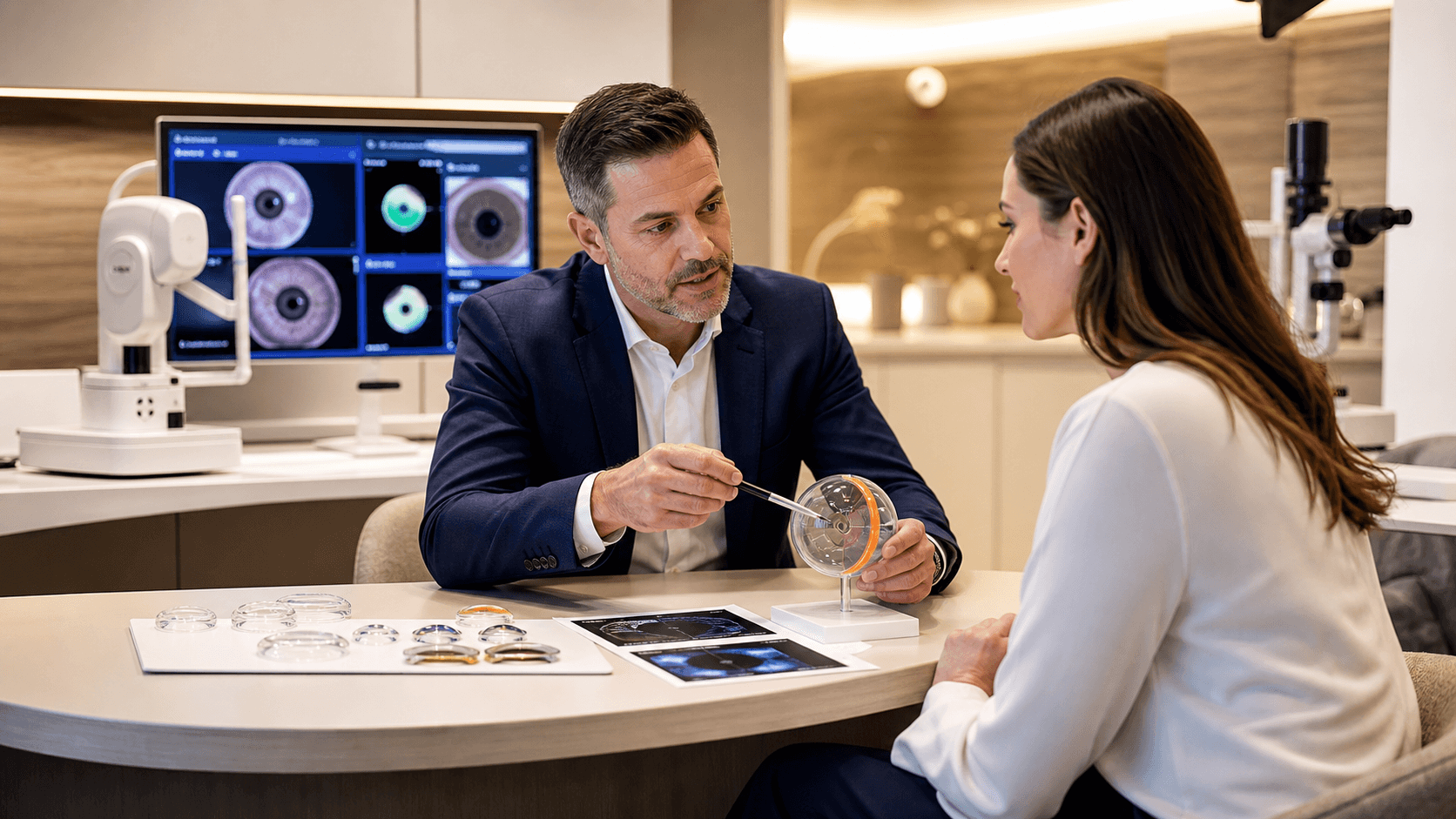
Before any vision correction procedure-whether it’s LASIK, PRK, or custom lens replacement-your surgeon needs a complete three-dimensional understanding of your eye.
Corneal Topography and Tomography
These advanced imaging systems create detailed maps of your cornea’s shape, thickness, and structural integrity. This technology is essential for:
- Detecting subtle irregularities that might disqualify you from LASIK but make you perfect for ICL
- Customizing femtosecond laser treatment patterns for wavefront-guided LASIK
- Identifying early keratoconus, ectasia risk, or other corneal conditions that may move the visit toward CXL, CTAK, specialty lenses, or monitoring
- Planning safe, precise PRK or SMILE procedures
Advanced Biometry
Precision biometry measures every aspect of your eye’s internal dimensions, critical for:
- Calculating the perfect power for ICL implants
- Selecting premium intraocular lenses (IOLs) for custom lens replacement or cataract surgery
- Achieving optimal outcomes with multifocal, extended depth of focus (EDOF), or toric lenses
- Planning RLE (refractive lens exchange) for high prescriptions
Comprehensive Eye Health Assessment
- Retinal health and macular integrity
- Glaucoma screening with OCT imaging
- Dry eye assessment (a major factor in LASIK candidacy)
- Pupil size and aberrometry for nighttime vision optimization
This isn’t about having fancy equipment-it’s about using the right tools to match the right procedure to your unique eyes.
If corneal maps show progressive steepening, corneal thinning, irregular astigmatism, or possible keratoconus, the next step is a cornea specialist evaluation in Plano, not elective LASIK planning. That step separates keratoconus treatment, CXL timing, CTAK candidacy, specialty lenses, and whether PRK, SMILE, EVO ICL, or no elective correction is safer.
3. A Surgeon Who Truly Understands How to Match Procedure to Patient
This is the art and science that separates exceptional refractive surgeons from the rest.
Having all the latest technology means nothing if your surgeon doesn’t have the experience and judgment to interpret the data and recommend the procedure that’s genuinely best for you-not just the one that’s most profitable or easiest to perform.
Your Complete Guide to Vision Correction Options in Plano, Texas
LASIK (Laser-Assisted In Situ Keratomileusis)
What it is: The most popular laser vision correction procedure, using a femtosecond laser to create a corneal flap, then reshaping the underlying tissue with an excimer laser.
Best for:
- Adults with stable prescriptions after refraction and eye health are reviewed
- Mild to moderate nearsightedness, farsightedness, or astigmatism
- Adequate corneal thickness
- No significant dry eye issues
- Active lifestyles requiring quick recovery
Available upgrades:
- Custom wavefront-guided LASIK for sharper night vision
- Topography-guided LASIK for irregular corneas
- All-laser “bladeless” LASIK with femtosecond laser
Recovery: Most patients see clearly within 24 hours and return to work the next day.
PRK (Photorefractive Keratectomy)
What it is: Surface laser treatment without creating a corneal flap-the original laser vision correction technique, now refined with modern technology.
Best for:
- Patients with thinner corneas not suitable for LASIK
- Active military, law enforcement, or contact sports athletes
- Patients with previous corneal issues
- Anyone who wants to avoid flap-related complications
Recovery: Slower than LASIK (3–5 days of mild discomfort, full visual recovery in 1–2 weeks), but ultimate outcomes are equivalent.
ICL (Implantable Collamer Lens) / EVO Visian ICL
What it is: A long-term, doctor-removable lens implanted behind your iris and in front of your natural lens-think of it as a “contact lens inside your eye.”
Best for:
- High prescriptions beyond the safe range for LASIK (−3.0 to −20.0 diopters)
- Patients with thin corneas or irregular corneal topography
- Adult patients whose age, prescription stability, anterior chamber depth, angle anatomy, endothelial health, and lens sizing fit current EVO ICL labeling and surgeon review
- Patients prioritizing optical quality while preserving corneal tissue
Why ICL is revolutionary: Unlike laser procedures that remove corneal tissue, ICL preserves your natural cornea.
Recovery: Typically one day, with minimal discomfort.
CLR/RLE (Clear Lens Replacement / Refractive Lens Exchange)
What it is: Replacing your natural lens with a premium intraocular lens (IOL).
Best for:
- Patients over 45 experiencing presbyopia
- High hyperopia not correctable with LASIK
- Patients who want to address both distance and near vision
- Anyone wanting to prevent future cataracts
Recovery: Most patients see well within days and achieve final vision within weeks.
Bottom line
The right procedure is not chosen from a menu. It is chosen from measurements: corneal thickness, corneal shape, prescription stability, tear film, age, and what your natural lens is already doing.
For most younger patients with healthy corneas, LASIK or SMILE is the starting conversation. For thin corneas, high prescriptions, or dry eye risk, PRK or EVO ICL may protect the eye better. For patients over 40 who are fighting readers, Custom Lens Replacement or RLE may solve a problem LASIK cannot.
Keep Reading
→ All Vision Correction Procedures in Texas
→ LASIK, EVO ICL, and PRK Comparison
→ How to Choose an EVO ICL Surgeon in Plano
→ EVO ICL Cost and Candidacy in Plano
Your exam can clarify which options fit your eyes. Visit our Plano team from anywhere in DFW.
Book a free visit