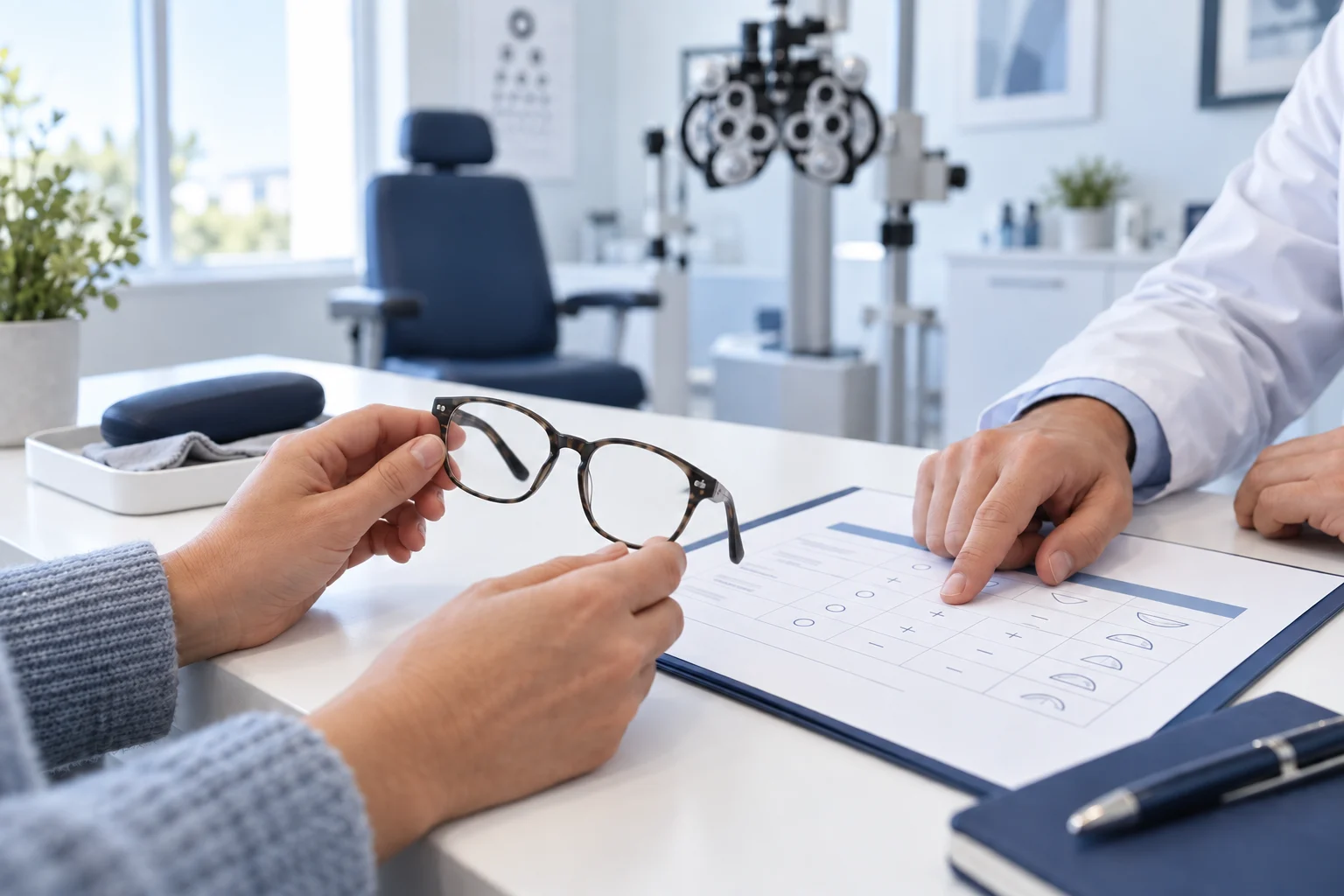
An eyeglass prescription describes the correction needed in a lens: SPH is spherical power, CYL is astigmatism correction, axis is its orientation, and ADD is extra power for near work when prescribed. Some prescriptions also include prism. These numbers describe optical correction, not the complete health of the eye or eligibility for surgery.
Reading the form can help you ask clearer questions at your next examination. It should not be used to diagnose a visual problem or change an existing prescription without your eye-care professional.
What do OD, OS, and SPH mean?
OD identifies the right eye and OS the left eye. Some forms use R and L instead; OU refers to both eyes. Check which row you are reading before comparing numbers.
SPH means sphere, measured in diopters. A minus value generally corrects nearsightedness, while a plus value generally corrects farsightedness. "Plano" or "PL" in the sphere column means zero spherical power, not that the prescription was written in Plano, Texas. A zero sphere can still appear alongside astigmatism correction.
The size of the number describes lens power, not how well the eye sees with the right correction. Two people with the same SPH value can have different visual acuity, symptoms, and eye-health findings. A larger number should prompt questions, not an assumption that the eye is unhealthy.
How do cylinder and axis describe astigmatism?
CYL is the amount of cylindrical correction. Axis, usually recorded from 1 to 180 degrees, specifies its orientation; it is not a severity score. An axis of 180 is not worse than an axis of 20.
Astigmatism often relates to unequal curvature in the cornea or lens. The familiar football analogy can help explain uneven focusing, but it does not mean the entire eye has that shape. A blank cylinder entry indicates that no cylindrical correction was specified on that prescription, not proof that every measurement of the eye is perfectly regular.
Prescriptions can be written in plus-cylinder or minus-cylinder notation. The same optical correction can look different after conversion, so do not compare CYL alone to decide whether your prescription changed. Ask the prescriber or optician to compare the complete values.
What do ADD and prism tell you?
ADD is extra plus power for a closer working distance, commonly used in bifocals or progressives. It often appears when age-related loss of near focusing, called presbyopia, becomes noticeable. It is not a diagnosis by itself, and an ADD value does not specify the entire design or fit of a progressive lens.
Prism is used for certain eye-alignment needs. It includes an amount and a base direction. Do not drop that part when entering a prescription or assume it is another astigmatism number. If the form includes unfamiliar abbreviations, have the dispensing professional confirm them.
For a broader discussion of age-related near vision, see our reading-glasses guide. This article explains the notation rather than choosing a treatment for presbyopia.
Can you show an example without diagnosing my eyes?
Consider a fictional right-eye entry of SPH -2.00, CYL -1.00, axis 180, with ADD +2.00. The first three values describe a distance correction with astigmatism; the ADD specifies additional near power. They do not tell you the corneal thickness, retinal health, visual acuity, or whether a particular operation is appropriate.
Use the example to locate the columns on your form, not to order a different prescription. If your glasses feel wrong, bring both the glasses and the prescription to the professional who supplied them. Lens manufacture, frame fit, adaptation, and the underlying examination may all need checking.
Is a glasses prescription the same as a contact-lens prescription?
No. Contact-lens prescribing also involves the fitted lens, including its dimensions and other product-specific information. Power may differ because a contact lens sits on the eye instead of in front of it. Do not copy a glasses prescription into a contact-lens order or substitute a product based only on its printed power.
Pupillary distance is a fitting measurement, not the same thing as SPH or axis. Ask the dispensing optician which measurements are needed for your frames and lens design. A photograph of your prescription alone may not include everything necessary for comfortable glasses.
What should you bring to a Plano eye examination?
Bring the current prescription, older prescriptions if available, the glasses you actually wear, and the contact-lens packaging if you use contacts. Add a short note about the task that is difficult: a monitor, small print, distance signs, or night driving. A timeline of symptoms is more useful than simply describing the numbers as "bad."
Patients coming from Richardson, Allen, or Dallas can ask whether dilation is planned and whether they should arrange a driver. Visionary Eye's comprehensive eye-care page explains the examination pathway at its Plano practice.
If you are considering vision correction, your prescription is only one part of candidacy. Our high-prescription guide addresses that separate question. Sudden vision loss, severe eye pain, or a new curtain in vision requires urgent assessment, not waiting for a routine glasses update.
Sources
National Eye Institute: refractive errors
American Academy of Ophthalmology EyeWiki: lens powers and lensometry
American Academy of Ophthalmology EyeWiki: contact lenses
This guide explains terminology and does not interpret an individual's prescription or recommend treatment.
Keep Reading
Is my prescription too high for LASIK?
Explore this content with AI
Open this article in your preferred AI assistant for a plain-English summary, action steps, and questions to ask before booking a consultation.
Want a direct answer about your eyes? A complimentary consultation gives you a clear, written recommendation.