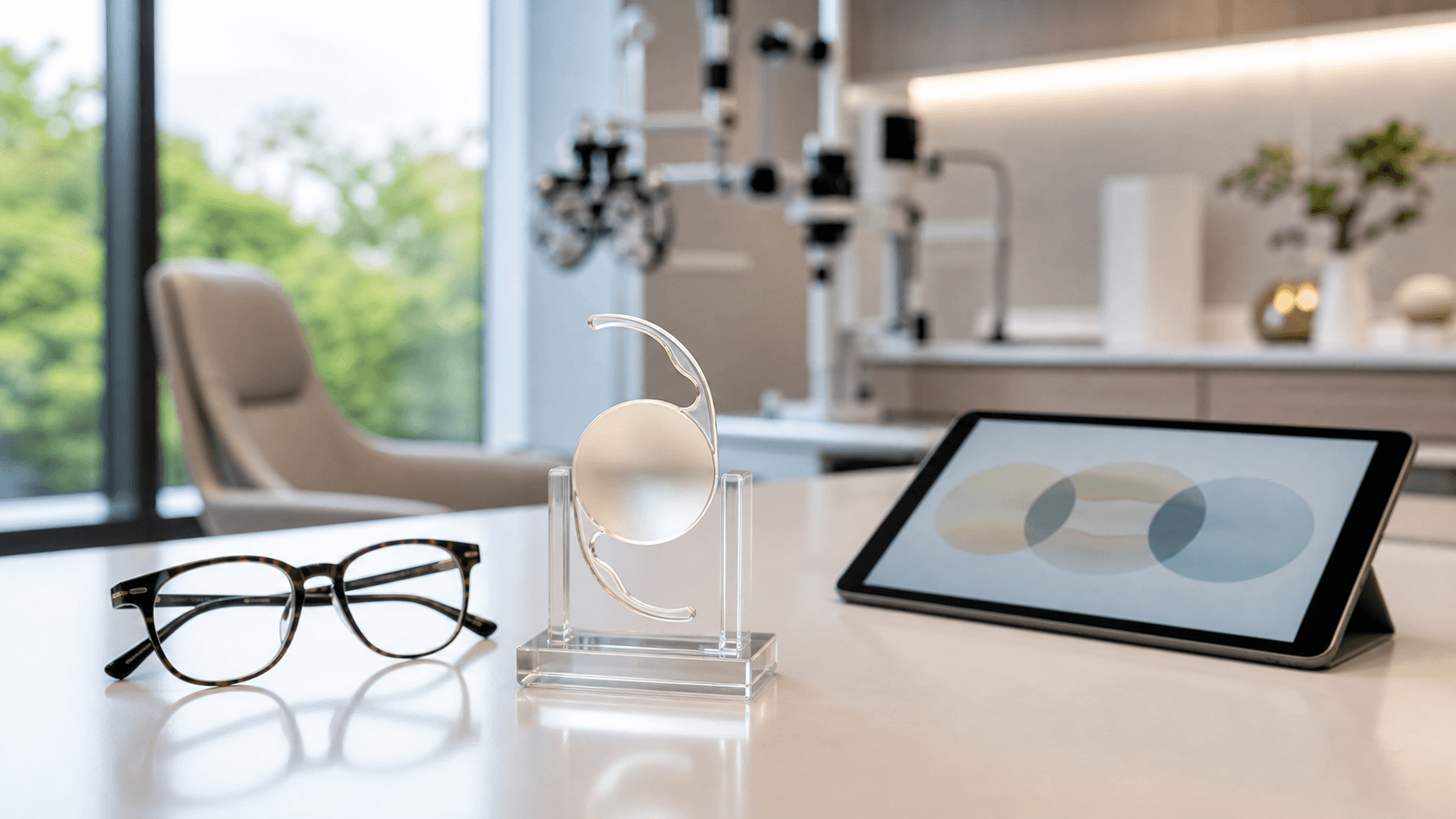
It happens to nearly everyone. Sometime around your early to mid-forties, you notice that your phone screen is getting harder to read. You start holding menus at arm’s length. You find yourself buying reading glasses at the drugstore, first one pair, then a pair for every room.
This is presbyopia. It is not a disease. It is the natural stiffening of the lens inside your eye that makes it harder to focus on close objects. By age 45, virtually everyone experiences it to some degree. By 50, reading without some form of correction becomes nearly impossible for most people.
The good news: you may not have to live in reading glasses for the next three decades. The right answer depends on whether the problem is mainly the aging lens, the cornea, or both.
What "stop wearing glasses" means after 40
The phrase can mean different things, so the next step should match the age and anatomy behind the frustration.
| What you mean | Usually start with |
|---|---|
| Readers, progressives, or phone and menu blur after 40 | Refractive Lens Exchange / Custom Lens Replacement |
| Distance blur in a younger adult | LASIK, SMILE, PRK, or EVO ICL comparison |
| Cataracts, glare, haze, or night-driving trouble | Advanced Cataract Surgery in Plano |
| Astigmatism plus readers after 40 | RLE consultation with toric, EDOF, multifocal, or light adjustable lens planning |
| You want the exam to decide | Book a lens replacement consultation |
What a complete RLE consultation should answer
Many RLE and custom lens replacement pages correctly mention age 40 or 45, presbyopia, LASIK non-candidacy, clear lens exchange, multifocal IOLs, and the fact that the removed natural lens cannot later become a cataract. Those points are useful, but they are still not enough to decide whether you should have surgery.
A complete consultation should answer a more specific set of questions:
- Is the frustration mainly readers, progressives, distance blur, contact lens intolerance, or cataract-related glare?
- Is the natural lens already stiffening, changing, or clouding enough to justify lens replacement?
- Is the cornea regular enough for toric IOL planning if astigmatism is part of the goal?
- Would LASIK, PRK, EVO ICL, monovision, or simply waiting be safer than RLE?
- Can the retina, optic nerve, tear film, and pupil behavior support multifocal, EDOF, light adjustable, or blended lens optics?
- What glasses may still be useful for fine print, dim restaurants, long screen sessions, or night driving?
- What part is elective refractive surgery versus medically timed cataract surgery, and how are cost, financing, FSA/HSA, and insurance handled?
That is the difference between a phrase like "no more readers" and a real plan for reducing glasses safely after 40.
How lens choices change the answer
Many pages about reading glasses after 40 focus on the promise of being glasses-free. The stronger question is which lens strategy fits your eyes, because each option solves a different part of presbyopia.
| Lens strategy | What it may help with | Tradeoff to discuss |
|---|---|---|
| Monofocal IOL | Crisp distance vision when readers are acceptable | Near work usually still needs glasses |
| Toric IOL | Regular astigmatism during RLE or cataract surgery | Only works when astigmatism is measurable and stable |
| Extended-depth-of-focus IOL | Distance and computer range with less reader dependence | Fine near print may still need help |
| Multifocal or trifocal IOL | Broader distance, intermediate, and near coverage | Halos, glare, and adaptation must be discussed honestly |
| Light adjustable lens | Fine-tuning lens power after surgery for selected eyes | Requires post-op light treatments and UV-protective glasses during the adjustment period |
The right answer is not always the most advanced lens. It is the lens that fits your measurements and the daily vision you care about most.
Why Reading Glasses Are a Band-Aid
Reading glasses correct the symptom, not the problem. They help you see up close by magnifying what is in front of you. But they do not address the aging lens inside your eye. And as presbyopia progresses, you need stronger and stronger readers. Eventually, many people end up in progressive lenses or bifocals, juggling multiple prescriptions for different distances.
Custom Lens Replacement: A Lens-Based Option
Custom lens replacement, also called refractive lens exchange or RLE, replaces the aging natural lens with a premium intraocular lens designed to provide clear vision at multiple distances: near, intermediate, and far.
The procedure is essentially the same as modern premium cataract surgery, but performed before a cataract fully develops. It takes about 15 to 20 minutes per eye, and most patients return to normal activities within a few days.
The premium lenses we use at Visionary Eye are designed to reduce dependence on glasses for many daily activities. Reading your phone, working on a computer, and driving can all be part of the lens plan when your eye anatomy supports it. Some patients still use readers for very fine print, dim lighting, or long near-work sessions.
This is also where astigmatism affects the RLE plan. A toric IOL can often treat regular astigmatism during lens replacement, while multifocal, EDOF, light adjustable, or blended lens choices address the range of vision. The consultation decides whether that combination is realistic for your cornea, retina, tear film, pupil behavior, and night-driving needs.
For Dallas and North Texas patients, use the main RLE page for procedure decisions. Use this guide for the reading-glasses education: why presbyopia happens, why readers keep getting stronger, when LASIK monovision is still reasonable, and when lens replacement deserves a closer look.
An Added Benefit: No Future Natural-Lens Cataract
Here is something most people do not realize. Once your natural lens is replaced with an artificial one, that removed lens cannot later become a cataract. That is one reason patients comparing presbyopia correction in Plano often ask about Custom Lens Replacement before cataracts are visually significant.
There is one nuance worth saying clearly: after any lens-replacement surgery, the clear membrane that holds the IOL can sometimes become hazy later. That is called posterior capsule opacification, not a new cataract, and it is usually treated with a quick YAG laser if it affects vision.
Is It Right for You?
Custom lens replacement is typically best suited for patients over 45 who are experiencing presbyopia and may also have early lens changes. It is also an excellent option for patients with high prescriptions who are not ideal candidates for All-Laser LASIK or ICL.
At Visionary Eye in Plano, we evaluate your complete visual system before making any recommendations. Some patients over 40 are still better served by LASIK or monovision correction. Others are good candidates for lens replacement. The right answer depends on your eyes, your lifestyle, and your goals.
If you are tired of reading glasses, a consultation should first identify what is causing the near-vision change and what tradeoffs you would accept. The answer may be monovision, custom lens replacement, cataract surgery, or simply waiting; LASIK and EVO ICL solve different problems and should only be considered when the measurements and visual goals support them.
Related resources
Your exam can clarify which options fit your eyes. Visit our Plano team from anywhere in DFW.
Book a free visit