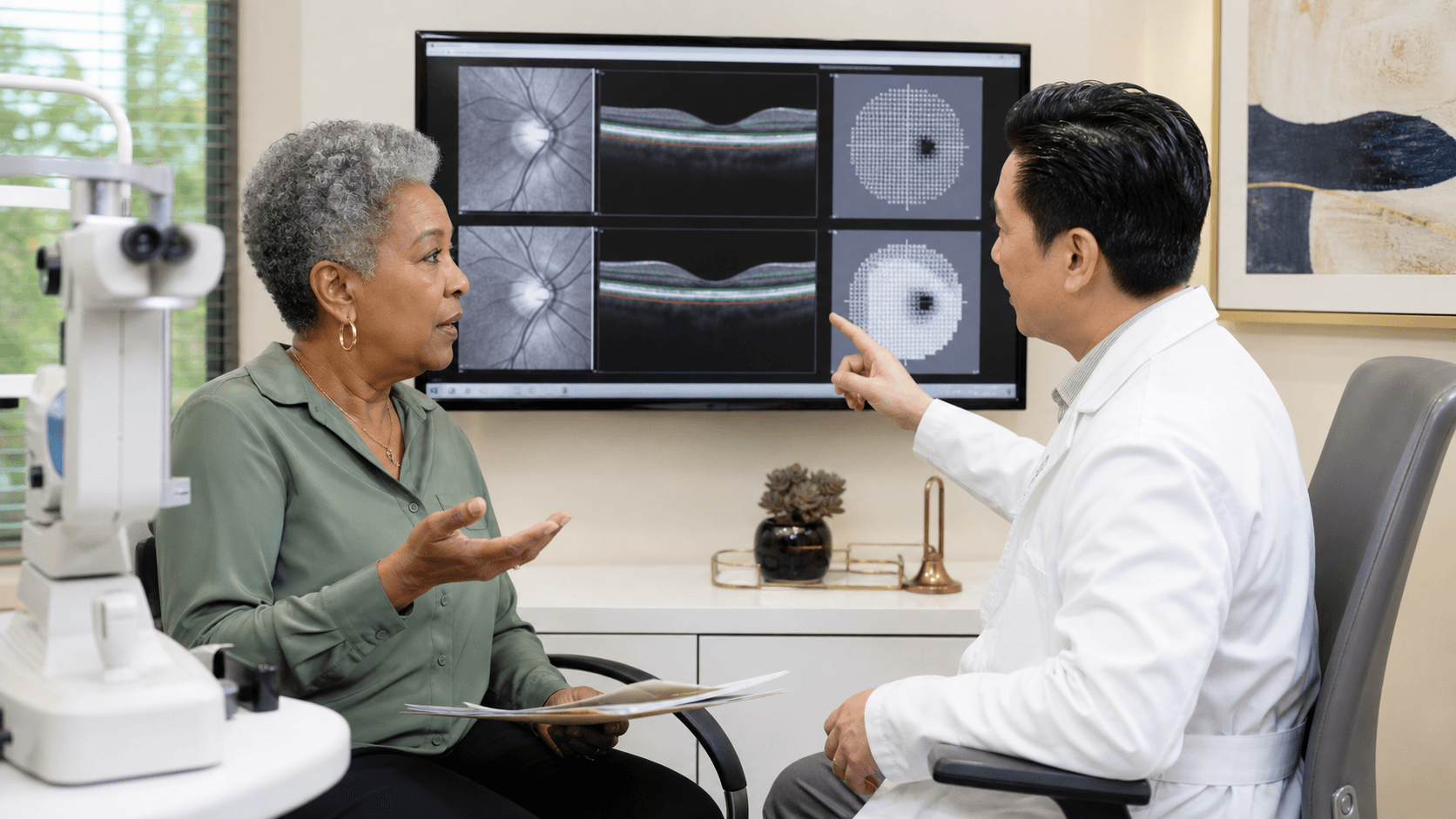
OCT images structures around the optic nerve; a visual-field test measures what you can see across the field of vision. Glaucoma care may use both because structural change and measurable vision loss do not always appear at the same time. Neither test, by itself, is a complete diagnosis or a reason to start surgery.
This is a guide to testing, not a substitute for the glaucoma evaluation page. If you were told you are a glaucoma suspect or have high eye pressure, the glaucoma suspect versus ocular hypertension guide explains those labels separately.
What does an OCT scan show?
Optical coherence tomography (OCT) uses light to make detailed cross-sectional images. For glaucoma, clinicians may examine the retinal nerve fiber layer, optic-nerve region, and other relevant tissue. A scan can help establish a baseline and show whether measurements change at later visits.
A color-coded printout is not a diagnosis. Image quality, eye anatomy, high myopia, and differences between scans can affect interpretation. Your clinician compares the scan with the optic-nerve examination, pressure, history, and prior images. A result marked outside a reference range can prompt a closer look without proving glaucoma on its own.
What does a visual-field test measure?
During standard automated perimetry, you look at a fixed point and respond when you notice lights in different locations. The test maps how sensitive different parts of your vision are, including areas you may not notice missing in daily life. It helps the clinician assess functional vision and look for change over time.
This test depends on your responses. Fatigue, blinking, dry eye, an unfamiliar test, or trouble keeping fixation can make a field less reliable. One unusual field may need repeating. Tell the technician if you need a pause or did not understand the instructions; an accurate result is more useful than rushing through it.
Why can the two results disagree?
OCT looks at tissue structure; the field test looks at visual function. Changes in one can appear before a clear change in the other. Scan artifacts and test variability can also create apparent disagreement. The question is whether the overall pattern makes sense for your eye, especially when compared with previous results.
Your doctor may also measure eye pressure, examine the drainage angle, check corneal thickness, and look directly at the optic nerve. The National Eye Institute's glaucoma guidance describes a comprehensive examination rather than reliance on a single screening number.
Do normal tests mean you can skip follow-up?
Not always. A person may need monitoring because of optic-nerve appearance, pressure, family history, or another risk factor even when one test looks normal. Conversely, an abnormal-looking printout may not mean treatment is needed. The schedule depends on the clinician's assessment and whether the findings are stable or changing.
Ask which finding is being watched, how reliable the baseline tests were, and what change would alter the plan. If you are considering a glaucoma second opinion, bring the actual OCT scans and visual-field printouts, not just a note saying they were “normal” or “abnormal.”
When does testing lead to a treatment discussion?
Treatment decisions consider the risk of future vision loss, documented damage or progression, eye pressure, and the patient as a whole. Drops, selective laser trabeculoplasty (SLT), and surgery address pressure in different ways; they do not replace the need to understand the testing. Our SLT versus drops guide begins only after the diagnostic question is clear.
Visionary Eye Surgery evaluates glaucoma at its Plano office. For patients traveling from Dallas, Frisco, McKinney, or elsewhere in DFW, ask whether old test results can be sent ahead and which follow-up visits must be in person. A useful visit should end with a plain-language explanation of what the tests showed and what happens next.
Sources
- National Eye Institute: detection of glaucoma
- American Academy of Ophthalmology EyeWiki: standard automated perimetry
- American Academy of Ophthalmology EyeWiki: OCT in glaucoma
Keep Reading
Your exam can clarify which options fit your eyes. Visit our Plano team from anywhere in DFW.
Book a free visit