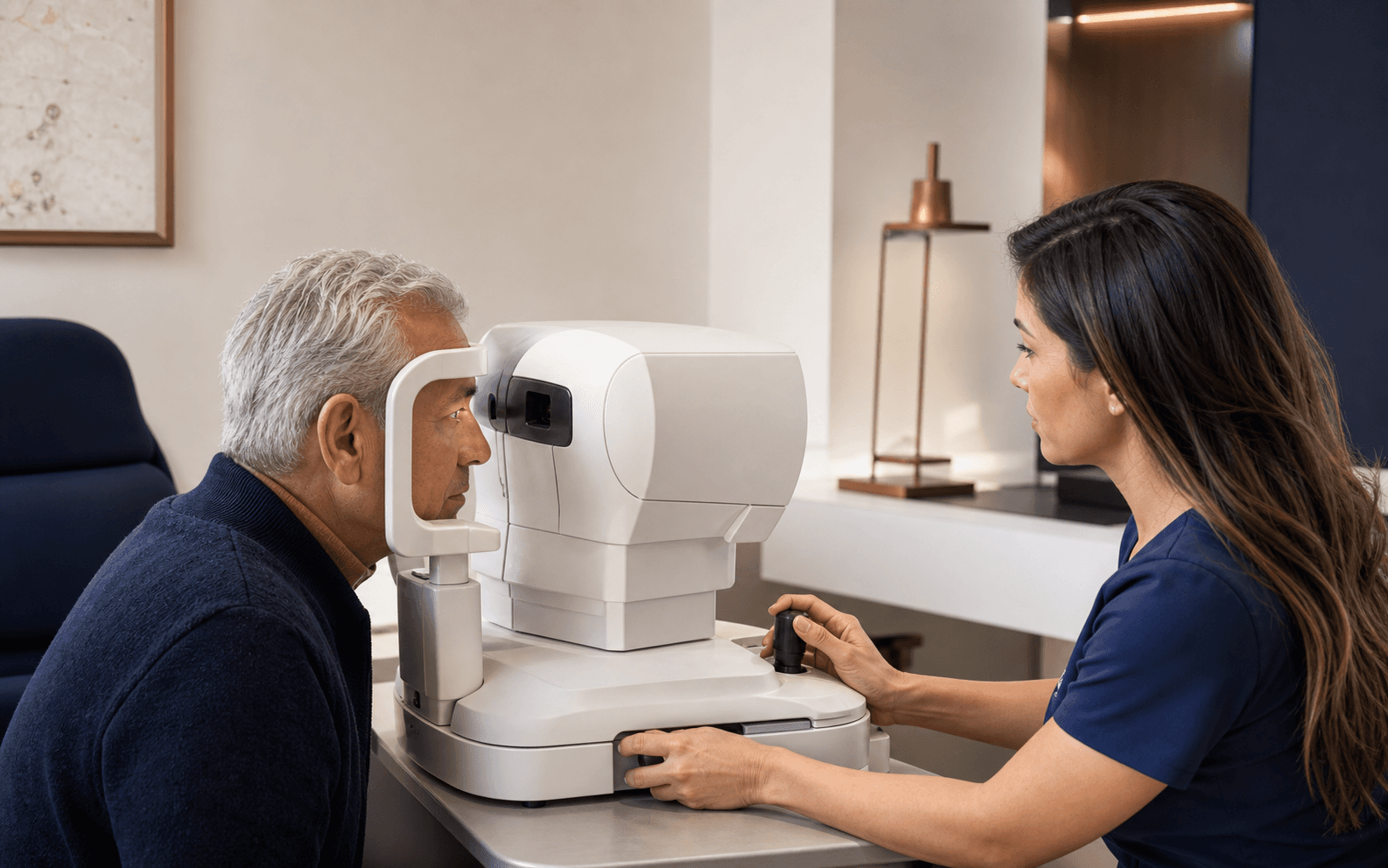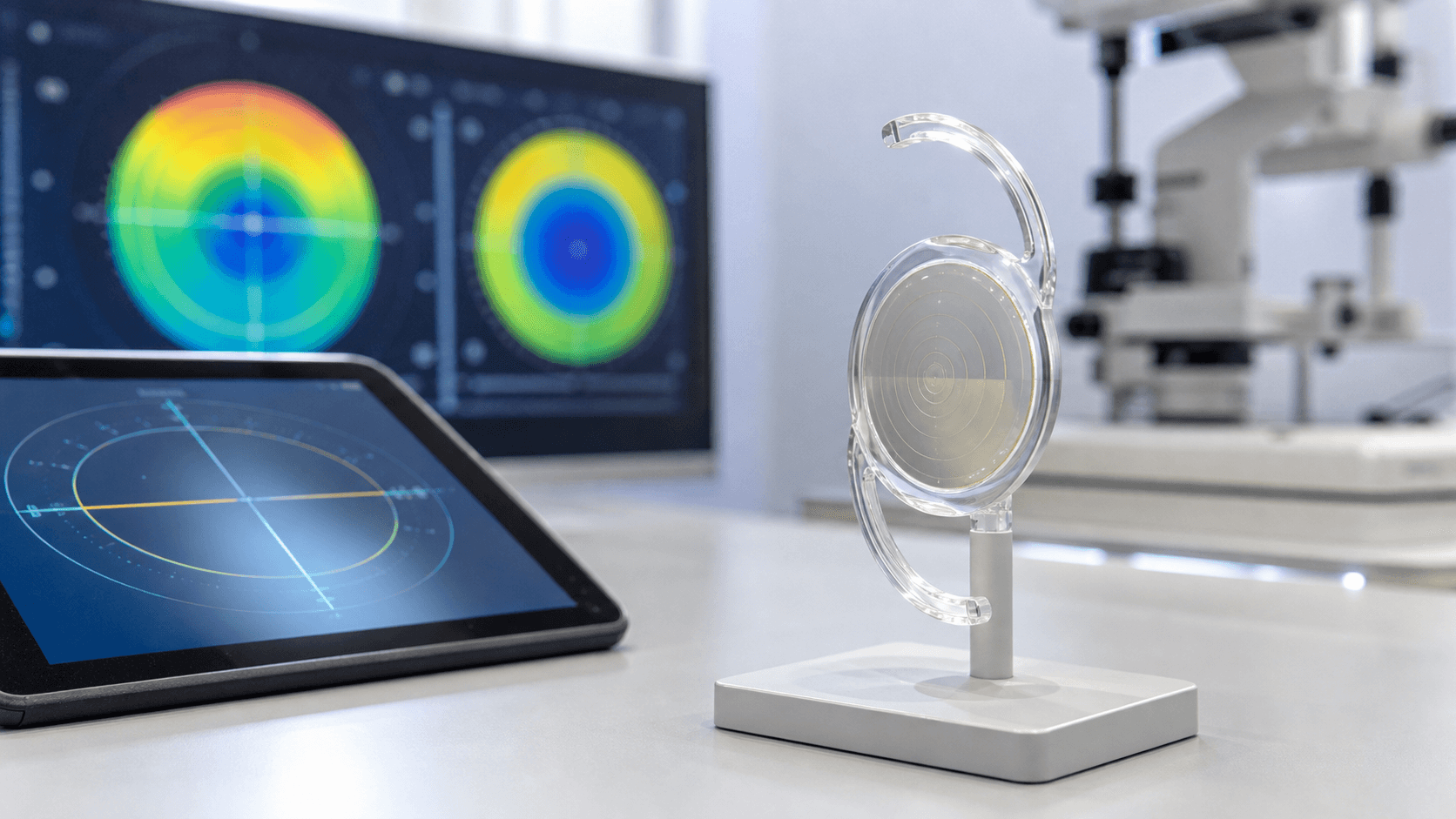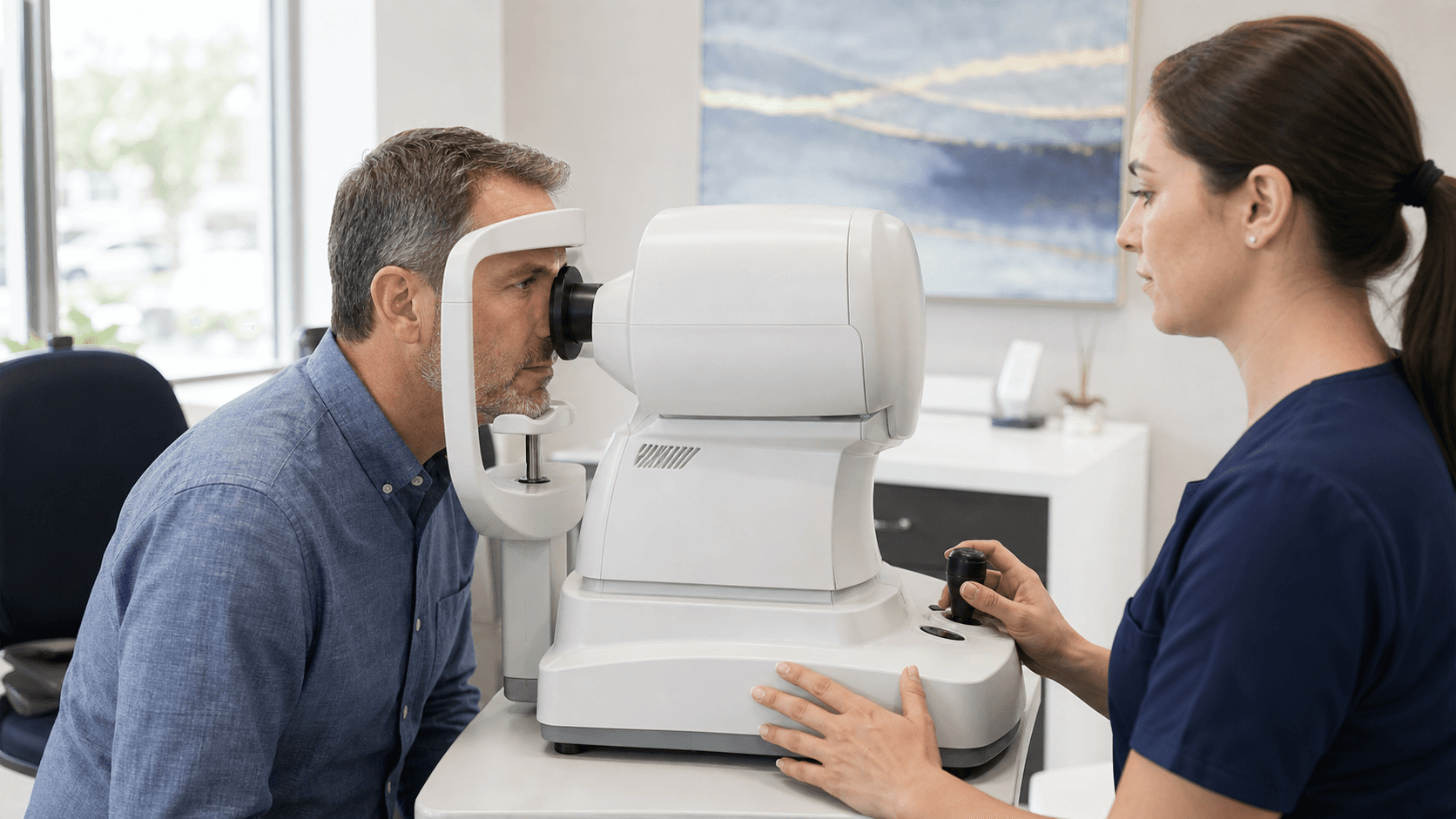
Yes, you can have cataract surgery after LASIK. Prior laser vision correction does not block cataract removal, but it does make lens-power planning less straightforward.
LASIK and PRK permanently change the shape of the cornea. Cataract surgery replaces the natural lens inside the eye with an intraocular lens, or IOL. The surgeon therefore has to calculate a new internal lens for an eye whose front focusing surface was previously altered.
That history matters even when the LASIK result was excellent and the procedure happened many years ago.
Why cataract calculations change after LASIK
Standard IOL formulas use several measurements to estimate the power of the replacement lens. Corneal curvature is one important input.
After myopic LASIK or PRK, the center of the cornea is flatter than it was before treatment. After hyperopic treatment, the central shape changes in the opposite direction. Traditional measurements and assumptions may not describe that altered cornea as accurately as they describe an untreated eye.
Modern post-refractive formulas, total corneal measurements, tomography, and other planning tools have improved accuracy. They do not eliminate every source of prediction error.
The practical point is simple: tell the cataract surgeon about prior LASIK, PRK, SMILE, radial keratotomy, or any other corneal procedure before the final lens is selected.
Bring old LASIK records if they still exist
Historical records are not always required, but they may help. Look for:
- Your prescription before laser vision correction.
- The treatment card or operative report.
- Preoperative corneal measurements.
- The date and type of procedure.
- Whether treatment was for nearsightedness, farsightedness, or astigmatism.
- Records of an enhancement or second procedure.
If the original practice no longer has the records, do not assume cataract surgery is impossible. Current no-history formulas are designed for this situation. Tell the surgeon as much as you remember and allow time for a complete measurement set.
The tear film has to be stable first
Dry eye and meibomian gland dysfunction are common reasons for inconsistent corneal readings. Prior LASIK patients may also have a long history of using artificial tears or noticing fluctuating vision.
If topography, keratometry, or refraction changes between visits, the surgeon may recommend treating the ocular surface and repeating the measurements. That delay can be frustrating, but unreliable measurements are a poor foundation for a precision lens choice.
The dry eye clinic page explains the surface evaluation used before surgical planning.
What testing may be useful
The exact workup depends on the eye, but a post-LASIK cataract evaluation may include:
- Refraction and visual acuity.
- Corneal topography or tomography.
- Ocular biometry and axial-length measurement.
- Anterior and posterior corneal power assessment when available.
- Tear-film and eyelid evaluation.
- Dilated retinal examination.
- Macular OCT when a premium-lens goal is being considered or the retina needs clarification.
- Optic-nerve and glaucoma review when appropriate.
Testing should answer whether the measurements are repeatable, whether the cornea is regular, whether another eye condition limits vision, and which IOL calculations are appropriate.
Does previous LASIK affect lens choice?
It can. Prior LASIK does not automatically rule out a toric, extended-depth-of-focus, multifocal, or light-adjustable strategy. It does make the screening and expectations more important.
The surgeon should evaluate:
- Whether the cornea is regular or irregular.
- The amount and stability of astigmatism.
- Night-driving needs and tolerance for glare or halos.
- Macular and optic-nerve health.
- Dry-eye severity.
- The visual target used during the original LASIK treatment.
- Whether monovision was used and whether you liked it.
A conventional monofocal lens can be the right recommendation. A premium lens is not automatically better because you previously chose LASIK.
Our cataract lens comparison explains what monofocal, toric, EDOF, multifocal, and adjustable strategies are designed to do.
What if I had monovision LASIK?
Monovision corrects one eye more for distance and the other more for near. If you used monovision successfully for years, tell the cataract surgeon which eye was the distance eye and which was the near eye.
That information can help frame the new target, but it does not force the same plan. Cataracts, age, retinal health, corneal measurements, and your current priorities may change what is appropriate.
If you disliked monovision, say so. Repeating an old target without discussing your experience is not personalized planning.
Will I be glasses-free again?
Possibly, but no surgeon should guarantee it.
The cataract operation removes the cloudy lens and places an IOL intended to reach a chosen focus. Prior LASIK adds uncertainty to that power prediction. A well-planned result may still leave a small amount of nearsightedness, farsightedness, or astigmatism.
Some patients use glasses for selected tasks. Others may be evaluated for an enhancement after the eye is fully healed and measurements are stable. An enhancement is another treatment with its own candidacy requirements, cost, recovery, and risk; it should not be presented as automatic.
The American Academy of Ophthalmology advises patients to tell the surgeon about prior refractive surgery and notes that glasses or an additional fine-tuning procedure may still be needed.
Are glare and halos more likely?
Glare and halos can come from the cataract itself, corneal optical changes, dry eye, residual prescription, pupil size, or the IOL design. Prior LASIK does not give one universal answer.
If night driving is important, describe the conditions that bother you now. Ask how the corneal map and lens option affect the risk of unwanted optical symptoms. A lens that offers a broader range of focus may involve a different night-vision tradeoff than a monofocal lens.
Questions to ask at the consultation
Bring these questions:
- Are my corneal measurements repeatable?
- Do you see any irregularity from prior LASIK or another condition?
- Which post-refractive IOL formulas or measurements are being used?
- Would old LASIK records change the plan?
- Does dry eye need treatment before final measurements?
- Which lens categories fit the cornea, retina, optic nerve, and visual goals?
- What is the realistic chance that I will still use glasses?
- If the result misses the target, when and how would it be reassessed?
- What costs are covered, optional, or related to a later enhancement?
Our broader cataract consultation checklist covers surgeon, insurance, recovery, and estimate questions as well.
LASIK history should change the plan, not stop it
The goal is not to treat a post-LASIK eye as a routine untouched cornea. The goal is to collect reliable measurements, use appropriate calculation methods, check the rest of the eye, and set expectations honestly.
Start with the premium cataract surgery page, compare cataract lens options, or schedule a cataract evaluation at Visionary Eye Surgery in Plano.
Sources
Medically Reviewed by Dr. Shehz, DO
Dr. Shehzad Batliwala, DO—better known as Dr. Shehz—is a board-certified ophthalmologist and eye surgeon who brings both technical precision and genuine compassion to every patient he treats.
Explore this content with AI
Open this article in your preferred AI assistant for a plain-English summary, action steps, and questions to ask before booking a consultation.
Want a direct answer about your eyes? A complimentary consultation gives you a clear, written recommendation.