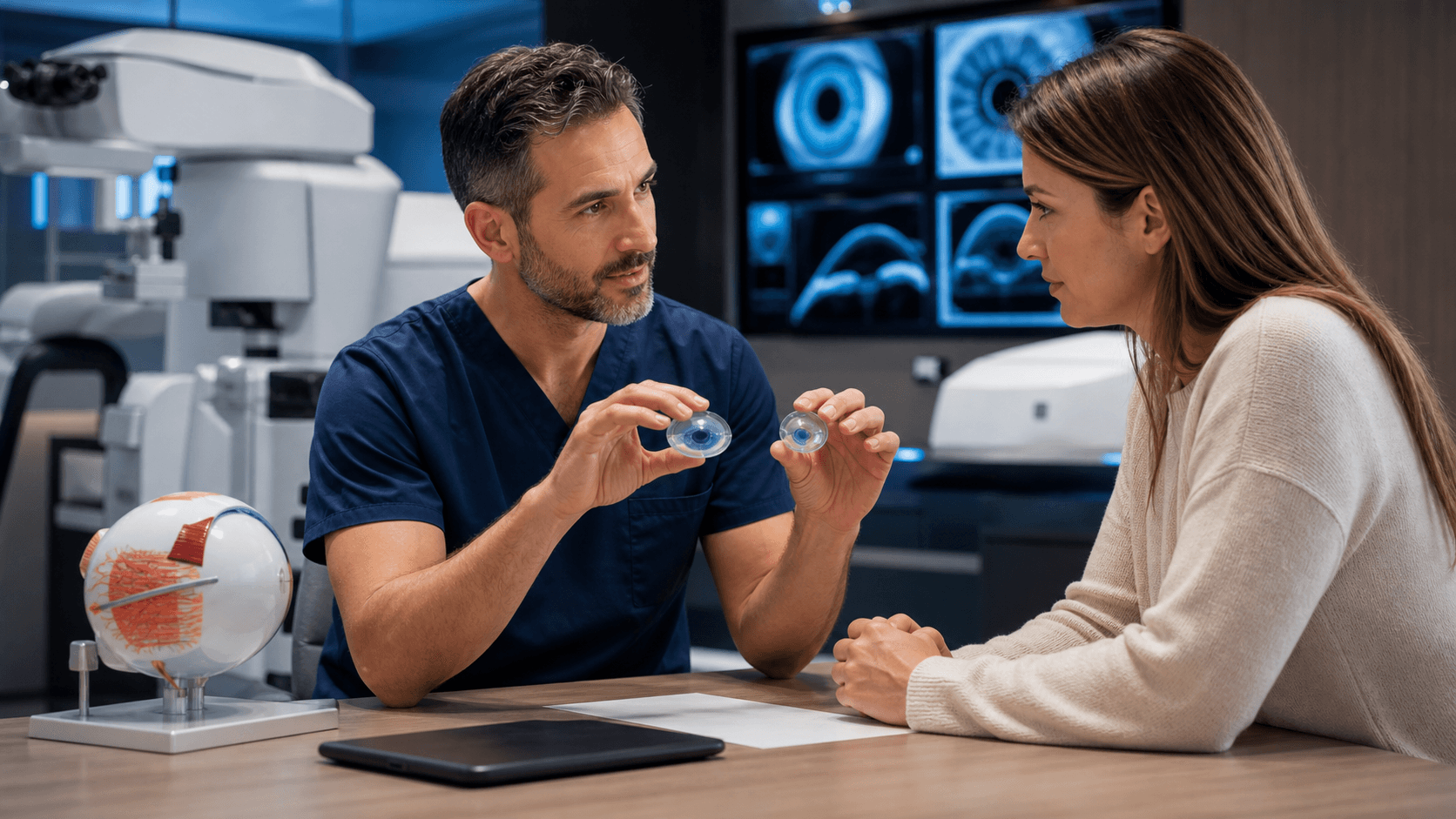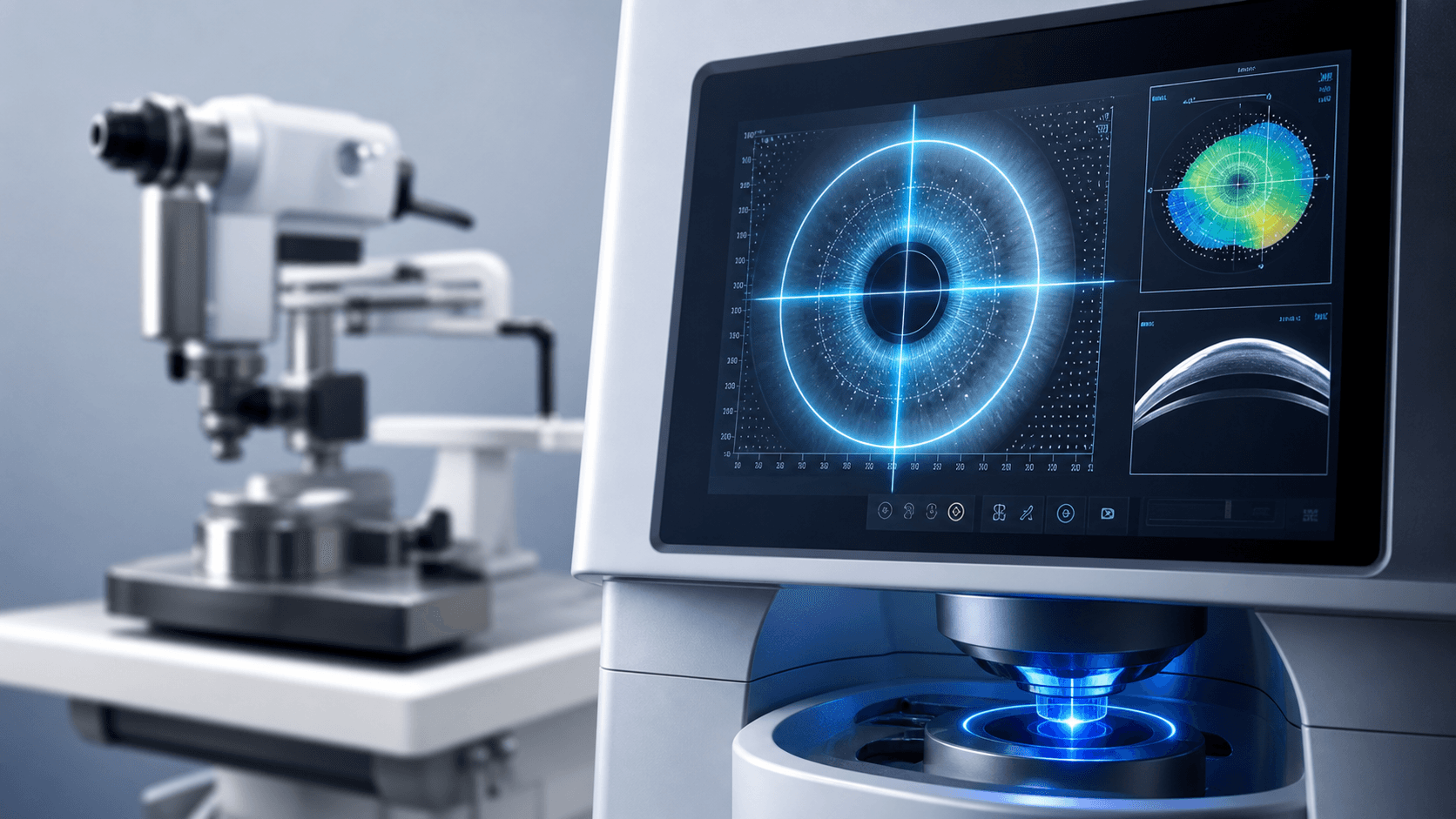
All-laser LASIK uses a femtosecond laser to create the flap and an excimer laser to reshape your cornea. Traditional bladed LASIK uses a mechanical microkeratome for the first step. In 2026, most reputable LASIK surgeons in Plano and the broader Dallas-Fort Worth area have moved to all-laser flap creation. At Visionary Eye Surgery, we do not use blades.
I get this question almost every week. Patients have read enough online to know there are two ways to do LASIK, but the difference still feels foggy.
Let me clear that up.
What’s the actual difference between all-laser and blade LASIK?
Both procedures correct the same problem. Light bends incorrectly inside your eye. We reshape the cornea so it bends correctly. Your prescription effectively goes away.
The difference is only in the first step. To reshape the cornea, we need to lift a thin flap of tissue off the surface. The way that flap is created is what separates the two techniques.
In bladed LASIK, a microkeratome cuts the flap with a metal blade that oscillates side to side. It’s the older technique, dating to the 1990s.
In all-laser LASIK, a femtosecond laser creates the flap with thousands of tiny laser pulses. No blade. No metal touching your eye for that step.
That’s it. One blade. One laser. Same end result, very different precision.
Why does it matter for Plano patients in 2026?
Because precision in the cornea is everything.
The flap a blade creates is shaped a bit like a contact lens. Thicker on the edges, thinner in the middle. The flap a laser creates is uniform across its width. That uniformity matters when we’re working at the level of microns.
It also matters for healing. A laser-created flap is planned with highly controlled dimensions. A blade-created flap can be more variable, which is one reason modern LASIK practices often prefer a femtosecond laser.
For most of my DFW patients, the visual outcome is similar. But the recovery, the dry eye risk, and the long-term flap stability all tilt in favor of all-laser.
Is bladed LASIK still done anywhere in Dallas-Fort Worth?
Yes. Mostly at the high-volume, low-price clinics that advertise heavily on radio and freeway billboards. Bladed equipment is cheaper to operate, and the per-eye cost can be dropped to attract patients.
If a price seems unusually low, the technology behind it is usually older. That’s not always a deal-breaker. But you should know what you’re agreeing to.
The clinics still using blades won’t volunteer this information. So ask. The exact question is: “Are you using a microkeratome or a femtosecond laser to make the flap?” If they pause, you have your answer.
Which is safer for someone with thin corneas?
If LASIK is still appropriate, all-laser flap creation is usually preferable to a blade because the flap is more predictable. That can preserve more planning room for the excimer laser correction.
But a thin cornea should not automatically lead to LASIK. It should trigger a careful comparison of ASA/PRK, SMILE, and EVO ICL. For some Plano patients, the safer answer is a flapless laser procedure or a lens-based option that avoids corneal tissue removal.
Some patients who were told no elsewhere are still candidates after better mapping. Others are not. The scan decides.
If the scan shows irregular astigmatism, progressive corneal thinning, or possible keratoconus, all-laser LASIK is not the next step. A keratoconus evaluation, CXL review, or broader cornea surgeon evaluation should come first.
If you’ve been told no in the past, it might be worth a second opinion. We see this happen in our Plano office often enough that it’s worth saying out loud.
Does all-laser LASIK hurt more or less?
Less. Not by a lot. But less.
The pressure during flap creation is the part patients remember. The blade pressure is more abrupt. The laser pressure is gentler and shorter. Patients describe the laser version as “weird” rather than “uncomfortable.”
Either way, the whole procedure takes about ten minutes per eye. The discomfort is gone before the day is over. Most of my patients are back at work in 24 to 48 hours.
If you’re nervous about the surgery itself, that’s normal. Probably anyone undergoing eye surgery has a moment of “what am I doing.” We talk you through it. Nobody does this alone.
What if I’m not a candidate for all-laser LASIK?
Then we have other options. SMILE eye surgery uses a different laser approach with no flap at all. EVO ICL places a tiny lens inside the eye for very high prescriptions. ASA, our version of advanced PRK, reshapes the surface without a flap.
The right procedure isn’t always the most popular one. It’s the one that fits your eyes.
That’s the whole point of the consultation. We measure. We map. We tell you the truth about what your eyes can handle. Sometimes that means we don’t operate at all. Some patients are better off staying in glasses or contacts. I’ll say it if it’s true.
So which one should I get in Plano?
If you are a candidate for LASIK, all-laser is the modern answer I would want discussed first. If cost is the only reason a clinic is steering you toward a blade, ask what else is being left out of the plan.
And if cost is the only factor, the rest of this post should give you pause.
You get one set of eyes. Spend the right amount on them.
Related resources
- All-Laser LASIK in Plano
- LASIK candidacy testing
- Book a LASIK consultation
- Thin-cornea LASIK options
- ASA / Advanced PRK
Keep reading
Medically Reviewed by Dr. Shehz, DO
Dr. Shehzad Batliwala, DO—better known as Dr. Shehz—is a board-certified ophthalmologist and eye surgeon who brings both technical precision and genuine compassion to every patient he treats.
Explore this content with AI
Open this article in your preferred AI assistant for a plain-English summary, action steps, and questions to ask before booking a consultation.
Want a direct answer about your eyes? A complimentary consultation gives you a clear, written recommendation.