Come for the specific thing.
Routine keratoconus monitoring belongs near home. The trip is for CTAK, for a complex cornea, or for a second opinion on a transplant recommendation.
An hour each way is a decision, and it should be made for a reason. The reason is usually CTAK — reshaping the cornea with laser-shaped donor tissue rather than replacing it — plus a team that plans your visits knowing exactly how far you have come.
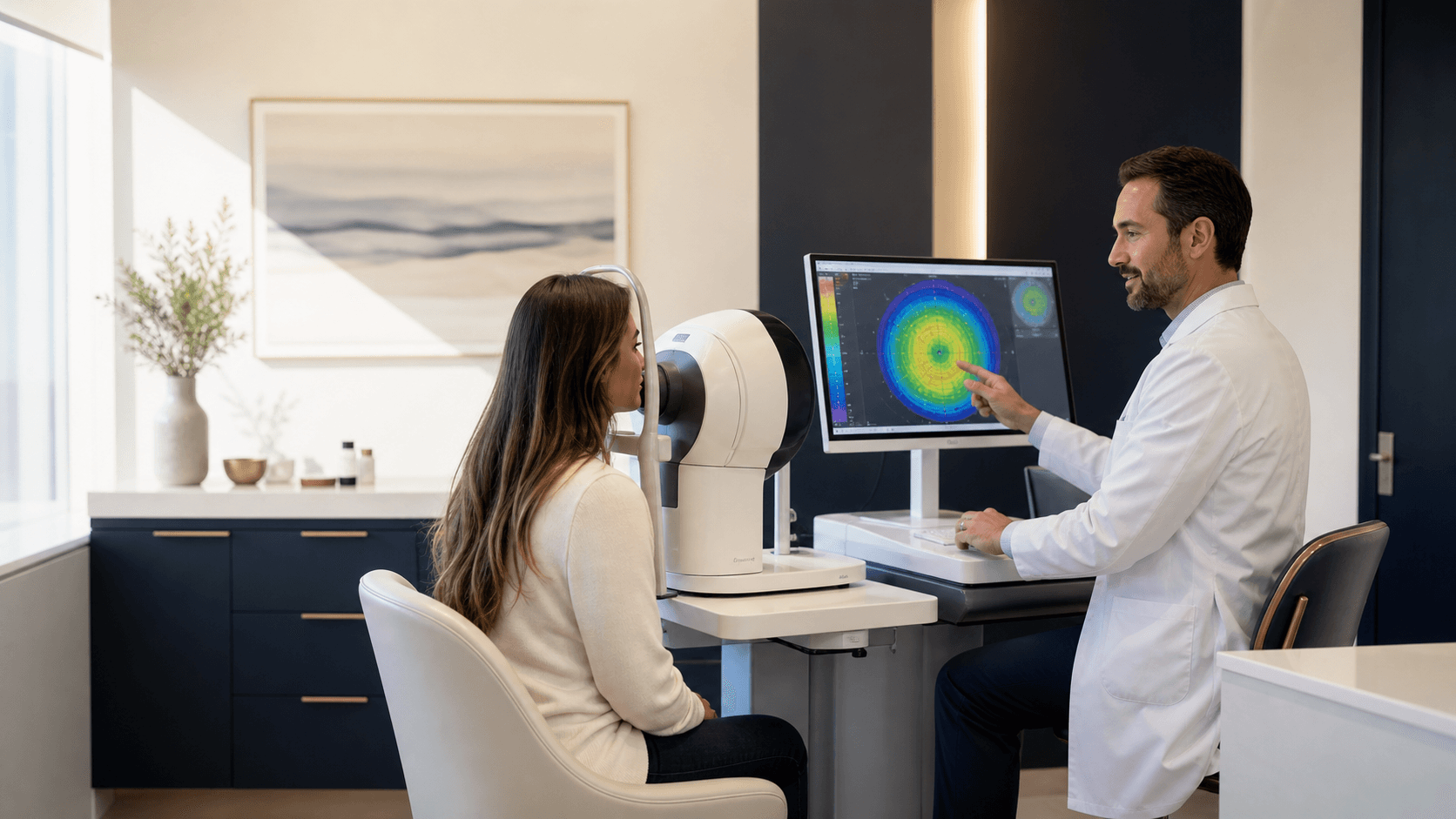
Fort Worth has excellent eye care, and for most of what keratoconus needs — monitoring, glasses, a well-fitted lens — the right answer is close to home. The trip east makes sense for a narrower question: when the cornea has distorted past what lenses handle comfortably, and the conversation has started drifting toward transplant.
CTAK is what sits in that gap. A femtosecond laser sculpts sterilized donor corneal tissue to your individual corneal map, and the inlay is placed inside a channel in your own cornea to round the cone back toward a more regular shape. Nothing is removed. Because it is additive rather than subtractive, it preserves options a transplant spends — which is precisely why it is worth a drive when it is the right fit, and why we will tell you plainly when it is not.
We are set up for patients who travel. Mapping, consultation, and the treatment decision are clustered into as few visits as the clinical picture allows, and our out-of-town patient coordination exists for exactly this. Fort Worth is roughly fifty minutes via 121 or 183 depending on traffic and where you start.
The drive is only justified if the answer at the end of it is different. Sometimes it is not, and we will say so.
Routine keratoconus monitoring belongs near home. The trip is for CTAK, for a complex cornea, or for a second opinion on a transplant recommendation.
Visits are clustered where clinically sound, and our out-of-town coordination handles the scheduling around a long drive rather than ignoring it.
If your cornea is not a good CTAK candidate, you will hear that at the consultation rather than after a series of trips. Scarring and very thin corneas do rule it out.
A cone-shaped cornea is progressive, it is irregular, and it is hard to correct. Those are three different problems. Cross-linking answers the first by halting progression. It does not answer the second — a stabilized cornea is still a distorted one.
CTAK answers the second. By adding laser-shaped donor tissue inside your own cornea, it works toward a more regular surface, which is what makes the third problem tractable: glasses and contacts start working again. Which combination your eye needs, and in what order, is what the consultation is for.
Which of these your eye needs, and in what sequence, comes out of the corneal maps rather than off a menu. Cross-linking is the time-sensitive one. Reshaping can wait for a stable cornea, and usually should.

A piece of sterilized donor cornea, laser-shaped to the map of your own eye and placed inside your cornea to round the cone back toward its natural shape. Nothing is removed, so a transplant stays on the table rather than behind you.

The FDA-approved treatment that uses riboflavin and ultraviolet light to strengthen the collagen bonds holding your cornea's shape. It does not reverse keratoconus — it stops it getting worse, which is why timing matters more here than anywhere else.

Scleral and rigid gas-permeable lenses vault over an irregular cornea and give light a smooth surface to pass through. Often the bridge between diagnosis and stability — and, after CTAK, frequently easier to fit and wear.
Keratoconus care is a sequence, and the order is not arbitrary. Stabilizing a cornea that is still changing comes first, because reshaping one that has not settled does not hold. Each step below answers a different question about your eye.

Corneal cross-linking strengthens the collagen bonds holding your cornea's shape. It is the time-sensitive step: it protects the cornea you still have rather than recovering the cornea you had.

CTAK places a laser-shaped piece of sterilized donor tissue inside your own cornea, working the cone back toward a regular shape. Nothing of yours is removed, which is what separates it from a transplant.

Once the cornea is stable and more regular, glasses or specialty lenses do the remaining work — and a more regular cornea is markedly easier to fit and more comfortable to wear against.
East on SH-121 or 183 toward the Tollway — roughly fifty minutes from Fort Worth, traffic depending. Ground floor with free parking.
8080 Independence Pkwy, Suite 155
Plano, TX 75025
Say you are travelling from Fort Worth when you book. We cluster mapping, consultation, and the treatment decision into as few visits as the clinical picture allows, and coordinate longer-distance scheduling directly.
Open Monday–Friday 8:00–5:00 and Saturday 9:00–3:00, with English- and Spanish-speaking staff. Questions before booking? Call 214-972-2020 and a human answers.
Don't see your question? Call 214-972-2020 or book a visit and ask Dr. Shehz directly.
Talk to our team, no pressure, no sales pitch. We answer the question, not the upsell.
If cross-linking alone is what your cornea needs, that may well be available closer to home, and we will say so. The drive earns itself when reshaping is the question — and the maps are what settle it.
Cost, safety, candidacy — the questions patients actually ask, answered in plain English in our patient education library.
Learn when CTAK donor-tissue reshaping may be considered for selected stable keratoconus and how it differs from CXL, specialty lenses, and corneal transplant.
Read articleLearn how serial corneal maps, thickness, age, documented progression, specialty lenses, and treatment protocol determine when CXL should be considered.
Read articleLearn how corneal thickness and tomography affect LASIK candidacy and when PRK, EVO ICL, SMILE, CXL-first care, or monitoring may be safer.
Read articleA LASIK rejection does not end the discussion. Learn how the reason - corneal shape, thickness, prescription, dry eye, or age - guides safer alternatives.
Read articleCorneal mapping, a candid assessment of whether CTAK fits your eye, and visits planned around a fifty-minute drive rather than in spite of it. Call 214-972-2020 or book online.