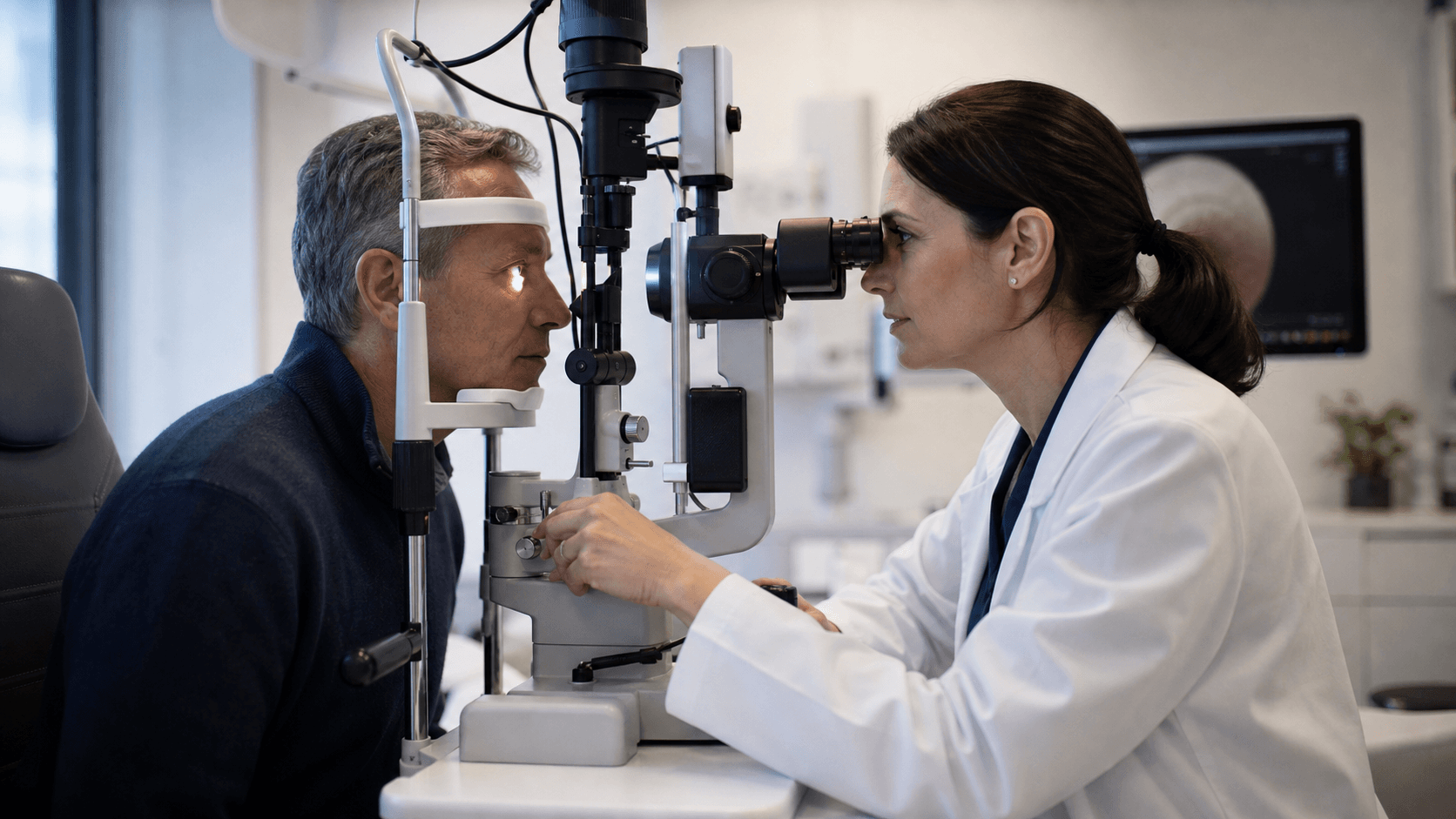
If you were told you have keratoconus and your contacts no longer give reliable vision, it is natural to ask whether CTAK or another corneal procedure could improve the shape of the eye.
The important starting point is that CTAK is not the first treatment for every keratoconus diagnosis. CTAK, short for Corneal Tissue Addition Keratoplasty, is usually a reshaping conversation for selected corneas after the stability question has been answered.
For full procedure details, start with our main CTAK in Plano page. This article explains where CTAK fits when patients are comparing specialty contact lenses, corneal cross-linking, and corneal transplant.
The same rule applies wherever a patient is evaluated: document the corneal shape, determine whether it is stable or progressing, and then compare CXL, CTAK, specialty lenses, monitoring, or transplant-level review.
What CTAK is trying to solve
Keratoconus changes the cornea from a smooth dome into a more irregular cone. That irregular shape scatters light before it reaches the retina. Glasses may stop sharpening vision clearly, and even rigid or scleral lenses may become harder to fit when the cone is steep, decentered, or unstable.
CTAK is designed to improve the corneal shape in selected eyes. Instead of removing tissue like laser vision correction or replacing the whole cornea like a transplant, CTAK adds a custom-shaped piece of preserved donor corneal tissue inside the patient's own cornea.
The goal is not to promise glasses-free vision. The goal is to make the cornea more regular and more correctable. For some patients, that may improve how glasses or contact lenses work. For others, it may justify considering a tissue-addition option before transplant-level care, without guaranteeing that transplant can be avoided.
That is why the CTAK conversation should be specific. The real question is whether tissue addition has a reasonable role before a larger corneal operation.
When CTAK may enter the conversation
A CTAK consultation usually makes the most sense when several things are true:
- Keratoconus or corneal ectasia has already been diagnosed.
- The cornea is irregular enough that glasses are not enough.
- Specialty contact lenses are difficult to fit, uncomfortable, or not giving usable vision.
- The cornea is not actively infected or inflamed.
- The surgeon can document corneal thickness, cone location, scarring, and prior-map history.
- CXL timing has already been considered if the cornea may still be changing.
- Transplant has been mentioned, but less invasive options may still be worth reviewing.
That does not mean every patient in this group is a CTAK candidate. It means the question is reasonable enough to deserve corneal mapping, tomography, pachymetry, best-corrected vision testing, and a discussion with a cornea surgeon.
CTAK vs CXL
CTAK and CXL solve different problems.
Corneal cross-linking, often called CXL, is a stabilizing treatment. It uses riboflavin and controlled UV-A light to strengthen a weakening cornea when keratoconus or ectasia is progressing.
CTAK is a reshaping treatment for selected corneas. It changes the corneal contour by adding a custom donor-tissue inlay.
The order matters. If the cornea is actively getting steeper or thinner, CXL or close monitoring usually comes first. Reshaping an unstable cornea without answering the progression question can lead to a weaker plan.
If you are not sure whether your keratoconus is changing, read our CXL timing guide. If you already know the cornea is stable but still too irregular for clear functional vision, CTAK may become the more relevant discussion.
CTAK vs corneal transplant
Corneal transplant can be vision-saving for advanced keratoconus, especially when scarring, severe thinning, or extreme irregularity leaves fewer options.
But transplant is a larger operation than CTAK. It replaces corneal tissue, requires long-term follow-up, and may involve suture management, rejection monitoring, healing variability, and future optical correction.
CTAK is different because it preserves the patient's own cornea and adds tissue inside it. For a selected eye, that can make CTAK worth discussing before corneal transplant, while the evidence and anatomy still need careful review.
That wording should be used carefully. CTAK does not replace transplant for every advanced cornea. If there is dense central scarring, very poor corneal clarity, or anatomy that cannot safely hold an inlay, transplant-level care may still be the better discussion. A strong keratoconus consultation should explain that line clearly instead of treating CTAK as a cure-all.
CTAK vs specialty contact lenses
Specialty lenses, including scleral lenses and rigid gas permeable lenses, can be excellent for keratoconus. They create a smoother optical surface over the irregular cornea and can give very sharp vision.
But lenses do not change the cornea itself. They help the optics.
CTAK may be considered when the corneal shape makes lens fitting difficult, when the lens is uncomfortable despite skilled fitting, or when the patient still cannot get useful vision. In some cases, CTAK may improve the corneal shape enough that specialty lenses fit better afterward.
This is why CTAK and specialty lenses should not be framed as enemies. Many patients need both: surgical reshaping to improve the foundation, then glasses or contacts to sharpen the final vision.
What the consultation should document
A CTAK consultation should be measurement-heavy.
A useful visit should document:
- Corneal topography and tomography.
- Pachymetry or thickness mapping.
- Cone location and steepness.
- Whether there is central scarring.
- Best-corrected vision with glasses.
- Contact lens history and tolerance.
- Prior corneal maps, if available.
- Whether keratoconus is stable or progressing.
- Whether CXL has already been performed or should be considered.
- Whether the eye is too advanced for CTAK and needs transplant-level review.
- Dry eye, allergy, eye rubbing, or eyelid inflammation that could affect measurements and healing.
The surgeon should also explain what success means. For many CTAK patients, success is better correctable vision, improved lens tolerance, or a more regular cornea, not total independence from glasses or contacts.
When CTAK may not be the right next step
CTAK may not fit if the cornea is actively changing and has not been stabilized, if the cornea has dense central scarring, if the tissue is too thin or irregular for a safe inlay, if infection or inflammation is active, or if vision is already correctable comfortably with glasses or contacts.
It may also be premature when a patient has a brand-new keratoconus diagnosis without prior maps. In that situation, the first step may be a keratoconus baseline, CXL discussion, allergy and eye-rubbing control, and specialty-lens evaluation before CTAK is scheduled.
That protects patients from skipping the stabilizing step just because a newer procedure sounds more advanced.
Sources and clinical references
- Corneal Tissue Addition Keratoplasty review - PubMed
- CTAK outcomes study record - ClinicalTrials.gov
- Keratoconus and corneal conditions - National Eye Institute
CTAK is an evolving area of care. Published evidence and an individual corneal examination should guide the discussion.
Related resources
Bottom line
CTAK may be worth discussing if keratoconus or ectasia has left the cornea too irregular for comfortable, useful correction and tissue addition may still be reasonable to discuss before transplant-level care.
It is not the first step for every new diagnosis, and it is not the same as CXL. The safest recommendation comes from corneal maps, thickness measurements, lens history, scarring review, stability evidence, and a surgeon who can explain whether CXL, CTAK, specialty lenses, monitoring, or transplant-level care should come next.
Start with CTAK in Plano, review the keratoconus guide, or schedule a cornea specialist evaluation if you need a second opinion before deciding what to do next.
Your exam can clarify which options fit your eyes. Visit our Plano team from anywhere in DFW.
Book a free visit