Cornea-trained surgeon.
Dr. Shehz has specific training in CXL, CTAK, and keratoconus management — not every ophthalmologist performs cross-linking, and fewer offer tissue addition.
Cross-linking to stop keratoconus progressing. CTAK to reshape the cone it already made. Both performed by a cornea-trained surgeon 15 minutes north in Plano, and both starting from the same set of corneal maps.
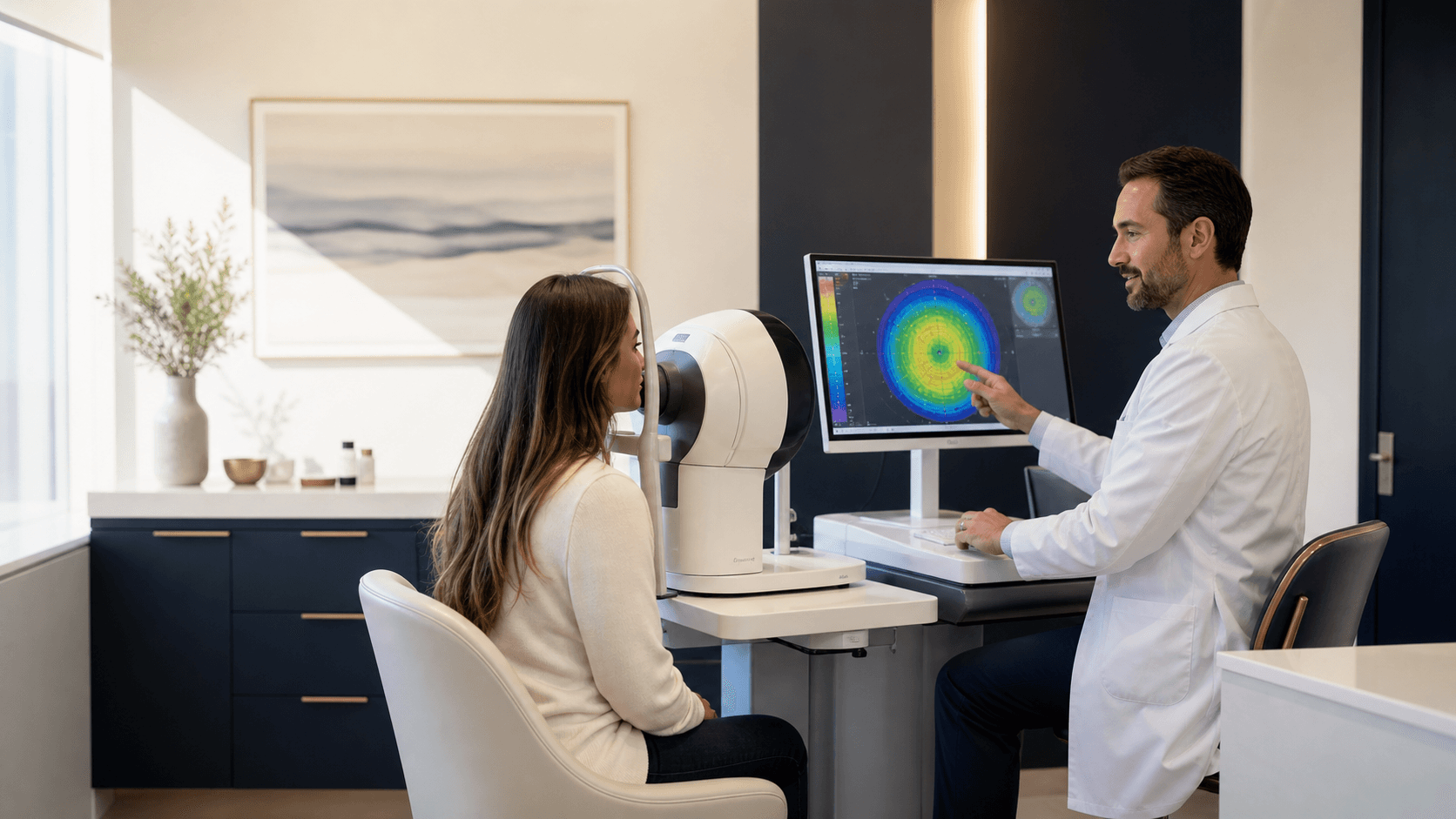
Proximity to UT Dallas and the corporate corridor gives Richardson a younger-than-average keratoconus population — students, graduate researchers, and young professionals whose moving prescriptions or contact lens intolerance finally led to a topographic diagnosis. Younger eyes are also where keratoconus tends to progress fastest, which makes that first appointment more consequential than it feels.
Cross-linking is the time-sensitive half of the answer. Riboflavin and ultraviolet light strengthen the collagen bonds in a weakening cornea and halt the cone-shaped distortion, preserving corneal integrity rather than recovering it. Treated early, it is frequently what keeps a transplant off the horizon entirely.
The other half is the shape already there. Cross-linking does not reshape anything, so a cornea can be successfully stabilized and still refuse to correct with glasses or contacts. CTAK addresses that directly: sterilized donor tissue, laser-shaped to your individual corneal map and placed inside your own cornea to round the cone back toward a regular form, with none of your tissue removed.
Dr. Shehz is a cornea-trained surgeon performing both at our Plano facility, about 15 minutes north on US-75. The consultation includes corneal topography, pachymetry, and an assessment of progression, which together decide whether to treat now or monitor. We accept referrals from Richardson optometrists directly, send reports back, and coordinate ongoing care.
Stabilizing and reshaping answer different questions. A plan that only ever asked the first one is half a plan.
Dr. Shehz has specific training in CXL, CTAK, and keratoconus management — not every ophthalmologist performs cross-linking, and fewer offer tissue addition.
Topography and pachymetry determine whether treatment is needed now — not every case requires immediate intervention, and some corneas want monitoring.
CXL, CTAK, and specialty lens fitting are all performed here, so the sequence is a clinical judgment rather than a chain of referrals.
A cone-shaped cornea is progressive, it is irregular, and it is hard to correct. Those are three different problems. Cross-linking answers the first by halting progression. It does not answer the second — a stabilized cornea is still a distorted one.
CTAK answers the second. By adding laser-shaped donor tissue inside your own cornea, it works toward a more regular surface, which is what makes the third problem tractable: glasses and contacts start working again. Which combination your eye needs, and in what order, is what the consultation is for.
Which of these your eye needs, and in what sequence, comes out of the corneal maps rather than off a menu. Cross-linking is the time-sensitive one. Reshaping can wait for a stable cornea, and usually should.

A piece of sterilized donor cornea, laser-shaped to the map of your own eye and placed inside your cornea to round the cone back toward its natural shape. Nothing is removed, so a transplant stays on the table rather than behind you.

The FDA-approved treatment that uses riboflavin and ultraviolet light to strengthen the collagen bonds holding your cornea's shape. It does not reverse keratoconus — it stops it getting worse, which is why timing matters more here than anywhere else.

Scleral and rigid gas-permeable lenses vault over an irregular cornea and give light a smooth surface to pass through. Often the bridge between diagnosis and stability — and, after CTAK, frequently easier to fit and wear.
Keratoconus care is a sequence, and the order is not arbitrary. Stabilizing a cornea that is still changing comes first, because reshaping one that has not settled does not hold. Each step below answers a different question about your eye.

Corneal cross-linking strengthens the collagen bonds holding your cornea's shape. It is the time-sensitive step: it protects the cornea you still have rather than recovering the cornea you had.

CTAK places a laser-shaped piece of sterilized donor tissue inside your own cornea, working the cone back toward a regular shape. Nothing of yours is removed, which is what separates it from a transplant.

Once the cornea is stable and more regular, glasses or specialty lenses do the remaining work — and a more regular cornea is markedly easier to fit and more comfortable to wear against.
US-75 north — about 15 minutes from central Richardson. Ground floor with free parking.
8080 Independence Pkwy, Suite 155
Plano, TX 75025
A cornea consultation includes topographic mapping — about 60–90 minutes. CXL is an outpatient procedure at our Plano facility.
Open Monday–Friday 8:00–5:00 and Saturday 9:00–3:00, with English- and Spanish-speaking staff. Questions before booking? Call 214-972-2020 and a human answers.
Don't see your question? Call 214-972-2020 or book a visit and ask Dr. Shehz directly.
Talk to our team, no pressure, no sales pitch. We answer the question, not the upsell.
Cross-linking answers whether keratoconus keeps getting worse. It does not answer whether your cornea is regular enough to correct. If the first is settled and the second is not, CTAK is the part of the pathway still open.
Explore cost, recovery, and candidacy at your own pace.
Learn when CTAK donor-tissue reshaping may be considered for selected stable keratoconus and how it differs from CXL, specialty lenses, and corneal transplant.
Read articleLearn how serial corneal maps, thickness, age, documented progression, specialty lenses, and treatment protocol determine when CXL should be considered.
Read articleA thin cornea does not decide LASIK eligibility by itself. Corneal shape, prescription, planned tissue removal, and eye health must be evaluated together.
Read articleA cornea consultation determines whether cross-linking is the right step, whether reshaping is warranted, and what the sequence should be. About 15 minutes from Richardson. Call 214-972-2020 or book online.