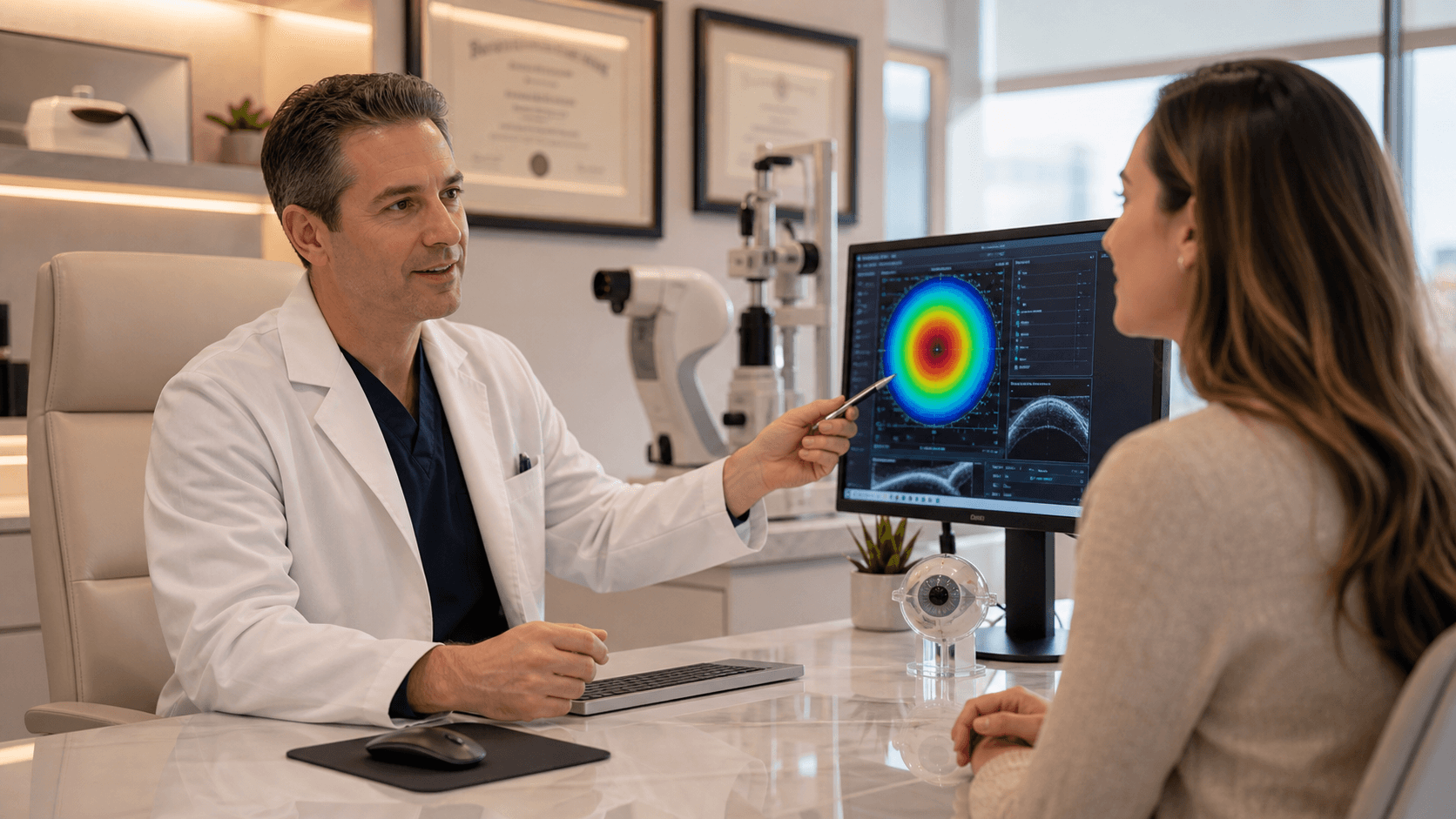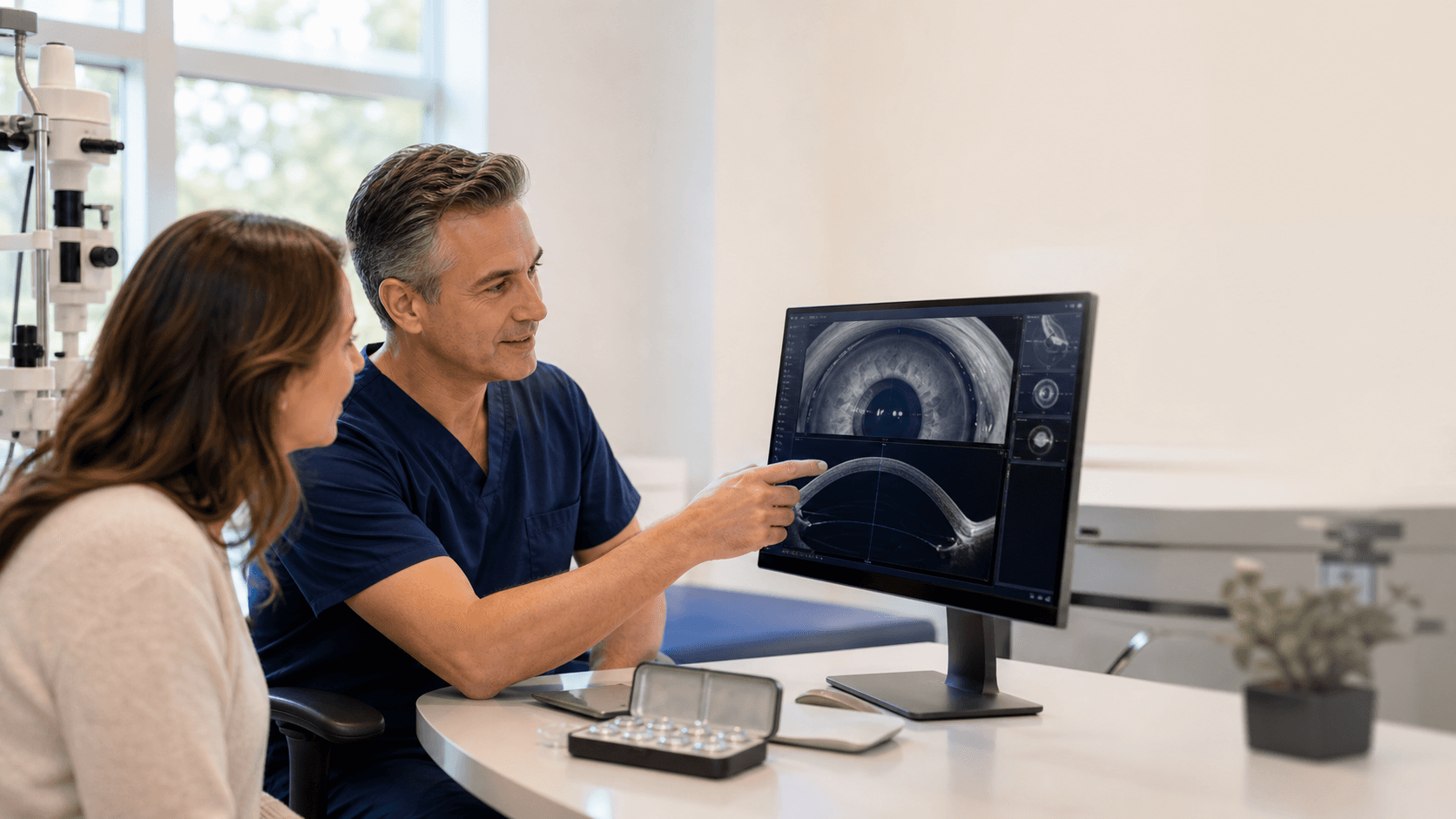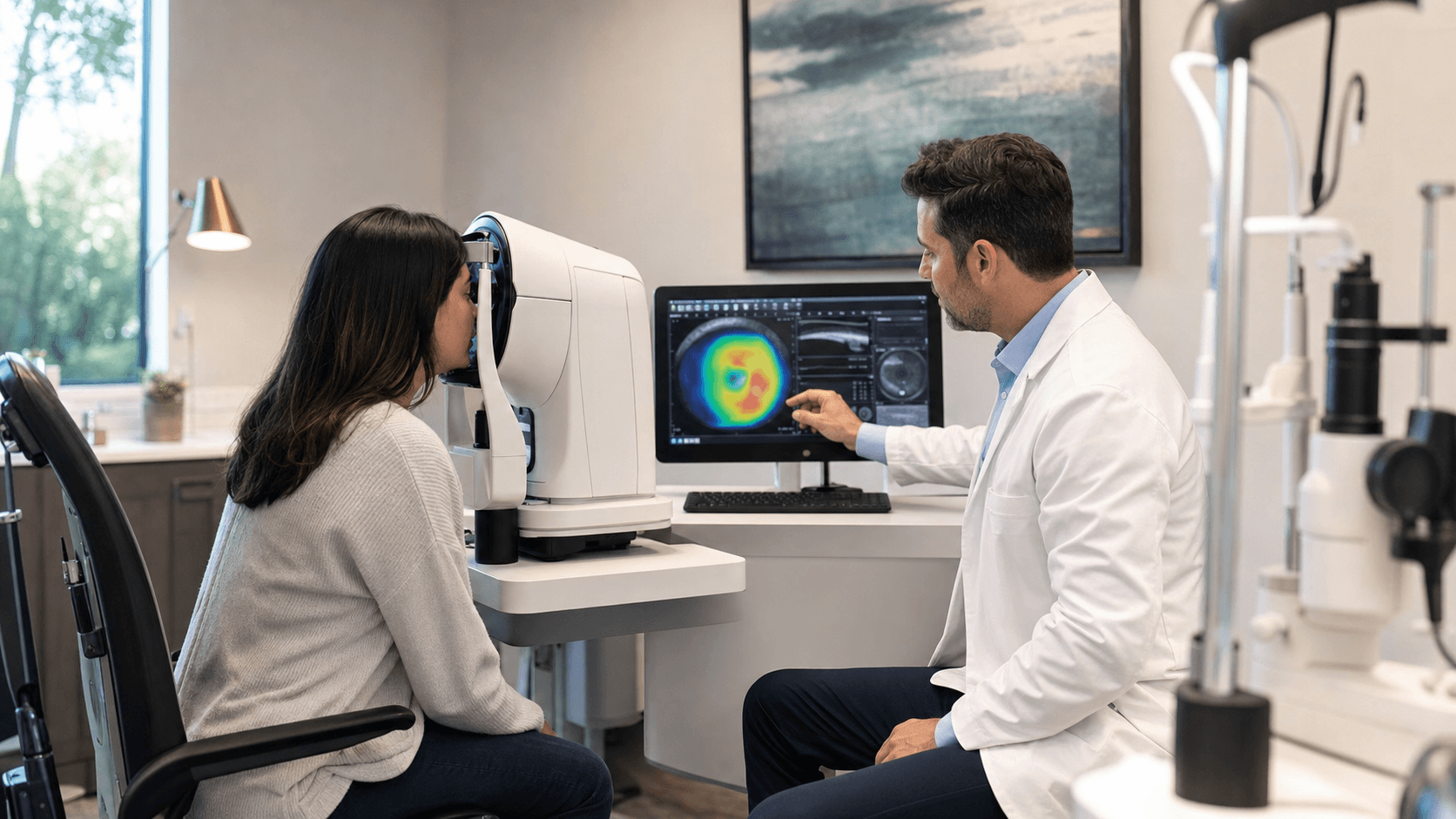
A LASIK consultation at Visionary Eye Surgery in Plano takes about 60 minutes. We map your corneas with a series of noninvasive scans, check your prescription and eye health, and then talk honestly about whether LASIK or another vision-correction option makes sense for you. The consultation is free, and my main job during it is to look for reasons to tell you no.
That last part surprises people. Most patients walk in braced for a sales pitch. What they actually get is a screening process, because the entire safety record of modern LASIK rests on picking the right eyes. So let me walk you through the visit, start to finish.
What Tests Happen at a LASIK Consultation?
The heart of the visit is imaging. We take detailed maps of your corneas, and I mean detailed. The topography scan reads thousands of points across the surface, which makes your cornea about as unique as your fingerprint.
We measure corneal thickness, because All-Laser LASIK works by reshaping tissue and I need to know exactly how much you have. We check your pupil size, your tear film, and your full prescription. Then I dilate your eyes and examine the retina and the lens, because clearing you for surgery means clearing the whole eye, not just the front of it.
The imaging is noninvasive. Some parts of the eye examination use bright lights or drops, and individual comfort varies.
Will My Eyes Be Dilated? Can I Drive Home?
Yes, dilation may be part of the evaluation. Your near vision may be blurry and your eyes may be light-sensitive for several hours, so bring sunglasses.
Because dilation affects people differently, ask our team whether you should arrange a driver. Do not drive until your vision is clear enough to do so safely.
One practical note: contact lenses can temporarily change corneal shape. Follow the lens-removal schedule our team gives you, because the timing depends on whether you wear soft, toric, rigid gas-permeable, or specialty lenses.
What Questions Should I Ask the Surgeon?
Ask who actually performs your surgery and who sees you at follow-ups. In some high-volume centers around Dallas-Fort Worth, the person who examines you is not the person holding the laser. Here, you get me both days.
Ask about training. I'm a double board certified eye surgeon with advanced subspecialty training in refractive surgery, and I tell patients to demand that level of background from anyone they let near their corneas.
Ask what the practice offers besides LASIK. If a clinic only has one procedure, every eye starts to look like a LASIK eye. We also do SMILE, EVO ICL, and ASA, which changes the conversation from can we do LASIK to what does this eye actually need.
And ask what happens if the result isn't perfect. Get the enhancement policy in plain language. Ours is written down as the 20/Happy Patient Guarantee, and I'd encourage you to make any surgeon in North Texas show you theirs.
What If I'm Not a LASIK Candidate?
A meaningful share of people who come through my consultation are not good LASIK candidates. Thin corneas, very high prescriptions, prescription instability, and significant dry eye are common reasons.
That is not a rejection. It's data. A patient with thin corneas and a strong prescription has probably spent weeks researching LASIK, and the real answer for them might be EVO ICL or ASA. Someone in their late forties fighting reading glasses might be better served by lens-based surgery altogether.
The consultation exists to find the right procedure for your eye, not to squeeze your eye into a procedure. When I say no to LASIK, I almost always have a better yes behind it.
How Soon After the Consultation Can I Have Surgery?
If your scans are clean and your prescription has been stable, surgery can usually happen within a week or two. Some patients in Plano book their procedure before they leave the parking lot.
There's no pressure to move that fast. Your corneal maps don't expire overnight. But if you've been putting this off for ten years, you should know the runway from consultation to clear vision is shorter than most people expect.
How Should I Prepare for a LASIK Consultation?
Follow the contact-lens removal instructions our team gives you. Bring your current glasses, any old prescriptions you can find, and a list of medications.
Then bring your questions, including the skeptical ones. Especially the skeptical ones. I would rather spend twenty minutes with a patient who grills me than two minutes with one who nods along. You're choosing someone to operate on the only pair of eyes you get, and a good surgeon in Dallas-Fort Worth will treat that decision with the weight it deserves.
The consultation costs you nothing but an afternoon. Worst case, you leave with a detailed map of your eyes and a straight answer. If you're ready for that answer, schedule a free consultation at Visionary Eye Surgery in Plano and let's look at what your corneas have to say.
Keep Reading
How Do I Choose a LASIK Surgeon in Plano?
Told You Are Not a LASIK Candidate? You Still Have Options
Your exam can clarify which options fit your eyes. Visit our Plano team from anywhere in DFW.
Book a free visit