Map the relatives, not just the patient.
Siblings and children of a diagnosed patient are worth screening. Topography finds the pattern before symptoms do, and a normal result is worth having.
Keratoconus clusters in families, and it is detectable on a corneal map long before it blurs anyone's vision. Treat the eye in front of us — then find out whether anyone else at the dinner table should be looked at.
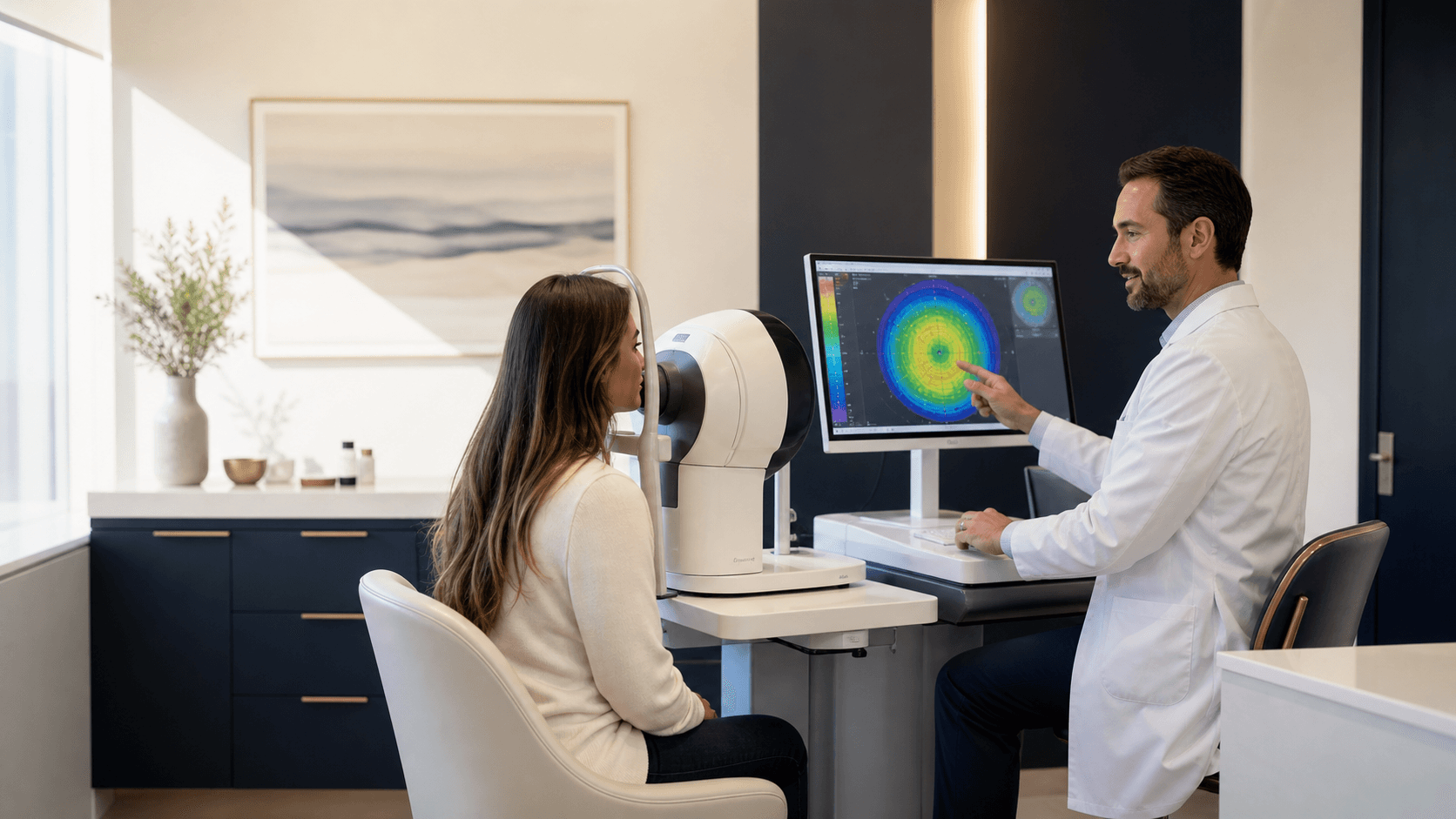
Keratoconus is more common among first-degree relatives of someone who has it. That is not a reason for alarm, and it is not a prediction about anyone in particular — it is a reason that a sibling or a child of a diagnosed patient is worth mapping rather than assuming clear.
Timing is the whole argument. Corneal topography can pick up the pattern well before vision changes enough to notice, and cross-linking is most valuable when there is more cornea left to protect. An early map that comes back normal is genuinely reassuring; an early map that shows a pattern converts a future problem into a present, treatable one.
For the eye that already has it, the pathway runs stabilize, reshape, refine: cross-linking to halt progression, CTAK to round the cone back toward a more regular shape with laser-shaped donor tissue placed inside your own cornea, and specialty lenses to sharpen what is left. Carrollton is about twenty minutes east on the PGBT, and families routinely book their appointments back to back.
A corneal map can see keratoconus before a patient can. That gap is where the treatable years live.
Siblings and children of a diagnosed patient are worth screening. Topography finds the pattern before symptoms do, and a normal result is worth having.
Families schedule together routinely. One trip east on the PGBT, several people mapped, one conversation about what it all means.
Cross-linking, CTAK, and specialty lens fitting are all performed here, so the plan can evolve without a referral each time it does.
A cone-shaped cornea is progressive, it is irregular, and it is hard to correct. Those are three different problems. Cross-linking answers the first by halting progression. It does not answer the second — a stabilized cornea is still a distorted one.
CTAK answers the second. By adding laser-shaped donor tissue inside your own cornea, it works toward a more regular surface, which is what makes the third problem tractable: glasses and contacts start working again. Which combination your eye needs, and in what order, is what the consultation is for.
Which of these your eye needs, and in what sequence, comes out of the corneal maps rather than off a menu. Cross-linking is the time-sensitive one. Reshaping can wait for a stable cornea, and usually should.

A piece of sterilized donor cornea, laser-shaped to the map of your own eye and placed inside your cornea to round the cone back toward its natural shape. Nothing is removed, so a transplant stays on the table rather than behind you.

The FDA-approved treatment that uses riboflavin and ultraviolet light to strengthen the collagen bonds holding your cornea's shape. It does not reverse keratoconus — it stops it getting worse, which is why timing matters more here than anywhere else.

Scleral and rigid gas-permeable lenses vault over an irregular cornea and give light a smooth surface to pass through. Often the bridge between diagnosis and stability — and, after CTAK, frequently easier to fit and wear.
Keratoconus care is a sequence, and the order is not arbitrary. Stabilizing a cornea that is still changing comes first, because reshaping one that has not settled does not hold. Each step below answers a different question about your eye.

Corneal cross-linking strengthens the collagen bonds holding your cornea's shape. It is the time-sensitive step: it protects the cornea you still have rather than recovering the cornea you had.

CTAK places a laser-shaped piece of sterilized donor tissue inside your own cornea, working the cone back toward a regular shape. Nothing of yours is removed, which is what separates it from a transplant.

Once the cornea is stable and more regular, glasses or specialty lenses do the remaining work — and a more regular cornea is markedly easier to fit and more comfortable to wear against.
East along the President George Bush Turnpike — about twenty minutes from Carrollton. Ground floor with free parking.
8080 Independence Pkwy, Suite 155
Plano, TX 75025
Allow about 60–90 minutes for a full keratoconus consultation with corneal mapping. Screening visits for family members are shorter; ask when you book and we will schedule them together.
Open Monday–Friday 8:00–5:00 and Saturday 9:00–3:00, with English- and Spanish-speaking staff. Questions before booking? Call 214-972-2020 and a human answers.
Don't see your question? Call 214-972-2020 or book a visit and ask Dr. Shehz directly.
Talk to our team, no pressure, no sales pitch. We answer the question, not the upsell.
A relative with an early pattern needs a baseline and monitoring. An eye that has progressed needs stabilizing. A cornea already distorted may need reshaping. The maps sort out which is which.
Cost, safety, candidacy — the questions patients actually ask, answered in plain English in our patient education library.
Learn when CTAK donor-tissue reshaping may be considered for selected stable keratoconus and how it differs from CXL, specialty lenses, and corneal transplant.
Read articleLearn how serial corneal maps, thickness, age, documented progression, specialty lenses, and treatment protocol determine when CXL should be considered.
Read articleLearn how corneal thickness and tomography affect LASIK candidacy and when PRK, EVO ICL, SMILE, CXL-first care, or monitoring may be safer.
Read articleA LASIK rejection does not end the discussion. Learn how the reason - corneal shape, thickness, prescription, dry eye, or age - guides safer alternatives.
Read articleCorneal topography, a progression assessment, and screening for relatives if it is warranted. Book appointments back to back and make one trip of it. Call 214-972-2020 or book online.