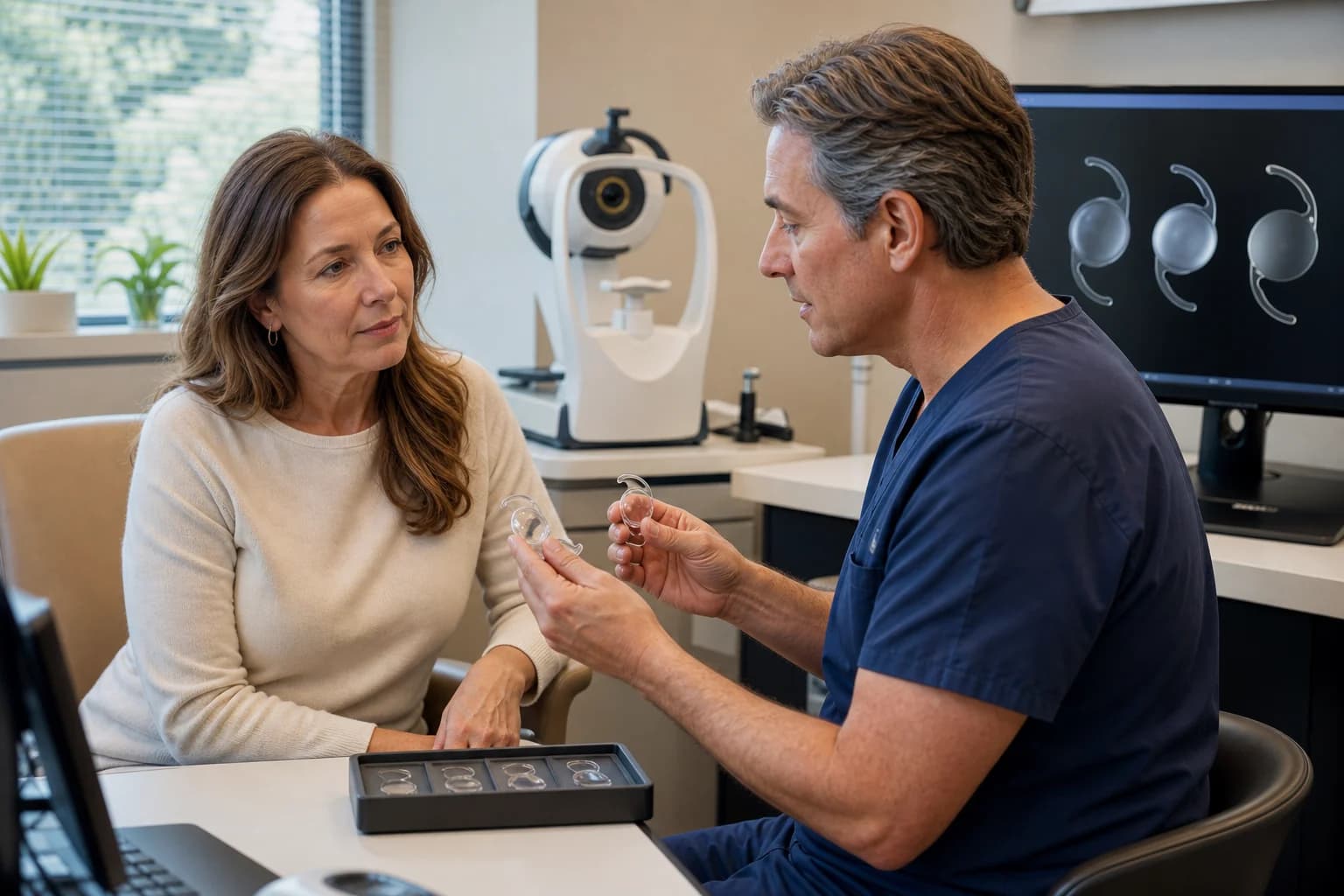
If you regularly drive after dark, say so before choosing a lens implant. Reducing reading-glasses use and preserving comfortable nighttime vision are both valuable goals, but a lens that offers more focal range can involve optical tradeoffs.
For patients considering RLE or cataract surgery, the right discussion starts with your existing symptoms, eye health, and daily driving demands. This guide focuses on low-light priorities; our lens-options overview covers the broader categories.
What do halos and reduced contrast mean?
Halos are rings around a light source; glare can make bright lights uncomfortable or obscure nearby detail. Contrast sensitivity describes how well you distinguish something from a similar background. Reading small black letters in an illuminated clinic does not measure every difficulty someone may notice on a dark road.
Presbyopia-correcting implants can increase the range of useful vision, but some people notice halos, glare, or reduced contrast. Different designs have different profiles, and the same implant can feel different to different people. No lens should be described as a universal guarantee of glare-free night driving.
Compare goals before comparing brand names
Bring a short account of the conditions that challenge you now. Do headlights hide lane markings? Is the problem worse when the eyes are dry? Are symptoms present with your current glasses? Does one eye behave differently? These details give the examination a useful starting point.
Then consider which compromise is easier to live with: needing glasses for selected tasks, accepting less near range, or accepting a possibility of more light phenomena. That is a preference discussion supported by testing, not something an online selector can settle.
| Priority to discuss | A useful question |
|---|---|
| Nighttime driving for work | Which lens design best preserves the visual quality my job requires? |
| Frequent reading | How much near vision is realistic, and when would readers still help? |
| Computer and dashboard vision | Which working distances should we target? |
| Astigmatism | Is correction needed, and does it change the lens choices? |
| Glaucoma or retinal disease | Does my eye health narrow the options? |
What about monofocal, EDOF, or multifocal lenses?
A monofocal implant generally targets one focal distance. Multifocal or trifocal designs offer multiple focal ranges, and extended-depth-of-focus (EDOF) designs aim to broaden useful focus. The names alone do not predict your exact need for glasses or your nighttime experience.
Ask for the patient information for the exact proposed model. Discuss visual disturbances and contrast alongside reading range, rather than comparing marketing descriptions from unrelated implants. If a provider gives a study percentage, ask what symptom was measured and whether the study patients resemble you.
Monovision is another strategy that targets the eyes differently. It can reduce dependence on readers but may affect binocular comfort and depth perception. If a trial is appropriate, ask how well it represents the proposed surgical targets and what its limitations are.
Make DFW driving needs concrete
For someone commuting between Dallas and Richardson, evening road use may be a routine requirement. A patient in McKinney might drive mainly in daylight but regularly travel farther for family visits. Write down those patterns rather than simply checking "drives" on a form.
Also explain any professional driving, aviation, or occupational vision requirements before treatment. Ask the relevant employer or licensing authority about its requirements; a clinic's expected recovery time is not an occupational clearance.
What if glare persists after surgery?
Tell your surgeon how the symptom affects you and whether it is improving, stable, or worsening. Tear-film problems, a remaining prescription, capsule changes, implant position, and other eye conditions can contribute. An examination is needed before assuming every symptom comes from the implant's design.
Some patients adapt over time; persistent difficulties still deserve assessment. Ask what the first treatment step would be and what additional procedures would involve. Do not agree to a second intervention without understanding the cause being treated, alternatives, and risks.
Sudden vision loss, severe pain, a new curtain or shadow, or new flashes with a sudden increase in floaters needs urgent assessment. Do not drive yourself if vision is impaired.
Your consultation takeaway
Bring three examples of nighttime tasks and your current glasses. Ask the surgeon to explain the proposed lens in terms of those tasks, including when glasses might still provide a useful result. Start with the RLE consultation checklist and keep recovery and driving clearance as a separate part of the plan.
Sources
- American Academy of Ophthalmology: presbyopia-correcting IOLs
- EyeWiki: presbyopia-correcting intraocular lenses
- EyeWiki: dysphotopsia and evaluation
- EyeWiki: monovision considerations
This guide supports a discussion of visual priorities and does not recommend a particular implant for an individual patient.
Your exam can clarify which options fit your eyes. Visit our Plano team from anywhere in DFW.
Book a free visit