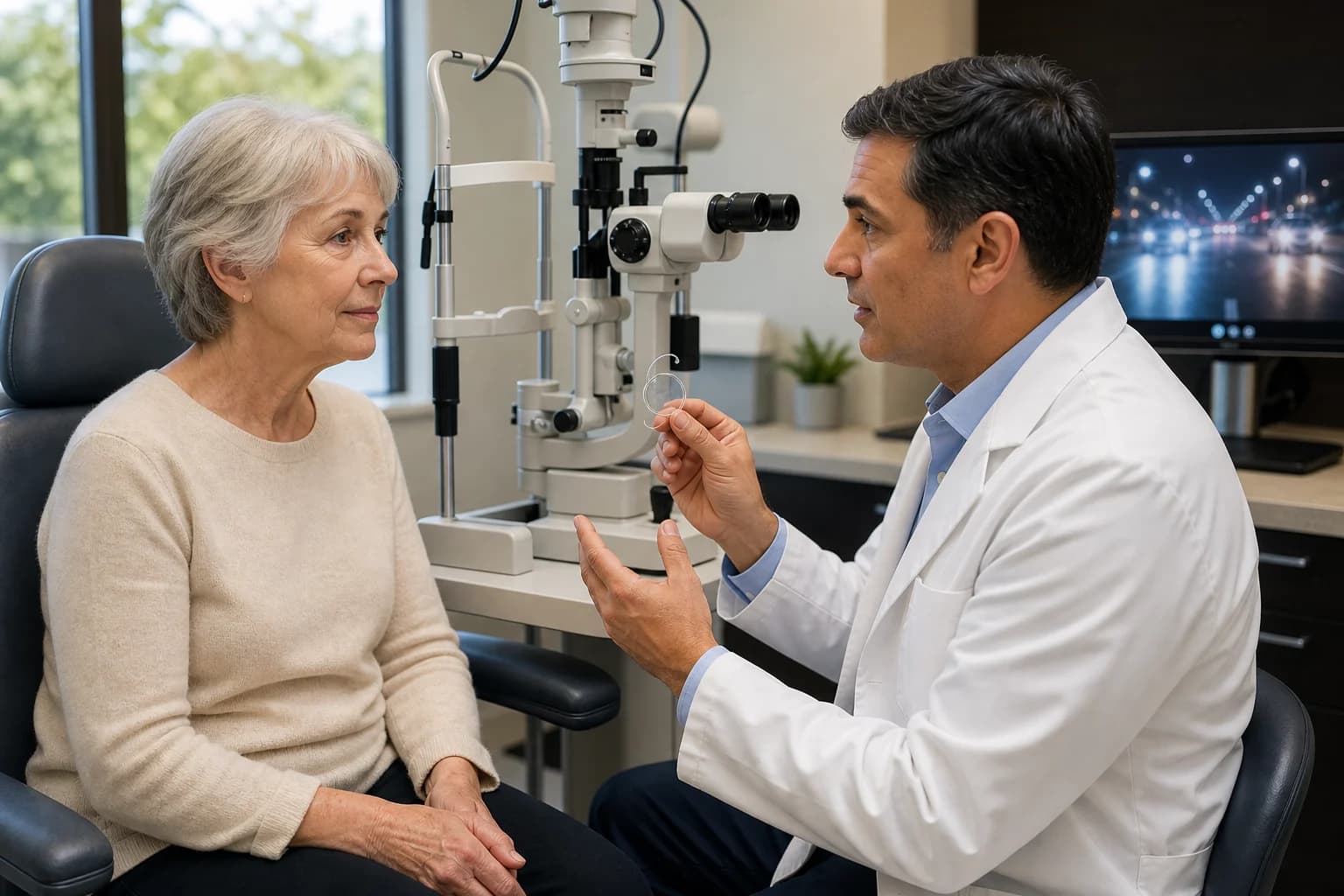
A cataract is a clouding of the eye's natural lens. The decision to remove it is usually not based on a single test result or a certain birthday. It is based on whether the cataract is responsible for vision problems that interfere with daily life and whether surgery's expected benefit outweighs its risks for that eye.
Common clues include worsening glare, faded colors, cloudy vision, frequent prescription changes, and difficulty driving at night. Those symptoms deserve an examination because cataracts are not the only possible cause.
Common cataract symptoms
Cataracts often develop gradually. Early changes can be subtle, and one eye may be more affected than the other.
Symptoms can include:
- Blurry, hazy, or cloudy vision.
- Headlight glare or halos that make night driving harder.
- Reduced contrast, especially in dim light.
- Colors that look faded, yellowed, or less distinct.
- Needing brighter light to read.
- Frequent changes in a glasses prescription.
- Double vision that remains when one eye is covered.
- A temporary improvement in near vision followed by continued change.
The National Eye Institute notes that mild cataracts may produce no symptoms at first. A dilated examination can confirm whether the natural lens is cloudy and whether another part of the eye is also affecting vision.
Cataract symptoms versus normal aging
Age-related changes do not all come from cataracts.
Presbyopia makes near focusing harder, usually beginning in the 40s. Dry eye can cause blur that changes with blinking. Retinal disease may reduce detail or distort straight lines. Glaucoma can damage peripheral vision without causing obvious central blur early on. Corneal disease and medication effects can also change vision.
A useful examination asks two separate questions:
- Is a cataract present?
- How much of the patient's visual problem is the cataract actually causing?
That distinction is important. Removing a cataract can clear the cloudy lens, but it cannot reverse vision loss caused by the retina, optic nerve, cornea, or another untreated condition.
The practical signs that surgery may be appropriate
There is no requirement to wait until a cataract is "ripe." In most cases, surgery becomes reasonable when vision is no longer meeting the patient's needs and the cataract is the likely cause.
Consider discussing surgery when:
- You avoid driving at night because glare or contrast has become unsafe.
- Reading, sewing, cooking, or medication labels require much more light.
- Work, hobbies, or mobility are limited by cloudy vision.
- A stronger glasses prescription no longer provides adequate clarity.
- The difference between the two eyes is difficult to tolerate.
- The cataract prevents the doctor from adequately examining or treating the retina.
Daily function matters more than a letter chart alone. Someone who drives after dark for work may be affected earlier than someone with the same measured acuity who rarely drives.
When it is reasonable to wait
Not every diagnosed cataract needs immediate surgery. Monitoring may be appropriate when:
- Symptoms are mild and daily activities remain comfortable.
- A new glasses prescription restores useful vision.
- Another eye condition needs evaluation or stabilization first.
- Dry eye or corneal irregularity is making the measurements unreliable.
- The expected improvement is limited by significant retinal or optic-nerve disease.
- The patient understands the options and prefers to wait.
For most age-related cataracts, a planned delay does not automatically make later surgery more difficult. Follow the examination schedule recommended for the individual eye, and report meaningful changes rather than waiting for the next routine visit.
What the cataract evaluation should answer
A cataract consultation should do more than confirm that the lens is cloudy. Depending on the eye, the workup may include:
- Visual acuity and refraction.
- A dilated examination of the lens, retina, and optic nerve.
- Eye-pressure measurement.
- Glare or contrast testing when symptoms and standard acuity do not match.
- Corneal topography or tomography when astigmatism or prior LASIK matters.
- Macular OCT when retinal detail may affect the outcome.
- Biometry to calculate an intraocular lens once surgery is being planned.
- Tear-film and eyelid evaluation before final measurements.
The result should be a clear explanation of what is limiting vision, what surgery can reasonably improve, and what may remain afterward.
The lens decision is separate from the timing decision
First decide whether removing the cataract is appropriate. Then decide how the replacement lens should be targeted.
The main categories include:
- Monofocal lenses: usually target one primary distance.
- Toric lenses: address qualifying corneal astigmatism.
- Extended-depth lenses: aim to provide a broader range, often with tradeoffs.
- Multifocal or trifocal lenses: divide focus across distances and may introduce glare, halos, or contrast tradeoffs.
- Light-adjustable lenses: allow postoperative power adjustments in qualifying eyes.
No lens guarantees complete freedom from glasses. Corneal shape, retina, optic nerve, pupil behavior, prior refractive surgery, night-driving needs, and tolerance for optical symptoms all matter.
Use the cataract lens guide to compare categories after the diagnosis and timing questions are settled.
Symptoms that are not typical of a slowly developing cataract
Seek prompt eye care for:
- Sudden vision loss.
- A curtain or shadow in vision.
- New flashes with many new floaters.
- Severe pain, marked redness, nausea, or headache.
- Sudden distortion or a new dark central spot.
- Significant light sensitivity with pain or discharge.
A routine cataract usually changes vision gradually and does not cause severe pain. Sudden symptoms can represent a different problem that should not wait for a future cataract appointment.
Questions to ask before choosing surgery
Ask the surgeon:
- How much of my blur or glare is caused by the cataract?
- Is another eye condition likely to limit the result?
- What visual target are we choosing for each eye?
- How much corneal astigmatism do I have, and where does it come from?
- Which lens options fit my retina, cornea, and night-driving needs?
- What glasses might I still need?
- What are the important risks for my specific eye?
- Which symptoms after surgery require an urgent call?
The full questions-before-cataract-surgery guide expands this checklist.
Plan the next step in Plano
If cataract symptoms are affecting daily tasks, use the cataract surgery page to prepare for an evaluation in Plano. Bring examples of what has changed and ask whether the cataract explains those difficulties before discussing lens choices or surgery dates.
If surgery is already scheduled, use the cataract recovery timeline. If you previously had LASIK or PRK, read how that changes cataract lens calculations after laser vision correction.
Sources
Your exam can clarify which options fit your eyes. Visit our Plano team from anywhere in DFW.
Book a free visit